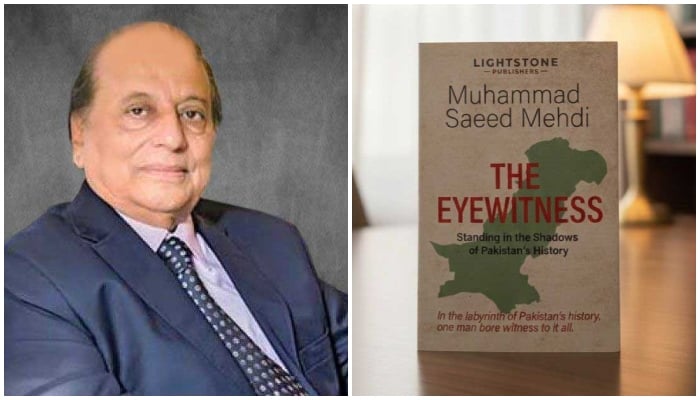
“People may appreciate or critically analyse my humble undertaking but it’s a variety of experiences that shape our history and I leave it to the historians to honour the ultimate truth.”
This was stated by Muhammad Saeed Mehdi, former principal secretary to the prime minister and Sindh chief secretary at a press conference called to announce the publication of his memoir titled ‘The Eyewitness, Standing in the Shadows of Pakistan’s History’. The book will be officially launched on Jan 12, Monday.
Talking about the author, Managing Director of Lightstone Publishers Ameena Saiyid said that it took Saeed Mehdi 25 years to think about this book, to write it and then decide what to write. “The book recounts events and details that cannot be found in any archive, as they are based on his firsthand eyewitness account,” she added.
“As Deputy Commissioner Rawalpindi, Mehdi witnessed history unfold. He witnessed Zulfikar Ali Bhutto’s confinement in Rawalpindi jail, his trial, appeal to the Supreme Court and his tragic execution.”
“As a commissioner of Lahore, he saw Benazir Bhutto’s return to Pakistan in 1986 and later the removal of Junejo. He was the last person to bid farewell to President Ziaul Haq when he was leaving for that fateful journey to Bahawalpur. As the principal secretary to then PM Nawaz Sharif, Mehdi witnessed the removal of General Jahangir Karamat and the appointment of Genral Pervez Musharraf as chief of army staff and witnessed his retirement as well.”
Mehdi was also picked up along with then prime minister Nawaz Sharif on October 12, 1999 and kept in solitary confinement for 45 days. He was also kept in Landhi jail in Karachi and Adiala jail in Rawalpindi for two years. During his confinement, he was offered all kinds of inducements, pressures and threatened to become an approver that he refused steadfastly, she said. “This is a remarkable book which has information that is only contained in the pages of this book,” she added.
Mehdi said: “People may appreciate or critically analyse my humble undertaking, but it’s a variety of experiences that shape our history and I leave it to the historians to honour the ultimate truth.”
“I always knew what to say but it took me years since my release from Adiala Jail when to write. Finally I decided not to delay it further lest my memory or my life part ways for me.
“I had the opportunity to see dictators, sycophants, self-declared democrats of this country up and close and personal. I have been through so much ups and downs and seen so much that has been the privilege of very few.”
He said that he has not based his information on any official record, documents, or correspondence. “It is just full memory. My journey as a civil servant has often put me in the position of a bystander to great and even terrible events in our country’s history.”
He said he first saw the appellate process of Mr Bhutto in the Supreme Court unfold, including his rousing speech in his defence. “I was there when Pakistan’s first elected prime minister met his wife and daughter for the last time and I saw him tragically executed.” He said he saw the close return of the brave, resilient daughter Benazir Bhutto.
“It is therefore said that Saeed Mehdi was the last person to meet Mr Bhutto before he was taken to the gallows and was the first person to meet Muhtarma Benazir Bhutto when she landed at Lahore airport on April 18, 1986.”
“I have been a witness to history and in this book I intend to tell all. What I have penned down can be taken as living history. The events I have narrated are more descriptive than investigative. I have tried my best to be as correct and as precise in narrating events and facts as I saw. I have tried my best to not blow any character out of proportion in praise or criticism.”
Highlighting importance of books, Mehdi said that they keep you going even “in the dead of darkness, even in the jail which I have suffered for two years.” “It is said that books are portable magic,” he added.
According to a press release, Mehdi’s memoir is “gripping insider’s account of Pakistan’s tumultuous history, recounting pivotal moments that shaped the nation.”
As a civil servant at the heart of power, Mehdi witnessed firsthand the drama of Zulfikar Ali Bhutto’s trial and execution, General Zia-ul-Haq’s sudden death and the struggles between democracy and military rule. His story humanises major event, revealing the personal side of history: the euphoria of Benazir Bhutto’s return, the anguish of imprisonment and the quiet resilence in dark times.