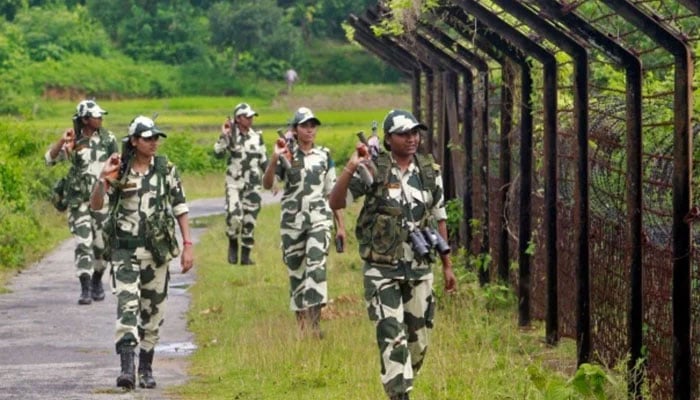
Amid transforming regional security dynamics, India has reinforced its eastern flank by establishing three fully operational military stations at strategic points around the Siliguri Corridor near the India-Bangladesh border.
The new bases include the Lachit Borphukan Military Station near Dhubri in Assam along with two forward bases at Chopra in West Bengal and Kishanganj in Bihar. The Indian Army is also reviewing a fourth station in Mizoram as part of an extended defence arc around the Siliguri Corridor. Amid deteriorating ties with Bangladesh, India’s fortification of its eastern frontier signals the opening of a new strategic front that demands vigilance. These advancements follow the ouster of the pro-India Sheikh Hasina government in 2024, evolving regional dynamics and Dhaka’s transformed military posturing.
The Siliguri Corridor, colloquially known as the Chicken Neck, holds profound significance for India. Located between Nepal, Bhutan and Bangladesh, it is a 22-kilometre narrow strip that links mainland India with its seven eastern states including Assam, hosting a population of 49 million. This geostrategic chokepoint is the primary transit passage for trade, military and civilian supplies. It is India’s most critical strategic vulnerability as any disruption to this passage could sever the northeast from mainland India.
The Siliguri Corridor has already been defended by the Trishakti Corps with Rafale jets, Akash and S-400 air defence systems and Brahmos missiles. However, the addition of forward bases signals a more proactive Indian strategy. The defining feature of the current buildup located near Bangladesh’s border is its integrated nature that sets it apart from previous border infrastructure. These new stations, equipped with advanced ISR capabilities, enhance India’s ground-based operational readiness. These stations act as a strategic triangle providing overlapping coverage of the corridor with minimal timeframe directives focused on rapid operational deployment.
Operationalising these bases marks a departure from India’s defensive posture of border management to rapid response offensive capabilities, indicating a reorientation of the Indian military’s threat perceptions about securing its periphery. This heavy militarisation suggests that India’s fortification of the Chicken Neck may become a flashpoint for high-tech complex military platforms.
This development aligns with the broader geopolitical context as India has expressed concerns regarding Dhaka’s interim government’s growing engagement with China and Pakistan. As elections draw near in Bangladesh, the recent high-level meeting of Yunus with Pakistan’s military leadership has heightened Indian anxieties.
Bangladesh has also revamped its military procurement. Yunus’ administration has disclosed plans to acquire Chinese J-10C aircraft as well as set up an industrial base in Dhaka for joint drone production with Beijing. Similarly, Pakistan has proposed selling JF-17 Block C Thunder jets to Dhaka. The Bangladesh Army has acquired the Chinese-built SY-400 short-range ballistic missile system.
Bangladesh also plans to revive a World War II-era base near Lalmonirhat with Chinese assistance. This includes the near completion of a large hangar capable of parking multiple fighter aircraft. Helicopters and light aircraft are reportedly conducting regular sorties from the base, compelling India to reinforce countermeasures. Recently, the Bangladesh Air Force has also signed a letter of intent with Italy’s Leonardo SPA to buy Eurofighter Typhoon multi-role combat aircraft as part of its modernisation plans.
However, given the stark power asymmetry between Dhaka and New Delhi, Bangladesh has a sound rationale to modernise its defences. India’s new military footprint near Bangladesh’s border inadvertently heightens its security dilemma. Historical precedents from Russia’s Crimean facilities to China and India’s logistical and military buildup suggest that these developments are like stacking dry kindling along a neighbour’s fence. The act can be disguised as mere collection of firewood until the political match is lit, providing the fuel for rapid escalation. Moreover, given Dhaka’s constrained strategic depth, the absence of any bilateral protocols limiting Indian military deployments exacerbates its sense of vulnerability.
Bangladesh is also facing the deportation issue of alleged illegal migrants by the Indian Border Security Forces. In an unexpected turn of events, anti-India sentiments have resurfaced in Bangladesh. The recent assassination attempt on a prominent figure of the July uprising, Sharif Osman Hadi, who later died in a hospital in Singapore, by alleged Indian assailants has sparked violent protests in Bangladesh.
Amid massive public outrage, the leader of Jatiya Siramek Shakti, Mutaleb Shikder, was also shot but survived his injuries. The political stakes are further heightened by the fact that one of the leaders was a prospective candidate in the upcoming elections. As pressure mounts on the interim government, this violence serves India’s interests by eliminating a direct internal political threat.
India is unwilling to cede control over Bangladesh, which it has long exercised through the client regime of Sheikh Hasina. With that influence significantly diminished in the 2024 uprising, India is resorting to coercive measures by militarising the Siliguri Corridor and through alleged interference in Bangladesh’s internal affairs. Yet each move acts as a political catalyst pushing Dhaka further away from New Delhi.
India treats Bangladesh as a mere corridor to be controlled rather than a sovereign neighbour to engage with. Dhaka has explicitly demanded the handover of Sheikh Hasina, yet New Delhi continues to provide her a platform for media appearances. This shows a lack of political will to resolve matters and compounds Bangladesh’s grievances. Far from neutralising a threat, India is assembling one on its doorstep with regional implications. The path forward cannot be built on bunkers but on diplomacy before India’s front becomes a regional frontline.
The writer is a research assistant at the Centre for Aerospace & Security Studies (CASS), Islamabad. She can be reached at: [email protected]