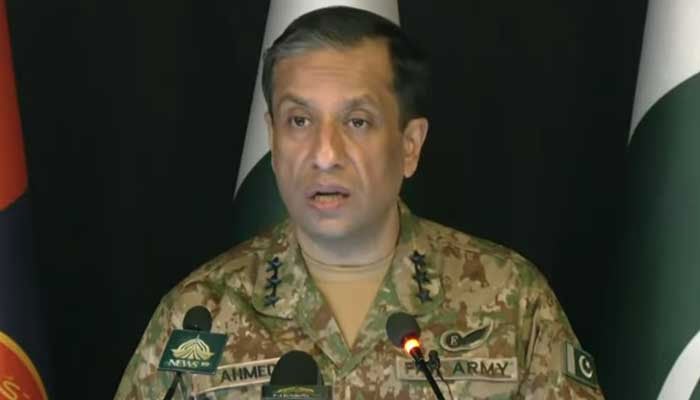
RAWALPINDI: Inter Services Public Relations (ISPR) Director General Lieutenant General Ahmed Sharif Chaudhry sharply criticised the Pakistan Tehreek e Insaf (PTI) leadership on Tuesday, holding it responsible for the rise in terrorism and for obstructing counter terrorism efforts in Khyber Pakhtunkhwa.
While briefing journalists, the DG ISPR said the PTI leadership was pursuing an appeasement policy towards the Afghan regime and Taliban, seeking guarantees from them for peace in the province. He added, “What kind of appeasement is this, begging Kabul? You are pleading for peace from a regime that patronises global terrorism.”
During the briefing, the DG ISPR said that Chief of the Army Staff and Chief of Defence Forces Field Marshal Asim Munir has clarified that there would be no talks with terrorists and they would not be provided any space. He said that international and United Nations reports indicated that Afghanistan had become a sanctuary for terrorists, but it was the KP government that was refusing to accept this and was distorting the facts.
Snubbing calls from the PTI leaders, including former National Assembly Speaker Asad Qaisar and KP Chief Minister Sohail Afridi, to withdraw the Pakistan Army from the KP province, the DG ISPR said that it (Army) was a federal force which was duty-bound to defend the country’s boundaries. “No can allow you hand over the province to terrorists and their facilitator for the sake of your political interests,” he said, adding that there could be no compromise on the territorial integrity and national security.
He also recalled as to what happened when the force was withdrawn from Swat as the people of Swat and Matta and soldiers gave sacrifices of thousands of lives. “You want to stop the operation in KP because you wish to allow the political crime nexus to thrive there,” Lt-Gen Chaudhry said, adding that no individual or party was above the state or its interests. He wondered if those opposing the military operation in the KP have any other option. “Should we sit at the feet of Khawarij, accept Noor Wali Mehsud, and wait for Haibatullah to tell us what must be done in Charsadda?” he asked.
He said that nearly 71 percent of terrorist incidents in 2025 were reported from KP, noting that the primary reason was a politically conducive environment – a political criminal terror nexus that allowed such activity to flourish. The ISPR DG also regretted allegations of the KP chief minister that Pakistan Army was deployed in the province for dollars and because of mineral wealth there. “It is the provincial government not us which had issued around 5,000 licences for mines exploration,” he said. To a question, he also raised a question as to why their (PTI) leadership was never attacked by Khwarij whereas leaders of all other parties whether it is the PPP, PMLN, JUI or ANP were targeted, saying it was because they (the PTI) wanted to be the “blue eyed” favourites of terrorists.
The ISPR Director General said it was also a misguided political narrative to claim that a government is not all powerful, noting that today’s government is strong and that the previous administration was equally powerful. He said police and the home department implement decisions but unfortunately they are not autonomous as they have been politicised. “It is ridiculous to say that they have no powers to take decisions,” he said.
He further asserted that the army is the sole institution that does not tolerate political imposition, and that every Pakistani—irrespective of province, religion or ethnicity—is treated equally by it. “Nevertheless, please refrain from imposing your political affection upon us,” he added. He said, without naming PTI founder Imran Khan, that an individual had run the government and his party like a dictator, with everything revolving around him. He described the prime minister as all powerful and questioned the whereabouts of the-then Director General of ISI, whom the individual had allegedly used for his political ends. “He was so powerful that he even declared the-then army chief the ‘Father of The Nation’ to suit his politics,” he added. He emphasised that no prime minister could legitimately confer such a title on an army chief, noting that the only recognised Father of The Nation is Muhammad Ali Jinnah, and Allama Iqbal.
An annual report from the Centre for Research and Security Studies also mentions that KP experienced the most significant terrorist surge, where the “fatalities rose from 1,620 in 2024 to 2,331 in 2025” — more than 40 percent year-on-year increase in the province. Lt Gen Chaudhry also expressed the resolve to curb terrorism, saying that Pakistan has to win the war against terrorism at all costs. “In the last three months, we have closed the borders and there are signs here for those who can understand.” Noting that Pakistan targeted terrorists at the Afghan border in October 2025 and dozens of Afghan posts were eliminated within hours, he said, “We targeted the TTP, not TTA.”
Recalling the Doha agreement, the 2020 US-Taliban peace deal, he said the Afghan Taliban had assured that terrorism would be eradicated from the Afghan soil. However, he lamented, the neighbouring country remains a stronghold of Fitna al-Khawarij and Fitna al-Hindustan. All terrorist organisations are based in Afghanistan and are being nurtured there, he said.
Lt-Gen Chaudhry said a false narrative is being propagated that the Pakistan Army uses drones during anti-terror operations. He said that it was Fitna Al-Khawarij and TTP, which started using armed quadcopters, adding that their patron, India, provides them with full support. The military spokesman said a special wing of the militants operates armed quadcopters, which are used for terrorist activities, adding that terrorists use mosques, public places and houses to carry out attacks and use women and children as human shields to conduct their activities. He said the last one year was most consequential and landmark as never before counter-terrorism activities of such unprecedented intensity were undertaken.
The ISPR chief said that the Afghan Taliban regime had attacked Pakistani border posts, following which, “the state of Pakistan did what was necessary, and a strong message was given”.
He said that the Afghan Taliban regime has found a “new hero” in the form of Indian Prime Minister Narendra Modi. He said that the nexus between Fitna Al-Khawarij and India became fully exposed in 2025, posing a serious threat to regional peace and security. He said that if Afghanistan and India wish to confront Pakistan, they are welcome to do so, adding that, “We will fulfill their desire,” Geo News reported.
He said in May last year, there was the Marka-e-Haq, and in October, skirmishes occurred on the Afghan border. The world saw that during the Marka-e-Haq, India’s image was shattered, which was necessary. After Marka-e-Haq, India promoted terrorism in a big way. “The stain of Indian defeat during ‘Operation Sindoor’ still hasn’t been wiped from its face.”
He told a questioner that Pakistan would use every available option, dealing with the Afghan Taliban either firmly or through diplomatic engagement, depending on what the institutions deem appropriate. “Afghan Taliban must understand that as the prime minister and Field Marshal have said they have to make choice between Pakistan and Khwarij,” he said. To a question that India’s designs were very clear that it would never accept the existence of Pakistan, he said, “India’s designs against Pakistan are unmistakable, whether she acts directly or indirectly through proxies.” He said the civilian and military leaderships were very clear and were always prepared to give befitting response to any aggression.
Providing details of counterterrorism efforts in 2025, the ISPR chief said that law enforcement agencies carried out 75,175 intelligence-based operations (IBOs) across the country. Giving a breakdown, he said 14,658 IBOs were conducted in the KP, 58,778 in Balochistan, while 1,739 operations took place in the rest of the country.
He said that 5,397 terrorism incidents were reported nationwide during the last year. Of these, 3,811 incidents occurred in KP, 1,557 in Balochistan and 29 incidents were reported in other parts of the country. He said that 2,597 terrorists were killed during counterterror operations last year. While providing details of 10 major terror attacks, he said that civilians and soft targets had been deliberately targeted, and Afghan militants were involved in all attacks. “We have evidence of the presence of all terrorists, wherever they are and wherever they operate.” During the presser, video confessions of arrested terrorists were also played.
Lt-Gen Chaudhry said 21 civilians were martyred in the Jaffar Express attack, adding that the incident would never fade from the memory of Pakistanis. He further stated that a civilian bus was also targeted in Noshki, while an attack on the Frontier Corps headquarters in Quetta resulted in the martyrdom of eight civilians.
He stressed that Pakistan’s fight against terrorism was a collective national war, warning that militancy thrived through illegal arms and drugs. Referring to Afghan refugee settlements in Pakistan, he said that camps in Punjab and Balochistan had been cleared, while the majority of the camps in KP were still present.
On counter terrorism strategy, the military’s spokesperson reiterated that Pakistan makes no distinction among terrorists, describing the fight against militancy as a war for national integrity.
He replied that for Pakistan, there is no “colour” or “shade” of a terrorist; the country has no sympathy for any terrorist. He added that the armed forces take pride in the fight against terrorism — a difficult struggle, but one that Pakistan must win. “We have faced the Taliban, Daesh, Fitna Al Khwarij, Fitna Al Hindustan and their political facilitators, but the truth will always prevail,” he said. He told a questioner that the Afghan regime is the patron of Taliban and Daesh and that, on its advice, they are united despite lacking any coherent ideology or faith.
Regarding the closure of Pakistan-Afghanistan border, he stated that Islamabad was already reaping benefits from shutting down the crossings, adding that Pakistan’s economy was not dependent on Afghanistan. He warned that social media was increasingly being misused for terrorism and criminal activity, stressing that enforcement of laws was essential to protect society and its citizens. “Social media is being used for terrorism and for its promotion as well. Laws are meant to ensure the protection of society.”
The military spokesperson reiterated that no individual or political party was above Pakistan, saying all political parties and provinces were equal for the military if they stood within the constitutional framework. Asked as to what the response of the army is when a political party says it is ready to talk to the army, the DG ISPR maintained political parties talk to each other. “We do not talk to political parties,” he said, adding that the army never said that it wanted to negotiate with any political party.