There is a class of professionals in Pakistan whose working lives bear little resemblance to the respect we claim to afford them. They work far beyond official hours, absorb responsibilities they are never compensated for, and surrender weekends, holidays and family time to an unrelenting workload.
They are not corporate executives. They are not finance professionals. They are not surgeons on emergency call.
They are primary school teachers.
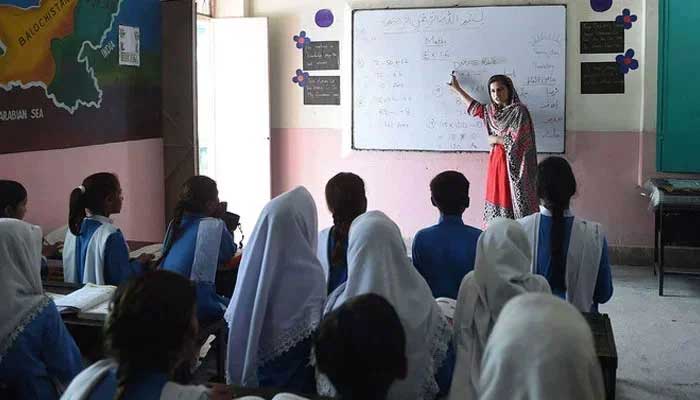
Across Pakistan, nearly 30,000 public primary schools are run by a single teacher. One person is expected to teach, administer, supervise, maintain records, manage enrolments, engage with parents, ensure safety and keep the school functioning. These schools account for roughly one quarter of the public primary education system.
In practice, this means one teacher handling multiple grades at once, dividing attention between classrooms and paperwork, opening and closing the school each day and serving as the sole line of accountability when anything goes wrong.
This is not commitment. It is institutional abandonment normalised over time.
The damage goes well beyond teacher exhaustion. Learning collapses when attention is stretched this thin. Today, 77 per cent of Pakistani children cannot read an age-appropriate text by the age of ten. Classrooms become exercises in crowd control rather than learning. Parents lose confidence. Communities disengage.
This crisis did not happen by chance.
For over five years, teacher recruitment was effectively frozen across large parts of the country. In Sindh, hiring was halted due to the authorities' failure to classify hard and soft posting areas correctly. That ban persisted through the 2024-25 cycle.
In Khyber Pakhtunkhwa, recruitment stalled amid political and bureaucratic paralysis, including prolonged delays in cabinet formation. Files remained stuck while classrooms emptied. Punjab followed a similar path. In 2022, the School Education Department abruptly halted teacher hiring, citing administrative restructuring. The decision was taken without a transition plan and without regard for already overworked teachers. The impact was immediate and predictable. Vacancies widened, workloads intensified and learning gaps deepened.
In Balochistan, the failure took a darker turn. Teacher hiring processes were repeatedly stalled amid allegations of bribery and corruption. Court interventions were necessary to prevent recruitment from collapsing entirely. While files moved between offices and inquiries dragged on, students continued to suffer.
These were not unavoidable constraints but policy choices.
When teacher recruitment stops, access to education shrinks. Each year without hiring pushes student-teacher ratios further into dysfunction. Reversing this damage will now require a decade of uninterrupted recruitment and placement simply to return to baseline. That is a decade of lost learning and lost potential that no reform slogan can recover.
Even when hiring resumes, the instability does not end. Transfers and postings remain deeply politicised. Teachers appointed to rural and underserved schools are frequently moved to urban centres through influence and connections. The schools that need continuity most remain vacant once again. The cycle repeats itself. Hire. Transfer. Shortage. Collapse.
Only recently, in 2024-25, has the system begun to move again. Sindh has recruited nearly 93,000 teachers after years of delay. Punjab has chosen to outsource thousands of low-performing public schools to private entities to cope with the issue. Balochistan and Khyber Pakhtunkhwa have announced plans to hire around 9,000 and 17,000 teachers, respectively, to address chronic shortages.
These steps matter. But they come after over half a decade of damage.
Let us be clear. A ban on teacher recruitment is not fiscal discipline but educational sabotage. It quietly but steadily pushes children out of school by denying them qualified adults in classrooms. Temporary budget relief comes at the permanent expense of a generation.
Pakistan’s education crisis is driven by a lack of resources but also by abrupt decisions, poor execution and short-term political thinking. Millions of children have paid the price for administrative failure.
If the state is serious about its constitutional obligation to educate every child, teacher recruitment cannot be treated as a switch to be flipped on and off. It must be a sustained, protected, long-term commitment.
Because every classroom without a teacher is not just a staffing gap. It is silence. And that silence steals futures.
The writer is a senior manager at Tabadlab.