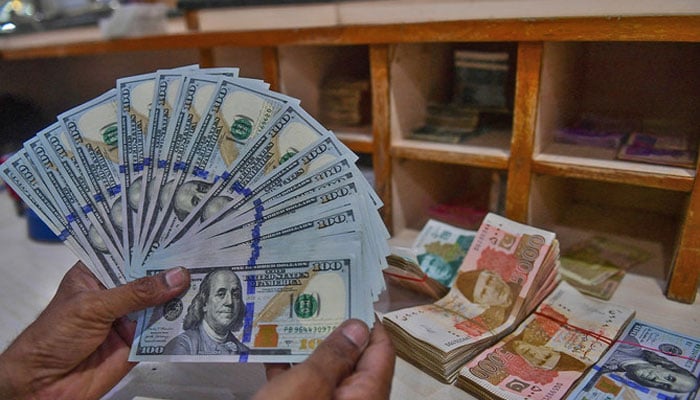
KARACHI: The Pakistani rupee weakened by a marginal 0.57 percent against the U.S. dollar in 2025, thanks to strong remittances and an increase in foreign exchange reserves.
However, the rupee could depreciate to 282-283 versus the dollar by the end of the fiscal year ending in June 2026 due to the widening of the current account deficit amid higher imports, analysts forecast. The currency is expected to trade between 290 and 295 per dollar by the end of 2026. On December 31, 2024, the rupee closed at 278.55 per dollar in the interbank market, and it ended at 280.16 on December 29, 2025.
The rupee remained broadly stable during the outgoing year, supported by strong remittances, disciplined monetary management, and a meaningful buildup in forex reserves, according to a report from Arif Habib Limited (AHL) issued last week.
“This stability, reinforced by improved external accounts and a renewed IMF programme, helped anchor expectations and limit market-driven volatility,” it added.
Looking ahead, however, the AHL report expects that the currency will enter a more measured phase of adjustment.
“As economic activity strengthens, import demand is expected to rise, widening the current account deficit and gently pressuring the Pakistani rupee,” the report said. “As a result, the rupee is projected to soften to Rs282.8 (avg.) in FY26 and further to Rs292.3 in FY27, reflecting an annual depreciation of around 3.3 per cent, a level considered manageable given Pakistan’s ongoing stabilisation trajectory.”
Market commentators believe that the current stability of the rupee is artificial, as it has been managed through restrictions on imports, which have led to an improvement in the current account balance. Additionally, administrative measures were implemented when the currency fell to around 85 per dollar in July.
Awais Ashraf, director of research at AKD Securities Limited, also expects the rupee to depreciate by 3.0 per cent next year due to increasing pressure from imports. “However, robust remittances along with stronger services sector exports amid improved external borrowing options after rating upgrades from credit rating agencies would keep the dollar inflows strong and help to build FX reserves,” Awais added.
The current account is projected to reach 0-1 per cent of GDP in FY26. Remittances are anticipated to exceed $40 billion, which will help ease pressure on the current account. The SBP’s foreign exchange reserves are expected to increase steadily, reaching $17 billion by the end of June. This assumption is based on planned official inflows, primarily from IMF loan programmes, as well as potential issuances of Eurobonds, Panda Bonds, and Sukuk in international capital markets, along with rollovers of deposits and loans from Saudi Arabia, the UAE, and China. Additionally, the SBP’s dollar purchases in the local currency market have contributed to building its reserves. As of December 19, the central bank’s reserves stood at $15.9 billion.
Pakistan’s total external debt servicing for FY26 amounts to $25.8 billion, which includes $21.4 billion in principal and $4 billion in interest. So far, $4.4 billion has been repaid, and rollovers of approximately $5.3 billion have been secured. From the remaining $15.3 billion, around $9.3 billion is expected to be rolled over.