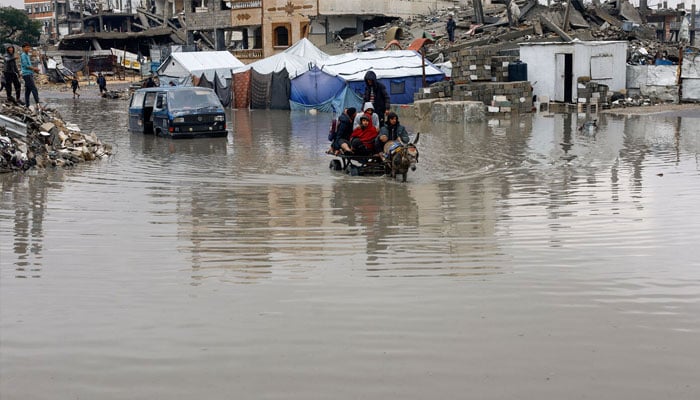
The rain in Gaza does not just fall; it invades. It hammers against the makeshift roofs of canvas and plastic sheeting that now serve as the only shield for nearly two million people.
Beneath these flimsy structures, the ground has long since ceased to be earth. It is a churning, grey slurry, a toxic mix of mud, raw sewage and the pulverized debris of a year of relentless bombardment.
This is December 2025. All this is happening in real-time, within the reach of the world’s most advanced satellite arrays, and under the gaze of global powers that routinely lecture the world on the sanctity of ‘humanitarian values’.
As the mercury drops to 6 C, the international community has responded with its signature blend of performative concern and logistical busyness. Fresh aid allocations are announced with practiced regularity: winterisation kits, thermal blankets and pledges for field hospitals. Yet, beneath this machinery of compassionate logistics lies a profound moral abdication. The West, along with the silent capitals of the Muslim world, has chosen to frame Gaza’s winter not as a political crisis requiring courageous intervention, but as a technical challenge requiring better supply chains.
This is the central deception that the winter of 2025 exposes: Humanitarianism has become a fig leaf for political cowardice. By treating the misery of Gaza as a problem of ‘insufficient blankets’ rather than that of a protracted siege, the both the Global North and Global South have built a system that ensures civilian suffering continues indefinitely, provided just enough calories and canvas arrive to prevent a total, headline-grabbing collapse.
The contrast with the international response to Ukraine remains the most damning indictment of our current world order. When Russian strikes targeted Ukraine’s energy grid in the winter of 2022, the Western mobilisation was a marvel of strategic clarity. Generators were shipped by the thousands; heating fuel arrived by the million-ton; infrastructure was rebuilt under fire. It was understood, correctly, that a civilian population’s ability to survive the elements was inextricably linked to their political and military agency.
For Ukrainians, winter was a battlefield where the West refused to let them lose. For Palestinians, winter is treated as an act of God, a natural disaster to be ‘managed’ rather than a human-made catastrophe to be halted. In Gaza, aid must navigate a labyrinth of political sensitivities, shifting ‘red lines’ and conditional funding. The difference is a deliberate choice about whose suffering matters. It reflects a chilling calculation: that the life of a displaced person in Gaza is a variable to be managed, while the life of a displaced person in Europe is a value to be defended.
The West, however, does not hold a monopoly on this hypocrisy. The response from Muslim states has been equally hollow, characterised by a rhetoric that substitutes for leverage. Muslims states have, instead, largely confined themselves to high-level summits and joint communiques. They prefer the safety of donor conferences to the discomfort of confronting the security partnerships that define their regional posture. This is not solidarity; it is symbolic politics. By refusing to tie their economic or security cooperation to concrete benchmarks for Palestinian protection, these nations have become silent partners in the management of Gaza’s destitution.
Western leaders often defend their tepid response by insisting they are doing all they reasonably can. We must scrutinize the word ‘reasonable’. In the current geopolitical lexicon, ‘reasonable’ means doing that which is politically costless. Announcing an extra $50 million in aid costs nothing with domestic voters. In fact, it provides a moral sedative for a public uneasy with the images on their screens.
However, pressing for an end to the siege, conditioning military aid on civilian protection, or demanding a time-bound framework for Palestinian sovereignty carries a high political price. It risks friction with strategic allies and invites domestic political backlash. Thus, the choice is made: it is more ‘reasonable’ to let a child freeze in a mud-caked tent than to risk a difficult conversation about arms sales or diplomatic red lines.
This is not realism; it is the abandonment of the ‘rules-based order’ that the West claims to lead. When international law is applied selectively, it ceases to be law and becomes a tool of empire. The moral authority of the liberal democratic project is currently being buried in the grey slurry of Gaza’s camps.
We must be clear-eyed about the facts. The horrors of October 7 cannot be erased. But the security argument has been allowed to consume all other logic. Military expediency has become the only metric of success, while the West has outsourced Gaza’s future to the arithmetic of tactical advantage.
If we are to move beyond the aid illusion, three steps are non-negotiable. First, the West must move from quiet diplomacy to explicit conditionality. Military support must be tied to measurable benchmarks for civilian protection and the restoration of essential services. Second, Arab and Muslim-majority nations must move beyond the summit cycle and exercise real leverage, making it clear that their regional cooperation is not a blank check. Finally, there must be a time-bound, internationally enforced framework for reconstruction and governance that recognises Palestinians not as aid recipients, but as a people with a right to a political future.
Winterised tents are a confession of a lack of policy. They are the instruments of indefinite postponement. Every blanket handed out without a corresponding political demand is simply a way of managing a catastrophe while pretending that management amounts to a conscience.
The families in Gaza do not need thicker blankets; they need the world to stop treating their survival as an optional logistics project. They need a political settlement that ends the cycle of managed misery. Anything less is merely a more comfortable way to watch a civilisation wither.
The writer is a journalist specialising in socio-political analysis and historical perspectives.