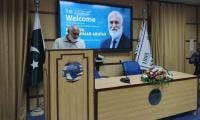
Sindh police chief Ghulam Nabi Memon, who is going to retire from service on December 31, 2025, has earned many achievements during his service, which includes the digitisation of the Sindh Police Department.
IGP Memon joined the police service in 1991 and served as the SSP in seven districts of Sindh. He also twice served as the Karachi additional IG. His achievements as Sindh police chief include digitization of the Special Branch and Investigation Department, and he also worked hard in the operations against street crime and dacoits in Karachi and the Katcha areas.
After the General Elections 2024, Memon was again appointed as IGP and he started the process of digitization of the Sindh Police.
Street crime
Karachi, one of the world’s largest and most populous metropolitan cities, has long been grappling with the complex challenge of street crime. With a diverse population and a vibrant economy, the city faces unique law enforcement hurdles. However, in recent years, the Sindh Police have made concerted efforts to tackle this issue, implementing various strategies to enhance public safety. Through improved investigation skills, increased use of technology and community engagement, the detection rates have increased multifold. The impact of these efforts is evident in the declining crime statistics.
Mobile phone-snatching cases dropped from 2,305 in January 2024 to 1,338 in November 2025, marking a significant reduction of 42%. Two-wheeler snatching/theft incidents decreased from 5,337 in January 2024 to 2,881 in November 2025, marking a reduction of 46%.
Moreover, the average of street crime incidents the per day dipped from 252.3 in January 2024 to 154.3.8 in November 2025, reflecting a 39% reduction.
Violent crimes
Karachi has seen a decline in violent crimes, particularly robbery with murder and injury, with a 64% decrease in November 2025 compared to the figure of January 2024. The average incidents per day dropped from 2.12 in January 2024 to 0.77 in October 2025. Murder incidents decreased from 13 in January 2024 to 4 in November 2025. Moreover, the number of persons injured dropped from 53 in January 2024 to 20 in November 2025. The total incidents reduced from 66 in January 2024 to 29 in October 2025
Key factors leading to a decline in crime include investing in technology, implementing CCTV networks and rapid response units, improved detection rate, enhanced investigation skills and identification parade procedures. Moreover, minimizing bailouts and maximizing convictions and ensuring identity parades are the main factors. Furthermore, effective law enforcement and Sindh Police’s efforts to crack down on street criminals and gangs also helped bring down the crime rate.
Narcotics
The arrest of 12,623, including seven killed and 26 injured, involved in narcotics sales and hustling has likely reduced the number of drug peddlers fuelling street crime. By disrupting the supply chain, authorities have addressed a significant driver of crime.
On the directives of the IGP, the Special Branch was able to successfully identify 364 A+ category narcotic, 75 narcotic suppliers to educational institutions, and 332 main gutka and mawa suppliers across the province. These lists were distributed among the field officers who were tasked to put them behind bars at the earliest. Followup meetings were done every 15 days with field and Special Branch officers for earliest action.
Sindh Police’s efforts to combat narcotics trade have yielded notable results, with a significant number of accused arrested and dens neutralized in the last 3 months. In the current year, 12,623 suspects including 7 killed and 26 injured involved in narcotics sales and hustling have been arrested with the total recovery of 6,125kg of hashish, 196kg of ice, 35kg of heroin and 287,980 litres of liquor.
Officials said the action on A+ category sellers is 92% enforcement success, with 328 out of 364 identified sellers arrested, 262 (80%) of those arrested are still in jail, with a strong followup on their cases.
Moreover, action against drug suppliers to educational institutions is also a 91% enforcement success, with 68 out of 75 identified sellers arrested. The crackdown on Gutka/Mawa sellers has seen an about 78% enforcement success, with 259 out of 332 identified sellers arrested, and 169 (65%) of arrested sellers are still in jail.
Scrap dealers
The crackdown on 234 scrap dealers who bought and sold stolen property has diminished the demand for stolen goods, making street crime less lucrative. This strategic move has contributed to the overall decline in street crime.
Katcha area policing
The Kutcha area operation was started in intensified in October 2024, leading to significant improvement in efforts to establish peace and stability in the Katcha (riverine) areas of Sindh, traditionally challenged by lawlessness. The primary success has been the notable improvement in the security situation, driven by intensified, coordinated operations between the Sindh Police and Rangers, often utilizing modern technology.
A major milestone is the successful implementation of the ‘Sindh Surrender Policy,’ which saw a substantial number of dacoits laying down their arms including sophisticated weaponry like rocket launchers and anti-aircraft guns. This policy, which offers assurances of rehabilitation, livelihood support, and family protection, aims to bring long-term peace by moving beyond mere law enforcement to socio-economic reintegration. Authorities have also reported a declining trend in serious crimes, particularly kidnapping for ransom, a decades-long challenge that is now reportedly close to being eliminated in many of the once bandit-filled areas.
All kidnappees have been recovered. Highway robberies have reduced to almost zero. On the other hand, Garhi Tegho, one of the main identified pockets which was a major safe haven for criminal activities and hub for honey trapping, attracting victims from all over Pakistan has been completely cleared. It was highly inaccessible due to terrain and presence of military-grade weapons. There have been 29 Shaheed since 2015.
Anti-terror drive
Another achievement of IGP Memon is working in line with the directions of the government to ensure implementations of the National Action Plan. The CTD and Sindh Police have been conducting various IBOs throughout 2025. Such IBOs did not only unearth the terrorist rackets inside the province but also led to an environment of security and better law and order situation.
The government of Sindh is committed to the capacity building and strengthening of the CTD. By investing in advanced technology, infrastructure, and operational resources, the government is ensuring that the CTD is well-equipped to effectively combat terrorism and organized crime in the province. These measures reflect a long-term strategy to enhance the department’s capacity. Allocation of Rs633 million for the establishment of CTD Regional Complexes in Karachi, Hyderabad, Sukkur and Larkana.
In line with the global advancements in counter-terrorism technology, a state-of-the- art center has been established with a budget of Rs772 million. This center is equipped with cutting-edge technology, including video enhancement tools for improving surveillance and evidence collection, digital forensic tools to analyze electronic devices and digital evidence, and mobile malware detection tools to detect and neutralize threats from mobile devices.
The other developments include steps to gather and analyze information from public and private sources for better intelligence. It has become possible with the purchase of new vehicles worth Rs633 million. An additional purchase of vehicles worth Rs495 million is currently in process to complete the remaining fleet requirements of the CTD.
Upgradation
IGP Ghulam Nabi Memon wants its transformation from a traditional police force into a service-oriented organization that believes in public service delivery, strict accountability and rule of law. Additionally, the government of Sindh has been dedicated towards strengthening Sindh Police in its operations, crime control, training, technological advancements, welfare and recruitments.
Likewise, Sindh Police have accomplished various milestones to ensure public facilitation, maintain transparency, easy access, and quick response to the public at large.
Sindh Smart Surveillance System (S4): The objective of this project is to establish a comprehensive and integrated security solution by installation of smart Al powered CCTV surveillance system on 42 Toll Plazas. It is integrated with the vehicle number plate reading and facial recognition technology to identify suspects and track criminal activity. It is integrated with criminal records, Excise Department, Anti Vehicle Lifting Cell (AVLC) snatch/stolen vehicle system and other related data. Some 389 criminals have been arrested since June 2024.
Highway patrols
The Sindh Police is going to launch a separate unit dedicated towards patrolling on the highways. This mega project aims at securing the highways from crime as well as improving police response mechanism. A fleet of 100 vehicles and a man power of 2,000 Personnel are being allocated to SPHP.
Special Branch
The Special Branch is tasked with collecting, collating, and disseminating intelligence, pre-empting internal security threats, and providing information for law and order management. It also ensures the security of VIPs and key installations while managing intelligence on anti-state elements and foreigners. Following initiatives were taken to revamp Special Branch: Regular training in threat analysis, intelligence collection, the use of modern surveillance tools, and establishment of a School of Intelligence for continuous learning and development.
Digital Intelligence & Monitoring Cell has been established to monitor and analyze social media, internet forums, and other digital platforms for actionable intelligence. Use of cutting-edge tools like big data analytics, open-source intelligence (OSINT) platforms, and social media monitoring software.
Police station reforms: In order to ensure capacity building of police stations, and to curb corruption, for the first time in the country, Sindh has pioneered the initiative of giving financial autonomy to the basic public service delivery institution of police station; 485 police stations have been provided dedicated budget and a total budget at PS level is Rs3.89 billion. SHOs and SIOs have been made DDO and sanction authority.
Digitization of police stations: About 484 police stations throughout the province have been given computers to shift from the manual system of record keeping to digitization of the data, starting from FIR to the submission of the final report in the court. The Police Station Record Management System (PSRMS) is operational in all police stations. Presently, all FIRS are being entered in the system and corresponding entries in to different registers are done electronically by the system itself.
Advanced Complaint Management System: An integrated online Complaint Management has been put in place, with public portal available throughout the world to register any complaint of criminal nature or against malpractice, corruption or high-handedness of police officers. The CMS has IGPS Login, in addition to the logins as DIGP, SSP, SDPO and SHO offices, thereby enabling one -window supervision of the number of complaints being redressed at any such level. Moreover, IGP Complaint cell helpline 1715 has been started, where all calls are converted into complaints in the CMS for early redressal.
Police welfare initiatives: Following welfare initiatives were taken during the year 2025. Shaheed package; the Sindh government has enhanced this Shaheed Package scheme from 10 million to Rs23.5 million to Rs70 million compensation with salary till the age to retirement and two jobs for the family.
Health card
The Sindh government, noticing the demand of police officers, has very kindly approved this insurance scheme up to Rs1 million for serving police personnel, spouse, children and parents, and it can be enhanced in case of chronic diseases.
During the current year, 22,855 availed treatment by police personnel and their families from against an amount to Rs3.04 Billion.
IGP Memon’s other upgradation and digitization projects are: Advanced Technical Infrastructure such as tie-clip cameras, snake cameras, and vehicle-mounted jammers. For enhanced coordination, the Special Branch has been integrated with the Counter-Terrorism Department’s (CTD) Fusion Center for intelligence sharing. Essential equipment like handheld mapping devices and bug detection tools has been procured. Jammer vehicles and other modern gadgets are also been procured.
Capacity building of SPU: The Special Protection Unit (SPU) is a dedicated security force responsible for ensuring the safety of Chinese nationals working on various projects in Sindh, particularly under the China-Pakistan Economic Corridor (CPEC) and non-CPEC projects. Given the evolving security challenges, following initiatives were taken to revamp and strengthen the SPU to improve its effectiveness; Troop strength has been increased up to 3,682; provision of 728 bullet proof jackets & helmets and CW39 Rifles to improve the weaponry.
The SPU fleet has been added with three jammer-installed vehicles. The SPU is being provided with four new Toyota Revo vehicles for addition into armored fleet, and a feedback mechanism to get the feedback from the Chinese visitors.
Training initiatives: The training is the backbone for effective and professional Police service. During 2025, Training Branch of Sindh Police yielded major breakthroughs; such as, a. Establishment of Training Directorate to determine and update the futuristic training aims and objectives by identifying and addressing the local training needs while incorporating national and international best practices into the training programmes and protocols to enhance the capacity building of Sindh Police human resources.
The courses include an accountant course for Station Clerks, Certification of Investigation Officers Course, Traffic Management Course, Combating trafficking in persons & smuggling of migrants course, Crime Scene Investigation Course, Gender-based violence management course h. Basic & promotional courses(syllabus-2024), Sindh police foreign training and scholarship policy 2024.
IT initiatives: The Criminal Record Management System (CRMS/CRO/CRI) is an automated and advanced version of Criminal Record Office (CRO) which includes entry of biometric details and online counter matching the same with NADRA database. There are a total of 871,700 entries.
Hotel Eye Management System (HEMS): The HEMS is a web application to log the check-in/ check out in hotels alongwith CNIC and personal details of visitors. This system is integrated with NADRA, PSRMS and CRO. Almost all Sindh hotels, guest houses, musafir khana and Hostels are registered with HEMS. 1599 criminals have been arrested through this system.
Driving License and Violation Management System (e-DL&VMS): The Driving License Management System is a centralized based system which is being used to issue computerized driving license to Public in 26 driving license branches of Sindh province. Facilities like renewal of license and issuance of the learner’s license etc. are now available online for facilitation of public. Total 359,840 licenses have been made online and delivered to its users since September 2024.
Employee Verification system (EVS): EVS is a web application which facilitates industries through biometric verification of their employees by checking their criminal record history. This system is integrated with PSRMS and CRO. All kinds of industries, factories, mills, shops & corporate offices with total of 346,588 entries in last six months. This verifications system has helped to apprehend over 11,404 criminals.
Police Station Record Management System (PSRMS): Police Station Record Management System (PSRMS) has been updated and is linked with Case Flow Management System (CFMS) of courts.
Geo-mapped CCTV Camera Installation in Karachi: As a self-initiative, in collaboration with the local community, some 40,000 CCTVs were installed throughout the streets, roads, markets, shopping malls, and the residential areas of Karachi, so as to enhance the capacity of investigation officers to detect the criminals through these CCTVs. All these CCTVs are geo-mapped. These CCTVs contribute a major factor in reduction of crime in Karachi, and its subsequent detection.
Crowd Management Unit: A professional unit of CMU, trained by Anti-Riot Force (ARF) of Turkey, has been established to deal with sit-ins, unlawful assemblies, riots and violent protests in highly professional, non-violent and disciplined manner.
E-Tagging of 4,000 Repeat offenders: Street Crime is mostly committed by the outlaws who are either habitual offenders or jail-returnees. Law is enacted and rules on this subject are pending for approval of the cabinet. This will help in electronic monitoring of the repeat criminals which will help to reduce the crime.
TRACS (Traffic Regulation And Citation System): Digital initiative introduced by Sindh Police to improve Traffic Management and automate traffic rule enforcement & citation issuance. It features Al-powered cameras for speed & violations and Mobile app for e- challan payment.
Revamping of Investigation Branch: the government of Sindh allocated Rs600 million separately to improve the Investigation branch of the Sindh Police. Following initiatives have been taken to upgrade the investigation branch; Sindh Government has enhanced the cost of investigation. Centralized Investigation Cells (CICs): Creation of Functional-based investigation cells with specialization of investigators. Moreover, 2,075 specialized IOs notified on functional basis.
Crime scene units: Sindh Police has established 50 Crime Scene Units across the province.
The question remains: will the system of digitization and the projects launched continue or will we see the same old force with limited resources after the retirement of IGP Ghulam Nabi Memon.