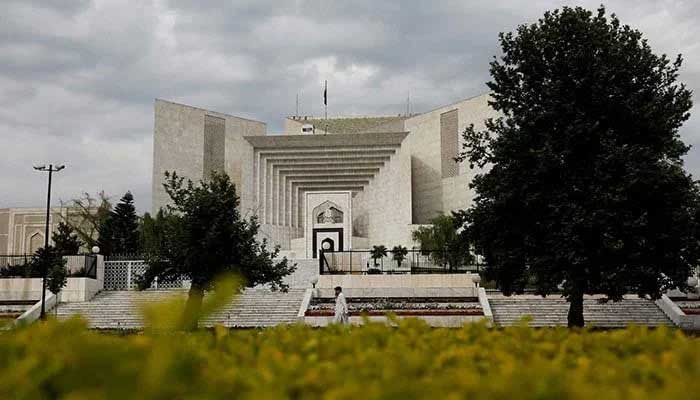
ISLAMABAD: The Supreme Court (SC) has held that the law declared by it will apply to the cases arising in future but the cases which have attained finality are fully protected under the doctrine of past and closed transactions.
A three-member bench of the apex court headed by Justice Muhammad Ali Mazhar and comprising Justice Athar Minallah and Justice Salahuddin Panhwar issued judgment in various appeals filed by the government of Sindh, challenging the different orders passed by the learned Sindh High Court, Circuit Court, Hyderabad and Bench at Sukkur
The learned High Court had passed orders in different constitution petitions vis-à-vis the right of employment on the strength and pursuit of deceased quota in terms of Rule 11-A of the Sindh Civil Servants (Appointment, Promotion & Transfer) Rules, 1974 (“APT Rules”), whereby the Constitution Petitions filed by the respondents were allowed subject to fulfillment of all codal formalities and rules.
The respondents included Azhar Ali, Nadir Ali, Sikandar Ali, Imtiaz Ali, Nadeem Abbas and Khalid Ahmed Nadeem Solangi.
The Supreme Court dismissed all the appeals of Sindh government, declaring that it did not find any illegality, perversity or impropriety in the impugned orders passed by the learned High Court.
“We are sanguine that the law declared by this court will apply to the cases arising in future but the cases which have attained finality are fully protected under the doctrine of past and closed transactions”, says a 7-page judgment authored by Justice Muhammad Ali Mazhar.
The court held that it is clear beyond any shadow of doubt that the judgment of this court has the prospective effect unless declared otherwise.
The court further held that the prospective declaration of law cannot reopen the past and closed matters to avoid or prevent the multiplicity of proceedings and undermining the doctrine of finality of judgments which in the present case successfully attained and the orders of the High Court cannot be assailed or set aside on the anvil of judgment rendered by this Court posterior i.e. on 26.09.2024.
The court noted that the learned Additional Advocate General, Sindh (“Addl.AG”) argued that the learned High Court ignored the pure language of the aforesaid rule and allowed the Constitution Petitions with certain directions to issue the appointment letters beyond the scope of the aforesaid rule, therefore, the impugned orders are against the law and facts.
He further argued that upon receipt of applications for the job against the deceased quota, Law Department fulfilled its obligation of scrutinising the same in the light of deceased quota policy and after scrutiny of the case of the respondents, the Law Department opined that the cases of the respondents do not fall within the ambit of existing policy including the cut-off date for applying for the job.
Likewise, the court noted that the learned counsel for the respondents argued that all the impugned orders were rendered by the High Court prior in time the dictum was laid down by this court in the case of General Post Office (supra).
It was further argued that the High Court after considering the niceties of Rule 11-A of APT Rules allowed the constitution petitions with due care and caution which cannot be undone or set aside on the basis of aforesaid judgment of this court.
The court noted that the substratum of erstwhile Rule 11-A APT Rules expounded that when a Civil Servant died while in service, or is declared invalidated or incapacitated, one of his children or, as the case may be, his spouse if his children are minor, shall be provided job, but the predominant condition was to apply within a period of two years of death or declaration of invalidity or incapacity of a civil servant.
The learned Addl. AG fervently avowed that the High Court in all impugned orders disregarded the definite date to adjudge whether the legal heirs of deceased civil servants and/or sons/daughters of invalidated or incapacitated civil servants applied for the job within the cut-off date mentioned in Rule 11-A of the APT Rules.
“However, he could not point out any instance within the realm or dominion of the erstwhile rule that since the children of deceased, invalidated or incapacitated civil servants were minor at the time when the job opportunity matured, therefore, under the beneficial provision, the spouse of such civil servant was accommodated or provided the job and if this was not done then what the reasons were as it was not even disclosed as an effective defense that the job was offered but the opportunity was not availed”, says the judgment.
The court held that the record reflects that many minors after attaining maturity within the cut-off date applied for the job and were accommodated by the High Court.
“If commonsensical and serviceable interpretation is made, then the aforesaid rule has not created any bar and obviously, if the widow was not accommodated for any reason, then neither the right to apply by a minor after attaining maturity is stifled nor he could be blamed if at the time of death of his father, he was minor especially in the state of affairs when his mother i.e. widow of deceased was not accommodated for a job consistent with the aforesaid rule”, says the judgment.
“So for all intent and purposes, the court declared that the High Court in its strength of mind rightfully extended the benefit of beneficial provision according to the spirit of law prevailing at the time of deciding the constitution petitions.
The court held that in order to hear this important matter, notices were issued to the Attorney General, Pakistan as well as to the Advocate Generals of all the provinces. In such a situation, the matter ought to have been dealt with according to Section (4) of the Supreme Court (Practice and Procedure) Act 2023 (as stood prior the 26th Constitutional Amendment), which provided in its original form that the matters where the interpretation of the Constitutional provisions is involved, committee should constitute the bench comprising not less than five judges of the Supreme Court but this elemental and crucial aspect touching the jurisdiction escaped the attention of the honorable bench seized of the lis, rather, the matter was fixed and decided by three member bench, the aspect which also needs to be thrashed out in appropriate proceedings whether the said judgment is “per incuriam” or not?
“In the case of Sakhi Muhammad and another vs. Capital Development Authority, Islamabad (PLD 1991 S.C 777), it was held by this court that the consequence of the Supreme Court judgment was that as from the date of decision all courts subordinate to the Supreme Court and all executive and quasi-judicial authorities were obliged by virtue of the Constitution to apply the rule laid down by the Supreme Court in cases coming up before them for decision”, says the judgment.