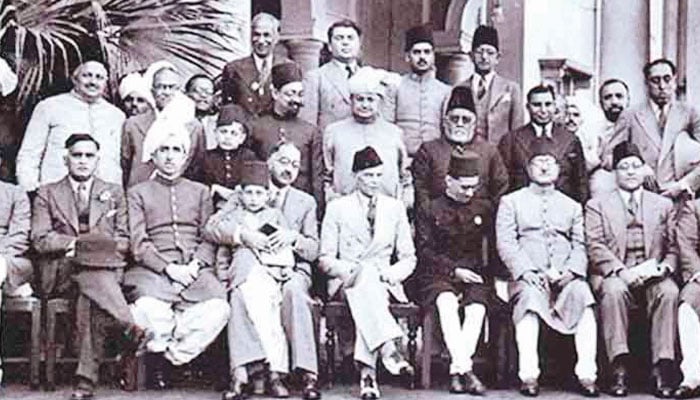
Muhammad Ali Jinnah was a visionary leader and one of the few who achieved their political goals in tangible form, as seen in the creation of Pakistan in 1947. Pakistan adopted a republican structure, also known as a parliamentary democracy. This adaptation aligns with how the founder, Quaid-i-Azam Muhammad Ali Jinnah, envisioned Pakistan to be.
The democratic inspirations of the Quaid-i-Azam are rooted in his education, which he received from the West, and his observations and experiences of political developments around the world as well as within India, during his political career.
The political career of Quaid-i-Azam has two dimensions, one before the creation of Pakistan and one after its creation. The politics of the Quaid-i-Azam before Pakistan’s creation had some unique differences from the politics after its creation. At times, some of his political decisions raise questions in the sight of political commentators and historians.
Due to his non-violent, active, and efficient politics, Quaid-i-Azam was able to lead the Muslim League, even after its defeat in the 1936-1937 elections. While the Muslim League was not successful in 1936-1937 elections, Quaid-i-Azam’s strong political campaign led to the passing of the Pakistan Resolution in 1940 i.e. only in 3 years after the defeat. Later, in the 1945-1946 elections, the Muslim League achieved a sweeping victory in Muslim majority areas, which became a turning point in the independence movement and the creation of Pakistan.
The partition of India was based on a democratic electoral process and the demography of Muslims and Hindus. Similarly, Punjab and Bengal provinces were divided between India and Pakistan through voting in their respective provincial assemblies.
After independence, the challenges changed dramatically. Pakistan was born amidst financial weakness, administrative vacuum, refugee influx, territorial disputes, and communal violence. At the same time, Jinnah was battling tuberculosis, a fatal disease he concealed from the public. In only 13 months of leadership, he had to make rapid decisions to prevent the new state from disintegration. These choices, sometimes perceived as undemocratic, were in fact driven by his urgent need to build a strong, unified centre.
One of the most debated decisions was his declaration of Urdu as the national language. Though Bengali was spoken by the majority, Jinnah viewed Urdu as a neutral Muslim lingua franca unconnected to provincial rivalries. He believed a single national language would bind the culturally diverse federation together.
Jinnah also shifted away from the extensive provincial autonomy promised in the 1940 Lahore Resolution. After partition, he feared that immediate decentralisation would weaken a state still struggling to build institutions. Thus, he supported a strong federal government capable of maintaining cohesion across both wings of Pakistan and among various ethnic groups, tribal regions, and princely states.
This logic was even clearer in the case of the State of Kalat (present-day Balochistan). Although Kalat initially sought independence, Jinnah believed that allowing any region to separate so early could trigger a chain reaction, threatening Pakistan’s territorial integrity. After failed negotiations, Kalat acceded to Pakistan under pressure. Critics call this undemocratic, but for Jinnah it was essential to prevent fragmentation of a vulnerable new country. Policymakers today frequently point to this example when discussing national integration and the necessity of a firm centre.
Similarly, Jinnah’s decision to declare Karachi a federal territory overruled the Sindh Assembly’s resolution seeking to retain the city within the province. For him, the national capital needed to be neutral, directly controlled by the centre, and administratively autonomous-free from provincial politics at a time when the federal machinery was just emerging.
His move to ban the Communist Party of Pakistan and restrict leftist labour activities was motivated by fears of ideological agitation and foreign influence during the early Cold War. Pakistan, already facing instability, could not afford political polarisation or class-based upheaval. To him, safeguarding the state was more important than allowing unrestricted political experimentation in its infancy.
The political choices Jinnah made after independence continue to shape Pakistan’s contemporary debates on centralisation, provincial autonomy, language, and national integration. While some of his decisions are scrutinised today, they reflect the mindset of a leader racing against time to stabilise a fragile country. His actions were not contradictions of his democratic ideals; they were adaptations to a drastically different reality.
Today, when Pakistan faces internal polarisation, regional grievances, and institutional instability, revisiting Jinnah’s state-building approach becomes crucial. His belief that unity and central strength were essential for Pakistan’s survival remains deeply relevant.
As we honour Quaid-i-Azam on his birth anniversary, we must remember him not as a saintly figure beyond criticism, but as a leader of sharp intellect, strategic foresight, and immense courage. His democratic struggle created Pakistan; his decisive post-partition actions preserved it. The greatest tribute we can pay him today is to pursue the unity, stability, and strong national identity he believed were essential for Pakistan’s destiny.
-The writer is a student of Mphil, University of Karachi