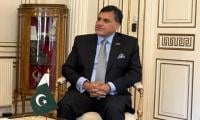
ISLAMABAD: President Asif Ali Zardari has approved the denotification of Justice Tariq Mehmood Jahangiri as a judge of the Islamabad High Court, on the advice of the Prime Minister, in compliance with the decision of the Islamabad High Court, which declared his appointment as a judge to be illegal and ordered him to vacate office, says a press release issued by the President’s Secretariat late Thursday night.
Earlier in the day, the Islamabad High Court (IHC) ordered removal of Justice Tariq Mehmood Jahangiri, ruling that he was not eligible to be appointed a judge for holding an invalid LLB degree. A two-member bench, led by Chief Justice Sarfraz Dogar, ruled that the judge did not have a valid LLB degree at the time of his appointment and therefore it was unlawful.
Justice Azam Khan was the other member of the bench.
The court directed the Ministry of Law and Justice to remove and denotify Justice Jahangiri.
The case centres on a controversy regarding Justice Jahangiri’s LLB degree, which was cancelled by the University of Karachi.
According to the university’s notification dated September 25, the university syndicate, in its meeting on August 31, 2024, approved “Resolution No 6” in compliance with the competent authority’s decision, upholding the recommendation of the Unfair Means Committee (UFM).
Justice Jahangiri did not appear in the court and was represented by Akram Sheikh and Barrister Salahuddin.
Barrister Salahuddin maintained that the court had three petitions related to Justice Jahangiri and should first take up those petitions.
Akram Sheikh apprised the court that Justice Jahangiri had instituted proceedings against the IHC chief justice and other transferred judges.
He said the respondents were violating the due process.
Meanwhile, Mian Dawood Advocate maintained that Justice Jahangiri appeared in the previous hearing and objected to the bench.
He said Justice Jahangiri had initially argued that the case should be heard by a single bench and had now submitted a request for the matter to be heard by a full court. Dawood added that even in a full court, Justice Jahangiri had sought the exclusion of the chief justice and other transferred judges. He said the Supreme Court had granted the authority, in writs of quo warranto, to scrutinise every single document.
He further alleged that Justice Tariq Jahangiri took a false oath on the Holy Quran and left.
Dawood said he himself swore that even Justice Jahangiri’s enrolment forms were bogus, adding that if Justice Jahangiri was truthful, he should produce his LLB Part I and Part II marks sheets.
Akram Sheikh said bias in the case was “evident to all”, adding that the matter was fundamentally based on prejudice.
He further told the court that the cases against the chief justice were pending with the Federal Constitutional Court and Supreme Judicial Council.
Sheikh said the chief justice was ranked 15th on the Lahore High Court (LHC) seniority list and questioned whether he could “settle scores”.
Barrister Salahuddin presented arguments on two petitions, while Sheikh argued on one petition.
Barrister Salahuddin requested that the case be adjourned for an indefinite period and asked the court to grant 30 days’ time for submission of replies.
Karachi University Registrar Imran Siddiqui also appeared before the court and submitted original academic record related to Justice Jahangiri’s degree.
Justice Dogar asked the registrar to clarify the final decision on the degree, to which he said the university had finally cancelled the judge’s degree.
At this, Barrister Salahuddin said a petition challenging this action was already pending and that the Sindh High Court (SHC) had suspended the Karachi University’s declaration.
Barrister Salahuddin argued that for the past one and a half years, propaganda had been spread alleging that Justice Jahangiri’s degree was a fake.
He said the registrar had now admitted that Justice Jahangiri had appeared in LLB Parts I, II and III, and that the issue pertained to procedural irregularities rather than a fake degree.
According to Barrister Salahuddin, Karachi University acknowledged issuing the degree and later cancelling it due to alleged irregularities.
The registrar also admitted that this was not a case of a fake degree but one cancelled on procedural grounds, he said.
Meanwhile, Siddiqui apprised the court that the Islamia Law College’s principal had said that Justice Jahangiri had not been the institution’s student.
“Justice Jahangiri was caught cheating [therefore] the [KU’s] UFM imposed a three-year ban on him for cheating and threatening the examiner,” the KU official told the court, adding that the judge was eligible to retake the exams again in 1992.
The KU registrar further pointed out that Justice Jahangiri used a fake enrolment form to bypass the ban and obtain the degree instead.
The judge, he added, appeared in the LLB Part I exam under the name “Tariq Jahangiri, son of Muhammad Akram”, whereas in the LLB Part II exam, he appeared as “Tariq Mehmood son of Qazi Muhammad Akram”.
“Justice Jahangiri appeared in the LLB exam via a fake enrolment number,” remarked Siddiqui, further highlighting that the Islamia Law College had no record of the form provided by the judge for LLB Part II.
“The authorities confirmed this and the [KU] syndicate declared the degree cancelled on the findings,” the KU registrar noted.
At this, the Islamabad Bar Council (IBC) lawyer Raja Aleem Abbasi said the varsity’s decision to cancel Justice Jahangiri’s degree had, in fact, been suspended by the Sindh High Court (SHC).
The Islamabad Bar Association (IBA) has announced a strike for today (Friday).
IBA President Naeem Gujjar and Secretary Abdul Halim Bhutto stated on Thursday, “The Islamabad Bar Association condemns illegal and unconstitutional decisions. No case should be decided without fulfilling all legal provisions. The Islamabad Bar Association will go on a complete strike on Friday against this unconstitutional decision. Lawyers will boycott court proceedings.”
Pakistan Tehreek-e-Insaf (PTI) Chairman Barrister Gohar Ali Khan said that the order against Justice Jahangiri is a disturbing move to remove judges from office, which he is deeply concerned about.
In a statement, he said that such an order further undermines judicial independence. “If a judge is unable to protect and defend himself in his own court, the constitutional oath to protect and defend the constitution becomes meaningless,” he contended.
Barrister Gohar said that this is not the first case where judges have been informally removed from their offices in this way. He emphasised, the path of such steps in the future will have to be blocked.
The PTI, in a statement, termed the IHC decision a serious threat to judicial independence and undermining the rule of law.
In a statement, the party asserted that denying an individual the right to be heard, access to the proper constitutional forum, and assurance of a fair trial did not constitute justice; rather, it amounted to the complete negation and killing of justice itself.
The PTI contended that the Constitution of Pakistan clearly provided a well-defined forum — the Supreme Judicial Council (SJC) — for the accountability of judges, encompassing matters related to misconduct, breaches of the judicial code of conduct, and allegations of corruption.
The statement emphasized that bypassing this constitutional forum and determining a judge’s future through any alternative mechanism constituted a clear departure from the Constitution of Pakistan.
It warned that pursuing such a course would raise serious concerns about the already diminished symbolic and institutional relevance of the Supreme Judicial Council.
The party expressed serious concern that the IHC’s decision went far beyond the case of a single individual, carrying far-reaching implications.
The party cautioned that if a judge could be declared unfit in this manner today, the other honorable judges could be subjected to the same treatment tomorrow.
Meanwhile, with the consultation of all stakeholders, the PTI Islamabad Region has constituted a Local Body Election Committee (LBEC) to ensure organized and full participation in the upcoming local government elections.
According to the related notification, the LBEC has been established to ensure a transparent, merit-based, and legally compliant electoral process in accordance with the party policy, ideology, and leadership.
The committee will be chaired by General Secretary Islamabad Malik Amir Awan. The panel will prepare a joint election manifesto for the local bodies’ elections. It will also plan and oversee a unified election campaign across Islamabad.
Moreover, it will form and supervise campaign teams at the district and union council levels, ensure full representation of PTI candidates in all union councils of the three constituencies and coordinate with the ticket holders.