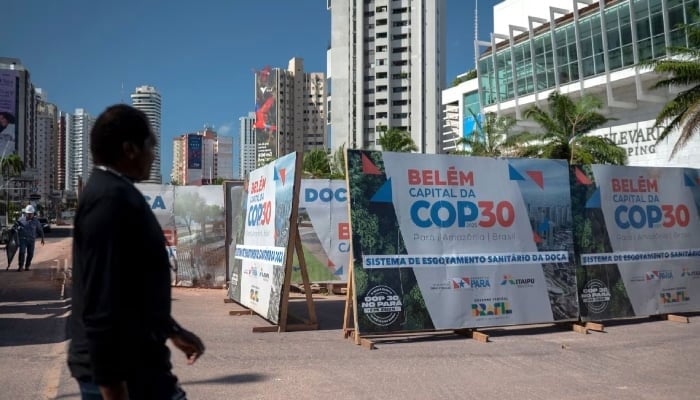
COP30 in Belem, held deep inside the Amazon, is being branded as the ‘Action COP’. Yet, uncertainty continues to overshadow expectations. Convened ten years after the Paris Agreement and more than three decades after the Rio Earth Summit that created the UNFCCC, COP30 carries undeniable symbolic weight.
But symbolism alone does not slow rise seas, melting glaciers or intensifying heatwaves. What ultimately matters are what survives the final negotiated text and whether commitments translate into real protection for communities on the frontlines of climate risk.
The conference began with an important procedural achievement: the swift adoption of the agenda, a step that avoided the routine deadlock over which items parties are willing to negotiate. However, some of the most politically sensitive issues, especially the debate over language on ‘transitioning away from fossil fuels’, were moved into a new ‘action agenda’. While this mechanism may enable progress without requiring consensus among all parties, it also risks pushing aside the very issues that demand full political confrontation and binding commitments.
A rare area of substantive movement this year has been on the Global Goal on Adaptation (GGA). Negotiators appear close to establishing the first global framework to track how countries are building resilience to escalating climate impacts. Institutionalising adaptation as a measurable component of climate ambition would mark a major shift from past COPs. Yet, without predictable and adequate financing, even the strongest framework will remain insufficient to protect vulnerable populations. The proposed new global finance targets $1.3 trillion annually by 2035, including $300 billion earmarked for adaptation, illustrates this gap between ambition and realism.
The Baku-to-Belem finance roadmap references potential innovations such as wealth taxes, fossil fuel levies and reformed multilateral lending. But none of these mechanisms are binding, and without legal anchors or compliance systems, they risk remaining aspirational rather than actionable.
Similar concerns surround the Loss and Damage Fund. Despite its operational status, it remains severely underfunded and procedurally cumbersome. Current pledges total less than $800 million, a negligible fraction of what climate-vulnerable developing countries require. Many of these countries remain entangled in bureaucratic procedures merely to access modest sums. With developed countries still hesitant to fully capitalise on the fund, the Global South has become increasingly assertive: the climate transition must be fair, equitable and locally owned.
The geopolitical dynamics at COP30 further complicate matters. The absence of a formal US federal delegation has created a leadership vacuum that sub-national actors and China have moved to fill. Beijing has hosted methane discussions, expanded renewable energy exports to developing countries and joined initiatives to harmonise carbon markets. Alongside other developing economies, China has sharply criticised the EU’s Carbon Border Adjustment Mechanism, warning that climate regulations should not evolve into disguised trade barriers.
The European Union remains active but overstretched. Internal political divisions, rising far-right sentiment and competing global crises have weakened the EU’s diplomatic influence relative to its role at COP21 or COP26. Still, it continues to push for transparency, fossil fuel phase-down language and expanded climate finance through mechanisms such as the Green Climate Fund and the European Investment Bank.
Scientific analyses presented at COP 30 have reinforced the urgency of the moment. UNFCCC leadership noted that current and incoming national climate plans may reduce emissions by only 12 per cent by 2035 compared with 2019 levels. The IPCC, by contrast, calls for reductions of at least 43 per cent by 2030 to keep the 1.5 C pathway alive. The gap between global pledges and planetary limits continues to widen.
Outside negotiation rooms, civil society groups, Indigenous communities and youth networks have injected momentum and moral pressure. Their demonstrations from river flotillas to mass marches highlight a growing consensus: climate justice cannot be delayed. Their advocacy is elevating issues such as land rights, food security, WASH services and public health within adaptation planning. The COP30 presidency must now clarify how the blended agenda will operate, particularly with respect to financing and the fossil fuel transition. Consultations continue, but certainty remains elusive.
For Pakistan, COP30 arrives at a moment of both high vulnerability and strategic opportunity. The country has updated its NDCs, committed to generating 20 per cent of its electricity from solar by 2026 and is advancing reforms under the IMF’s Resilience and Sustainability Facility. Pakistan remains among the most climate-exposed countries globally, dependent on external finance and repeatedly struck by floods, heatwaves and glacial outburst events.
Pakistan’s priorities at COP30 must therefore be clear and coordinated: secure timely access to the Loss and Damage Fund, build political support for NDC and RSF-linked reforms, and champion the Belem Action Mechanism for a fair and equitable transition. These positions align with the broader agenda of the G77, China and allied blocs in Africa and Latin America.
Pakistan’s narrative should be anchored in a simple but powerful premise: countries that contributed least to global emissions must not be expected to finance their survival through debt. The monsoon, now alternating unpredictably between drought and deluge, has become the operating condition of Pakistan’s economy. When villages flood, crops wither and heat forces schools and industries to close, the resulting financial burden cascades from households to provincial budgets to the national treasury. This is not a plea for charity but a claim for reparations rooted in decades of accumulated emissions elsewhere.
Four priority asks for Pakistan: First, international climate finance for vulnerable countries must be primarily grant-based or highly concessional. Adaptation and loss-and-damage needs cannot be met through loans that exacerbate fiscal stress.
Second, the New Collective Quantified Goal must be accompanied by enforceable timelines, transparent reporting and financing channels that reach provinces, municipalities and local institutions.
Third, the Loss and Damage Fund must operate with the urgency of an emergency response mechanism, supported by predictable replenishment, local-access windows and parametric triggers for rapid disbursement.
Fourth, climate risk should be recognised as a security threat requiring cooperative, cross-border support, particularly for Pakistan’s shared rivers, shared airshed and shared vulnerabilities with border countries.
To retain credibility in global forums, Pakistan must integrate international demands with domestic implementation: a costed climate investment pipeline, strengthened early-warning systems, urban, nature-based buffers, heat-health protocols and financing for climate-smart agriculture.
Ultimately, COP30 will be judged not by its symbolism but by its outcomes. Pakistan’s four asks aim to shift global conversations from abstract commitments to concrete protection for those most exposed. If the world delivers, climate justice may finally move from rhetoric to reality. If not, vulnerable nations will once again confront the next climate shock alone.
The writer works on climate finance, carbon markets and sustainable development across disaster risk reduction and climate change.