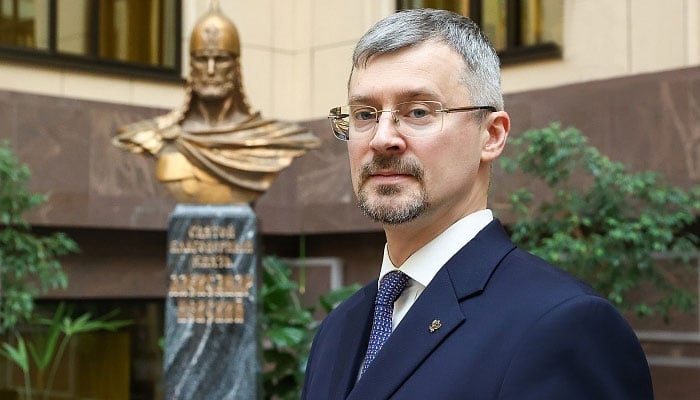
ISLAMABAD: Russian Ambassador Albert P Khorev on Thursday praised Pakistan’s “consistent neutrality” on the war in Ukraine and support for a diplomatic resolution of the over 45-month-old conflict.
“I would like to once again thank the government of Pakistan for its consistent policy of neutrality in the conflict in Ukraine, including at the United Nations, despite pressure from external forces. Pakistan strongly supports a diplomatic settlement of the conflict, which is fully in line with Russia’s position on this issue,” Khorev told reporters at his embassy here.
A bout the latest diplomatic developments on the Ukraine issue, the envoy declared the December 3 Moscow meeting between Russian President Vladimir Putin and American envoys Steve Witkoff and Jared Kushner as a “constructive and substantive” five-hour discussion on US President Donald Trump’s updated peace plan.
He said the blueprint, originally shaped at the Anchorage summit on August 15, had since been modified through rounds of shuttle diplomacy involving Washington, European capitals and Kyiv.
Khorev, however, said despite those efforts, progress toward a negotiated settlement remained slow, blaming European “illusions” about achieving a strategic defeat of Russia. On the contentious issue of Ukrainian children, the ambassador accused Western countries of promoting a “completely unfounded” narrative of mass abductions.
He said that during direct talks earlier this year, Ukraine provided just 339 names, contradicting allegations of “thousands” of children taken to Russia. The ambassador said the Russian side was working through the office of the Presidential Commissioner for Children’s Rights, Maria Lvova-Belova, to address individual cases.
He sharply criticised European efforts to create new legal structures, among them a “Register of Damage,” an “International Claims Commission” and a proposed “Special Tribunal”, calling them quasi-legal inventions designed to justify Kyiv’s demands for compensation and to pave the way for the seizure of frozen Russian assets.
“Any such actions will be treated as hostile and met with an adequate response,” he said. Khorev alleged that Kyiv, facing battlefield setbacks and financial strain, had become increasingly dependent on Western funding, amid fresh corruption scandals, including an alleged $100 million embezzlement in the energy sector.
He linked recent dismissals of senior Ukrainian officials to attempts by President Volodymyr Zelensky to deflect blame, claiming evidence pointed to Zelensky and his inner circle. The ambassador argued that Western sanctions had boomeranged, undermining European industry, disrupting global supply chains and contributing to sluggish growth across major economies. He said the EU’s break with Russian energy had pushed its industrial sector toward “de-industrialisation”.
“The conflict has already shattered the Euro-Atlantic security model anchored in NATO, the OSCE and European Union,” he said, reiterating Moscow’s push for a Greater Eurasian Partnership and a new, indivisible Eurasian security framework, initiatives championed by President Putin.
Khorev also highlighted Russia’s anti-neocolonial agenda, noting that Pakistan participates in expert-level work linked to the “Forum of Supporters of the Struggle Against Modern Neocolonialism.”
While insisting that Russia poses no threat to Europe, he warned that Moscow would respond decisively to any aggression. He referenced recently tested non-nuclear systems, including the Burevestnik intercontinental cruise missile and the Poseidon underwater unmanned vehicle, as examples of Russia’s advanced capabilities.