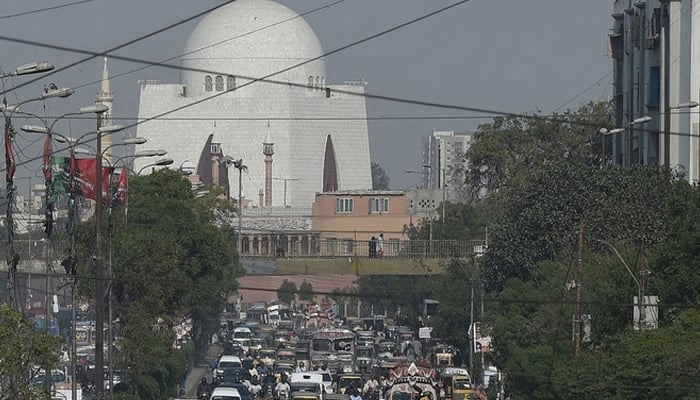
Civic sense is not a luxury. It is the basic glue that holds a city together. And nowhere is its absence more visible, more tragic and more dangerous than in Karachi today.
People often describe the city as unsafe, but this is not a comment about neighbourhoods or class. Whether you are in low-income districts or so-called ‘elite’ areas, the underlying reality is the same: broken infrastructure, open sewage drains, collapsing civic systems and a daily environment that exposes everyone to risk.
I remember going to a gym on the 14th floor of a tall mall tower in Karachi and admiring what looked like a beautiful coastal view. From above, the water glistened, mangroves stretched across the horizon and for a brief moment, the scene resembled something out of Miami. But that illusion only lasts from a distance.
A few days later, when I passed close to the same channel, barely half a kilometre away, the stench hit instantly. That glistening ‘waterfront’ was not a natural channel at all but an open sewage stream, flooding straight into the sea. The same contradiction confronts another building, home to some of the most prestigious corporate offices in the city. Tenants pay for an iconic ‘sea view’, yet what they actually overlook is sewage flowing directly into the Arabian Sea. This is Karachi’s rot displayed right at its commercial facade, a reminder that the city’s dysfunction leaks into every space, no matter how expensive the view. This is not just about aesthetics. It is about how dangerously people are forced to live.
Pakistan has the highest urban slum ratio in South Asia, as a percentage of the total urban population. Unicef reports that Karachi and Hyderabad alone contain around 1,300 slums. In these katchi abadis, families live beside open drains, toxic waste, unstable electricity wires and unregulated construction. These are permanent communities deprived of basic dignity. When people are forced to live in such hazardous environments, civic sense becomes both a necessity and a casualty. Neglect breeds further neglect. Toxic surroundings create a mindset of survival, not stewardship and the city’s condition deteriorates further.
And then tragedy strikes as it did recently in the Gulshan-e-Iqbal area of Karachi. A three-year-old girl fell into an open manhole and lost her life. A child slipped through a hole that should never have existed. No emergency service arrived in time and it took hours before her body could be recovered. The horror of this incident is almost unbearable yet somehow predictable. We mourn, we express outrage, we blame and then we return to normality until the next preventable disaster occurs. This habit of only waking up after damage has been done is destroying Karachi.
Many people have directed their anger at the city’s mayor. And of course, as the person responsible for local administration, he carries a share of responsibility. But to reduce the crisis to one individual is to ignore a decades-long failure of urban governance. Karachi’s infrastructure has been weakened for years by political fragmentation, overlapping jurisdictions, lack of maintenance and a failure to prioritise long-term planning. No mayor can repair a city structurally abandoned by multiple institutions over decades.
Recently, the city invested millions in advanced CCTV technologies. On the surface, this looks like progress toward a modern, ‘smart’ Karachi. But the logic is flawed. What good are cameras when people cannot even walk safely on pavements? Basic human safety does not stand equal to CCTV; it precedes it. Karachi did not need surveillance upgrades before it had sealed manholes, functioning drainage, stable roads and covered sewage systems. Installing CCTV in a city with collapsing basics is like upgrading your car engine while the tyres are cracked and unsafe.
True smart city planning begins by protecting people and the environment. It means infrastructure that can withstand monsoon stress, climate-induced flooding, urban heat and routine use without falling apart. Karachi, instead, is filled with thousands of open drains and manholes, any one of which can cause catastrophe. The city cannot survive on a disaster-response mentality. Once tragedy hits, the loss is already irreversible.
Yet civic sense is not the responsibility of government alone. Citizens play a decisive role in shaping the city they inhabit. Many residents dump garbage into drains, vandalise public property, break footpaths and then demand world-class facilities in return.
This contradiction is at the heart of Karachi’s decline. A city cannot flourish when its people treat public space as disposable. Civic sense means ownership: reporting hazards, respecting shared spaces, avoiding behaviours that endanger others and breaking out of the conformity that says ‘this is just how Karachi is’.
Reviving civic sense is the first step towards reviving Karachi. The city will not transform through technology alone nor through outrage after each tragedy. It will transform when citizens, political leaders and local institutions collectively refuse to accept the unacceptable. Only then can Karachi rebuild a foundation strong enough to support a safe, humane and modern urban life.
The writer is a consultant for the United Nations Office for Disaster Risk Reduction’s (UNDRR) PreventionWeb platform.