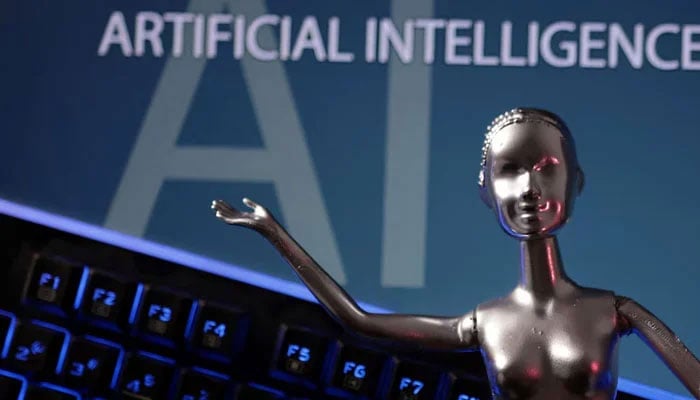
“AI can write better poetry than me lol”, my friend confessed over WhatsApp, a confession that sounded like defeat wrapped in humor.
She is a literature graduate, someone who must have spent years dissecting the anatomy of words, understanding rhythms, and savouring metaphors. So when she said it, I felt the weight of that sentence. Her lament was not just about poetry; it was about the unsettling feeling of redundancy in an age where machines mimic our most intimate expressions.
I replied instinctively, “It’s not like that at all. Art is useless”, quoting Oscar Wilde. That is, art has no utility; it exists for itself, for beauty, for indulgence. And so, nothing should bother us. But in hindsight, I am unsettled and not fully satisfied with that logic. In a way, we can let GPT learn the “art for art’s sake” approach and create haunting, eccentric poetry. After all, art, if judged on its own merit rather than by who creates it or under what conditions, remains art; a romantic poem is romantic even if written by a barbaric dictator.
For me, this impasse is easier to let go of than for her. I am an accountant by profession; my world is numbers, reconciliations and ledgers that must balance to the last decimal. Poetry, for me, is not a career or a claim to genius. It is simply a way to vent, to empty the tangled mess of emotions onto a page before they choke me from within. When I write, I am not competing with another poet, let alone an algorithm. The end is not eloquence, not recognition, but the very act of writing. The words are their own reward. (Of course, I am not asserting that those without a literature background have no claim to literature; rather, they simply have tentacles in other realms as well.)
But for her, the dilemma cuts deeper. She spent a significant part of her life studying the nitty-gritty of a craft. To wake up one day and realise that a prompt given to a bot can produce lines that look just as lyrical – if not more polished – must feel like a betrayal. What does originality even mean now? If everything has already been written in some form, and if art is just rearranging old patterns into new shapes, then is AI doing anything different from us? Maybe not. Maybe AI is the most human invention yet, because like us, it learns by imitation.
And yet, there is a difference. A bot works through extrapolation: absorbing mountains of data, identifying patterns, and predicting what comes next. A poet works on a pulse, an ache, a sudden collision of thought and feeling that no dataset can fully replicate. If someone writes something that has never been written before, not because of vocabulary but because of its emotional singularity, no machine can mimic that moment. The question is: how often does that happen? Rarely. Most art overlaps. So then what? Only art of a higher order endures, while the rest fades into the GPT-esque sea?
We can build philosophical defences all we want, but to the world at large, the debate doesn’t matter. De facto, no one cares whether an art was born of pain or produced by a predictive model – ‘the quantitatively captured average over a given contextual domain’. See the glut of AI-generated aesthetic images on social media. A University of Pittsburgh study presented participants with poems by ten renowned English-language poets – including Chaucer, Shakespeare, Whitman, Dickinson and Plath – alongside AI-generated poems in their style using ChatGPT 3.5. Interestingly, the AI poems were rated higher in overall quality than the human-written ones, contrary to previous findings.
When we read a poem, we read it for its content, irrespective of anything else. The emotional valence of Iqbal’s ‘Shikwa’ has nothing to do with his circumstances; whether he were a general in the British army or a debauched drunk, the poem would still be there to be read, cherished and savoured. Extending this logic, how can AI-written poems be rated lower simply because they were not written by a human? I don’t know.
At this point, I remember Ahmad Faraz’s couplet: “shikva-e-zulmat-e-shab se to kahin behtar tha / apne hisse ki koi shama jaaate jaate (It was better than complaining of the darkness of night / to keep lighting whatever little candles we had.) Maybe that’s all we can do – keep writing, even when the night belongs to algorithms.
There is no triumph here, no illusion of victory over machines under the dark clouds of economics, given the agility they possess. A melancholic hope for a better future, much like Faiz’s Subh-e-Azadi. Perhaps there is no way out, at least in my mind, except to accept that poetry was never about permanence or superiority. It has always been about presence, being there in that fleeting moment when a line comes to you, raw and unpolished, before the world and its comparisons rush in.
The writer is a Peshawar-based researcher who works in the financial sector. He can be reached at: [email protected]