QUETTA: Balochistan Chief Minister Sarfaraz Bugti has said that in recent years, the province has faced droughts, unusual rainfall, floods, extreme heatwaves, and other climatic irregularities, with poor and vulnerable groups being the hardest hit.
He added that 51% of households in Balochistan live below the poverty line, and 71% of the population suffers from multidimensional poverty. The provincial government has developed a comprehensive climate change policy to address these challenges, providing clear strategies for adaptation and mitigation in the energy, transport, agriculture, and water sectors.
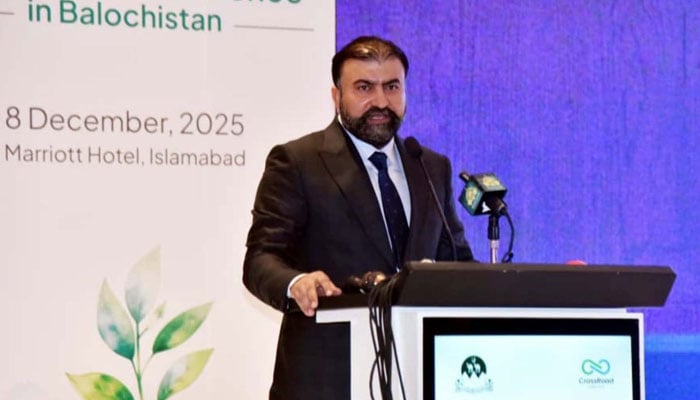
He expressed these views on Monday while addressing a symposium on “Sustainable Development and Environmental Resilience in Balochistan,” organized by the Planning and Development Department of the Balochistan government in Islamabad. Bugti said climate change is the biggest challenge facing the world today, and despite its direct and severe impacts, Balochistan is steadily progressing on the path of sustainable development. After COP30, the international community demands accelerated climate action, and for sensitive regions like Balochistan, this is both an opportunity and a responsibility.
Highlighting progress in renewable energy, the chief minister said efforts are underway to advance solar and wind energy projects to reduce dependence on fossil fuels. Measures are also being taken in the transport sector to promote electric vehicles and green infrastructure. In the agricultural sector, climate-smart practices such as conservation agriculture and agro-forestry are being promoted to enhance food security and reduce emissions. In the water sector, comprehensive strategies have been adopted for efficient management, as well as forest conservation and restoration.
He added that carbon trading presents an important opportunity for Balochistan, providing access to climate finance. The province is establishing a strong carbon market framework, identifying potential carbon projects, including blue carbon initiatives, with successful examples seen in the Sindh Delta Blue Carbon Project. The Balochistan Climate Change Fund is supporting projects that enhance adaptation, mitigation, and capacity-building in the province. Provincial recommendations for national climate targets also prioritize sustainable development, low-carbon emissions, and environmental resilience.
He urged all institutions, international partners, the private sector, and civil society to make joint efforts to tackle the climate crisis. “If we want to achieve positive goals, we must move forward together,” he said, emphasizing collective action for a sustainable, secure, and environmentally resilient future for Balochistan.
Congratulating the organizers on the successful symposium, he hoped that continued collective efforts would lead to effective measures in addressing the challenges posed by climate change.