For a brief moment, people around the world witnessed an unexpected scene in Gaza: a mass wedding involving more than 50 couples in the middle of a shattered landscape.
Young families gathered to celebrate against a backdrop where almost nothing feels stable, and the images spread widely because they suggested that some part of ordinary life could still be reclaimed.
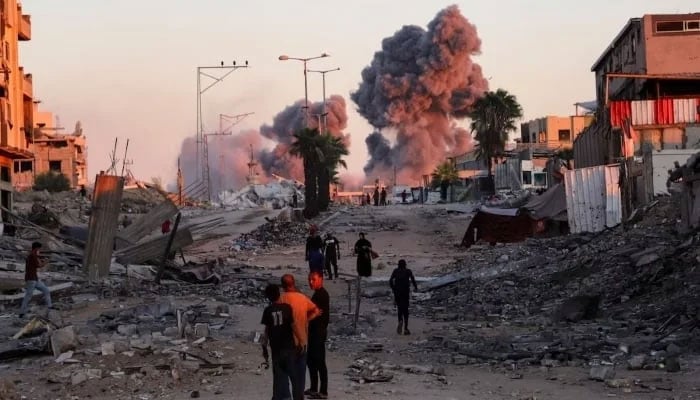
The ceremony took place during a period in which over 600 Palestinians had been killed despite the declared ceasefire, with violations being recorded almost daily. Only a short distance from the wedding, mass graves were being prepared, bodies were being recovered from collapsed structures and families were still trying to identify those who had not survived. Children were being buried even as the wedding celebrations continued.
That contrast captured the deeper truth of Gaza’s current reality. Life continues because people insist on holding onto hope, yet the violence persists in parallel. The international community has chosen not to confront this contradiction and continues to describe the situation as a ceasefire, despite evidence that contradicts that claim.
Governments continue to describe the situation as a ceasefire even though the facts do not support that claim. Violations have been recorded repeatedly. Humanitarian obligations remain unfulfilled. Civilians continue to be harmed. Many states prefer this language because acknowledging the full reality would require them to confront decisions they are unwilling to make.
The use of terms such as ‘pause’ or ‘de-escalation’ allows governments to stay quiet even when the actions taking place are inconsistent with those descriptions. They receive detailed reports from their own agencies and know exactly when aid is blocked, when strikes occur and when agreements are ignored. The silence that follows this knowledge is a deliberate political choice.
This silence weakens the idea that humanitarian law has universal application. It signals that commitments to protect civilians are subject to geopolitical considerations rather than principle. It diminishes the credibility of international institutions because it suggests that enforcement is selective and inconsistent. The harm extends beyond Gaza to the entire system that claims to govern conduct during conflict.
Hopeful images from Gaza often create the impression that life is stabilising, but they do not reflect an easing of the crisis. They reflect a decision by ordinary people to preserve dignity in the middle of loss. Their celebrations, however meaningful, should not be interpreted as signs of normalcy or used to soften the reality they continue to endure.
The reluctance to confront Israel’s actions has created a situation where violations continue without consequence. Diplomatic language has replaced diplomatic action. Statements that praise restraint or urge both sides to de-escalate appear even when the imbalance of force is clear, and in many cases seem designed to avoid discomfort rather than reflect reality.
The cost of this approach is significant. It erodes the belief that the international system is capable of treating all parties equally. It signals to vulnerable populations that they cannot rely on the institutions that were meant to protect them. It leaves ordinary people to navigate crises alone while governments prioritise political relationships over principle.
The people of Gaza continue to create moments of celebration while also preparing graves for those who did not survive. Their ability to find meaning under such conditions is remarkable, but it should not obscure the severity of what they continue to face.
The world has rarely lacked expressions of sympathy. What it lacks is the willingness to translate sympathy into accountability. The silence surrounding repeated ceasefire violations is not a technical oversight but a reflection of political expediency. It allows governments to maintain relationships, avoid confrontation and move on.
The question is not whether Gaza has hope. It does. The question is whether the international community has the integrity to acknowledge what is happening and the willingness to address it honestly.
The mass wedding and the mass graves exist side by side, one reflecting the effort to preserve life and the other revealing the consequences of a conflict that continues without accountability. These realities require candour, not neutrality disguised as silence.
The situation in Gaza is not ambiguous. The information is available, the violations are documented, and the humanitarian costs are visible to the world. What is missing is the political will to respond honestly. Governments have access to real-time reporting from their own agencies, yet they continue to frame this period as a functioning ceasefire despite evidence that contradicts their public statements.
If the international community continues to prioritise diplomatic comfort over accountability, then the principles it claims to defend will remain largely theoretical. Gaza is living the consequences of that gap every day, and the responsibility for narrowing it lies with those who have chosen not to confront the facts or the obligations they routinely demand of others.
The writer is a non-resident fellow at the Consortium for Asia Pacific & Eurasian Studies. He tweets/posts @umarwrites