I normally write about events once they have taken place or are at least in progress; it feels safer that way, more empirical and less speculative. One observes, analyses and reports. But every so often, an idea surfaces that demands articulation before it materialises, because its very success depends on timely awareness and collective support.
The forthcoming Water Festival 2025 in Jamshoro, scheduled for Saturday, December 13, is one such effort. It must be written about before it happens, for festivals of this nature do not thrive on applause afterwards – they survive on encouragement, participation and goodwill beforehand. And in a province sitting anxiously on the edge of water scarcity, hesitation is a luxury we can no longer afford. “Thousands have lived without love, not one without water", wrote W H Auden in 1957. It is a line quoted so frequently that it risks becoming furniture.
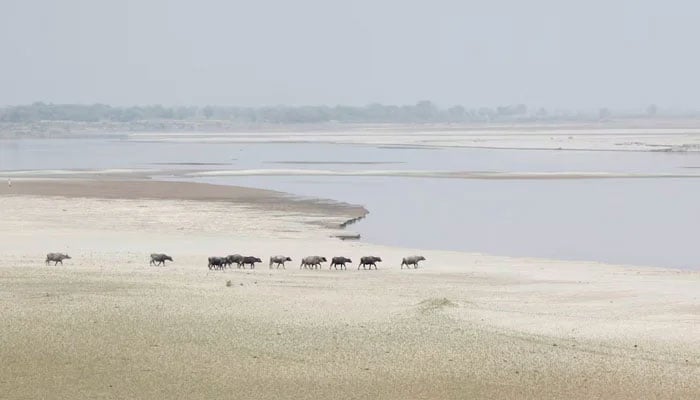
Yet in Sindh, where the Indus River shaped one of humanity’s earliest civilisations and irrigated centuries of agricultural wealth, the truth behind Auden’s remark carries the weight of impending crisis. Civilisations that believe themselves eternal seldom recognise the moment when abundance begins its slow transformation into anxiety. For Sindh, that moment has already arrived. Ironically, the idea for this festival did not emerge from a country facing droughts or collapsing agricultural yields, but from Sweden – a nation with lakes so numerous they are almost taken for granted, with rainfall, snow and water storage systems any South Asian government would envy.
Between 1991 and 1999, Stockholm held an annual Water Festival to draw public attention to the centrality of water, even in a country that seemed to have enough. If the Swedes could celebrate water to avert complacency, surely Sindh must foreground water to prevent catastrophe. Our region, historically one of water’s most blessed, now feels the tension that Sufi poets understood generations ago when they warned that life hangs precariously above the elemental necessity of water: “morraa mathi jhoopar ai paani.” Their imagery was ecological realism expressed in verse.
In Pakistan, water discourse is usually triggered only by conflict: provincial disputes over river shares, tanker mafias in cities, farmers arguing for canal releases, or environmentalists lamenting the shrinking Indus Delta. Rarely do we create civic spaces where water is examined collectively. The Water Festival 2025, to be held on December 13 at the M H Panhwar Institute of Sindh Studies in Jamshoro, seeks precisely this: an independent, citizen-led effort to bring water to the centre of public conscience before demographic pressures, climatic shocks and political inertia push Sindh into a fully water-stressed state.
The purpose of the festival is as straightforward as it is urgent. It is an attempt to remind policymakers and the public alike that if we fail to protect our water sources, we condemn not only ourselves but our coming generations to irreversible damage. In a country where short-term thinking dominates governance and where crises accumulate faster than solutions, water remains the one challenge that cannot be postponed. The festival seeks to foster informed discussion about how water is used, misused and extravagantly wasted across sectors.
Pakistan’s agricultural sector consumes the vast majority of the nation’s freshwater, yet remains one of the world’s least efficient users of irrigation. Urban centres fare no better. Cities like Karachi and Hyderabad operate with a combination of leaking pipelines, groundwater depletion, tanker monopolies and insufficient wastewater treatment – all under the loose oversight of municipal authorities that neither regulate nor reform. Overlay this with pollution from industries, sewage outfalls and plastic dumping, and the Indus carries more contaminants than any major river in the region except perhaps India’s Yamuna.
Then comes the tragedy of the Indus Delta, once a thriving ecological zone and now a fragile, saline stretch where freshwater rarely reaches the sea, mangrove forests retreat and communities lose both land and livelihood. To address this sprawling crisis, the festival is crafted around themes that capture the essential pressures on water in Sindh: agriculture, municipal use, pollution and the dying delta. These themes offer a framework not for academic lamentation but for pragmatic debate. They ask, for example, why Pakistan continues to subsidise water-intensive crops in arid zones, why urban water governance has been outsourced to truck operators, why industrial polluters escape accountability, and why delta communities are treated as footnotes to national water policy.
These are questions that every democratic society should be able to ask without fear of institutional sensitivities. Yet donor-driven conferences, government-funded summits and corporate-sponsored dialogues often avoid such bluntness. Which brings us to one of the most notable aspects of the Jamshoro festival: its intentional independence. Unlike many initiatives in Pakistan’s development sector, this festival will not seek funding from government departments, international agencies or corporate patrons. Independence is not an ideological stance here but a strategic one. The organisers believe that speaking freely about water – its mismanagement, inequitable allocation and politicised administration – requires insulation from the preferences of institutional funders.
A festival free from financial strings can afford criticism that is respectful but honest, logical but uncompromising. To sustain this independence, a modest sum of Rs2 million to Rs2.5 million is being raised from around 20-25 individuals, each contributing Rs100,000. In a time when development consultancies regularly spend more on a single workshop at a luxury hotel, this transparent, low-cost model seems refreshingly principled. The funds will support a one-day programme at the M H Panhwar Institute of Sindh Studies in Jamshoro, a venue chosen as much for its intellectual heritage as for its location.
M H Panhwar’s scholarship on Sindh’s agricultural and hydrological history is foundational; hosting a festival about water on the grounds of an institute bearing his name feels almost necessary. The schedule, stretching from morning to late evening, will combine deliberations with theatre, raag and art. Such integration reflects an important truth: data alone rarely moves societies, but culture often does.
Organised by Dr Bhai Khan Shar, Ghulam Sarwar Panhwar and Niranjan Rajani from MHPISS, under the leadership of Dr Ziauddin Abro of MUET, the festival brings together scholars, practitioners and citizens who understand that addressing water scarcity requires more than technical fixes. It requires changing the narrative – moving from crisis-driven commentary to proactive stewardship. Pakistan often waits for disaster before acting; this festival insists on the opposite. It is a collective reminder that preventing a catastrophe is far less costly than recovering from one. Critics may argue that a festival cannot fix canal leakages, reform irrigation policy or reverse delta degradation.
And they are right. A single day cannot amend water law, restructure agricultural incentives or cleanse industrial effluents. But festivals do something quieter and perhaps more profound: they shift public vocabulary. They enable citizens to speak about water with ownership rather than fatalism. They connect disparate experts who rarely share a room – hydrologists, farmers, artists, policymakers, students. They introduce terms like ‘water equity’, ‘delta restoration’, ‘sustainable withdrawal’, and ‘urban efficiency’ into civic discourse. And sometimes, this shift in vocabulary precedes a shift in policy.
In a country where intellectual spaces often mirror donors’ desires more than the public’s demands, a voluntarily funded water festival signals that citizens can take responsibility for issues that governments have consistently mismanaged. It asserts that civic imagination, not donor agendas, should drive conversations about the Indus, its tributaries and its future. Support for the festival, therefore, is not merely financial – though financial support is needed and deserved. It is also moral and participatory. Those who believe water is the defining challenge of Pakistan’s next decade must demonstrate that belief not only through commentary but through contribution.
Supporting the festival is, in a sense, supporting the idea that Sindh still possesses the political will, intellectual humility and civic creativity to avert a crisis long foretold. Writing now – before the banners are raised, before the speakers are confirmed, before the rehearsals of raag and theatre begin – is necessary. If the festival succeeds, it will do so because people believed in it early, not because they praised it afterwards. The Indus cannot wait for hindsight. It requires foresight, commitment and philanthropy in the most literal sense: the love of humanity ensured by the protection of its most essential element.
Auden was correct. Love can be postponed; water cannot. Sindh, cradle of riverine civilisation, must now decide whether it wishes to protect the very element that made civilisation possible. And that decision begins with supporting the Water Festival 2025.
The writer holds a PhD from the University of Birmingham, UK. He tweets/posts @NaazirMahmood and can be reached at: [email protected]