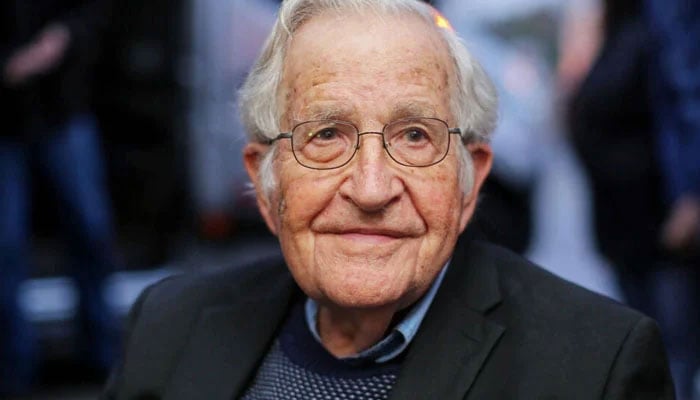
Noam Chomsky, the world’s foremost public intellectual, is 97 years old today (December 7). He has fallen silent since June 2023 as a result of a massive brain stroke, which rendered him unable to speak or write. What would he make of the sorry state of our world today? We have a fair idea because of the range and volume of his intellectual output. In every age, there have been sages who merit being called the conscience of their age. Such a one was Bertrand Russell during the first half of the 20th century. For most of the second half of the last century and the beginning of the present one, Noam Chomsky has been another.
To call Chomsky a polymath would be an underestimate. He is the father of modern linguistics and an authority on a whole range of scientific disciplines. But his fame over the past six decades has been largely due to his rigorous fact-based rational analysis of international relations and the state of the world. In particular, he has focused his talks and writings on the foreign policy of the US as determined by its corporate capitalist priorities which are asserted through the ‘manufacture of consent’ at home and the use of force, fraud and sanctions abroad.
His writings on Vietnam, Latin America, the Middle East, the politics of the US, the foreign policy of the US during and after the cold war, the human-made challenges facing mankind, the ‘vile maxims’ of corporate capitalism that provide the foundation for US militarism and global hegemony at the expense of global survival, etc are essential reading for anyone aspiring to be a credible and useful citizen of a world in trouble.
Norman Finkelstein, a younger and hugely respected American public intellectual, has justly called Chomsky “a stupendous force of nature” and “an indefatigable force for good”. He notes how ordinary people listened to Chomsky for hours on end because of the captivating rationality, humanity and ironic humour of his discourse backed by an inexhaustible range of facts and arguments.
The amount of time he spent in reading and answering emails from students and ordinary people all over the world was a constant source of amazement to his colleagues, given how busy a schedule of engagements, meetings, lectures and travels abroad he maintained – not to mention the approximately 150 path-breaking books he authored and the countless seminal articles he wrote.
It is no exaggeration to say that a minimal familiarity with the works of Noam Chomsky is a prerequisite for a proper understanding of the state of our world today, the existential challenges it faces, the obligations of public intellectuals who influence public opinion, and the attitudes and approaches one might usefully adopt to address, mitigate and hopefully overcome these challenges.
At no time, despite the profundity of his analyses and vast command of relevant facts, does Chomsky presume to have all the answers to the burning questions of today. He does not seek to convince or change anyone’s views and opinions other than to express his own which are based on his relentless study and investigation of the existing corpus of learning and literature on the subject he discusses. He offers opinions in the hope they may be of some use to those committed to addressing contemporary challenges facing humanity, which specialists and scientists overwhelmingly agree threaten human civilisation like never before.
There is a moral urgency in the wisdom Chomsky communicates that might yet be the saving of the world. He follows in the footsteps of Western intellectual sages and savants before him, like Socrates, Aristotle, St Augustine, St Aquinas, Descartes, Spinoza, Hume, Kant, Goethe, Karl Marx, Bertrand Russell, Gramsci and Albert Camus. He has inspired a generation of younger public intellectuals the world over such as Howard Zinn, Edward Said, Eqbal Ahmad, Norman Finkelstein, Jeffrey Sachs, Richard Wolff, Ilan Pappe, Arundhati Roy, Yanis Varoufakis, Vijay Prashad and countless others. Undoubtedly, they will carry forward the task of challenging and intellectually combating the evils of arbitrary and corrupt governance that threaten to make the 21st century the last for human civilisation as we have known it for the past ten thousand years.
Unfortunately, the 21st century has apparently got off to the very worst start possible, which makes the task of this generation of public intellectuals so much more challenging and indispensable. Chomsky’s views on the responsibilities of the intellectual have, accordingly, become more urgent than ever, given the survival stakes involved and the emergence of so many fake and pro-establishment intellectuals who infest the global and national media on behalf of entrenched interests that refuse to prioritise the survival of mankind.
I have personally had the pleasure and privilege of meeting Chomsky for the first time in New Delhi and subsequently at his home outside Boston in the US. His modesty, learning and, more than anything, the way in which he sought to learn from my views rather than teach or preach his own, made me aware of the rare privilege of being in the presence of a moral and intellectual world treasure. Unfortunately, only a few of his writings have been translated into Urdu, whereas our younger generation needs access to much more of his work to equip them to meet the ever-increasing challenges that will define their futures. However, it may be a forlorn hope to expect our decision-makers to give any priority to such a project. It is also symptomatic of the world we live in that the Nobel Peace Prize Committee has never thought fit to recognise the services to peace of Chomsky.
In conclusion, may I presume on behalf of my compatriots, including our readers, to extend through your columns birthday greetings to Noam Chomsky and to thank him for being with us and devoting his life to showing us the way towards a better and safer world despite the challenges besetting it.
The writer is a former ambassador to the US, India and China and head of UN missions in Iraq and Sudan. He can be reached at: [email protected]