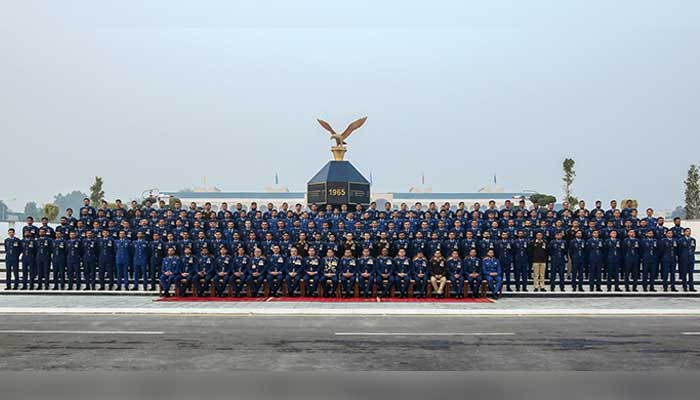
I was invited to the PAF’s Passing Out Parade on December 2, 2025, at the Pakistan Air Force Academy Asghar Khan. This was the first occasion on which the Chief of Air Staff, ACM Zaheer Ahmed Babar Sidhu, went on air after the May 2025 war. In his address, he apprised the nation of the actual happenings and the PAF’s contributions.
The speech was a fitting tribute to the PAF, celebrating its historic and decisive May 2025 victory that overwhelmed the adversary. He appreciated the military leadership and the well-executed tri-service synergy, especially the leadership of COAS Field Marshal Asim Munir, for making the bold decision to take on the Indians.
Several key points stood out in ACM Zaheer Ahmed Baber Sidhu’s speech. He emphasised the holistic and all-encompassing training received by cadets at the PAF Academy, describing a paradigm shift towards future-focused technological interfaces. The training places equal emphasis on character, leadership, intellectual prowess, mental resilience and physical robustness. It aims to develop human resources capable of operational orientation and of fighting outnumbered. The PAF’s training has evolved in line with a battlespace shaped by emerging technologies and an increasingly complex global and regional environment.
Within this context, ACM Baber Sidhu reiterated the enemy’s ill intent to undermine Pakistan’s sovereignty, as seen during the May 2025 war. He attributed the success of Marka-e-Haq to the PAF’s execution of a full-spectrum multidomain operation that integrated elements of space, electronic warfare, cyber, long-range vectors, killer drones, unmanned aerial systems and loitering munitions.
When the adversary breached Pakistan’s sovereignty on the night between May 6 and 7, the PAF upheld its legacy of fighting an outnumbered aggressor. The world witnessed the flawless execution of the PAF’s game-changing shift from a defensive to an offensive posture, unleashing its firepower and resulting in one of the largest BVR air battles of modern times. The enemy’s most advanced aircraft were shot down: four Rafales, one Su-30MKI, one Mirage-2000, and one Mig-29. This hour-long engagement is now being studied worldwide as a textbook MDO execution in one of the most intricate BVR-versus-BVR battles of modern aerial warfare, forcing the enemy’s skies into silence for the rest of the war.
ACM Baber Sidhu also highlighted the unified tri-service operation spearheaded by the PAF that delivered a decisive and paralysing blow to the enemy. Operation Bunyanum Marsoos was launched at dawn on May 10 and struck 34 adversarial targets, including more than 18 bases and ground assets deep inside enemy territory from north to south. India’s supposed game-changer, the S-400 at Adampur and Bhuj, was neutralised along with the Beas BrahMos storage, Brigade Headquarters, Command and Control centres and Field Supply depots.
The PAF’s evolution into an operational ecosystem was demonstrated throughout the May 2025 war, with every member showing professionalism and diligence. Its competence and exemplary performance spoke for itself through undeniable evidence.
The Air Chief noted that the PAF had the capability to inflict further damage but chose restraint in line with its strategic culture and ethos, which do not equate strength with unnecessary escalation. Instead, the PAF focused on ensuring peace with honour. Its calibrated and balanced actions reinforced its professionalism and superiority across all domains and showed that its claims were based on honesty and hard facts.
The PAF’s success in Marka-e-Haq resulted from a comprehensive indigenisation and modernisation strategy that transformed the PAF from a fighter-centric to a domain-centric air force. Credit for this paradigm shift goes to the air chief, who recognised the changing character of war and introduced a transformation plan based on indigenisation. Operational doctrine, concepts and strategies were realigned while considering fiscal constraints and available technologies. Despite limitations, the PAF pursued an aggressive, innovative, and practical modernisation strategy through smart inductions, including advanced combat and support capabilities such as the J-10 and the PL-15 BVR missile, as well as niche technologies operationalised in record time.
The air chief highlighted that NASTP forms the core of PAF’s MDO strategy. As a national-level enterprise, the NASTP has invigorated Pakistan’s aerospace ecosystem by driving rapid prototyping, seamless system integration, and deployment of homegrown kill-chain technologies. It has also paved the way for Pakistan to become an exporter of indigenous technologies. The battle-tested JF-17, sold to Nigeria, Myanmar and Azerbaijan, is a prime example, with two more countries engaged in acquisition talks.
The NASTP enabled the successful execution of a homegrown kill chain consisting of EW and space assets, unmanned systems, and cyber capabilities, all indigenously developed in record time.
Looking ahead, ACM Baber Sidhu stressed that the PAF remains focused on preparing for future challenges. He reiterated that Pakistan is a peace-loving country, but when its sovereignty is challenged, its adversaries will find its armed forces stronger and fully prepared to defend the nation.
Following Marka-e-Haq, Pakistan has emerged as the net regional stabiliser in South Asia. As a responsible nuclear state, its relations with global and regional powers have grown stronger. This was evident from the defence dignitaries visiting Air Headquarters to discuss expanding defence cooperation and military training with ACM Baber Sidhu.
The air chief’s speech was a powerful reminder of the PAF’s unwavering professionalism and evolving strength. It reaffirmed its commitment to protecting the ideological, aerial, and geographical frontiers of the country through selfless service and dedication.
The writer is president, Centre for Aerospace & Security Studies (CASS), Lahore.