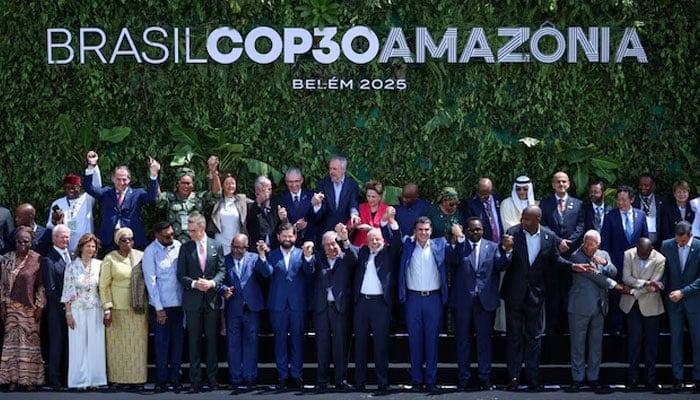
At COP30, delegations from 194 countries that had gathered in Brazil reached an agreement that fell short of expectations and the urgency of the climate crisis. The deal calls for increased funding to help nations adapt to climate change, but fails to establish a plan to phase out fossil fuels, the main driver of global warming.
The world’s historic emitter and top economy declined to send a formal delegation, as US President Trump declared global warming a hoax. According to three sources familiar with the closed-door talks, a representative for another large oil country told delegates in the final hours of negotiations that any language in the accord targeting its oil industry risked collapsing global consensus.
Unfortunately, previous conferences and agreements have also not produced any meaningful change in the real situation. Developed and oil-producing countries seem to be following a policy of prioritising the protection of their economic interests. Their approach of unsustainable industrialisation, deforestation and continued industrial production in traditional ways is hindering the implementation of environmentally friendly agreements worldwide.
More than 100 countries worldwide want to stop plastic production, while some oil-producing countries favour focusing solely on measures to reduce plastic production. China, Saudi Arabia, the US, India and South Korea are the five main countries that produce the most plastic (polymer). Despite efforts to reduce plastic production, its output is increasing rapidly. In fact, it is estimated that plastic production will triple by 2050. Plastic pollution, or microplastics, is now found in the air, water, food and even breast milk, containing more than 3,200 harmful chemicals.
Now it’s clear that the priority of the countries historically responsible for the highest carbon emissions is protecting their economies rather than limiting carbon emissions and thereby reducing the severity of climate disasters that are causing hunger and poverty around the world. These countries see this situation through the lens of their commercial interests. Perhaps that is why, until carbon emissions reduction becomes profitable – as they want – sustainable production cannot be ensured, even with the availability of alternative energy sources.
The main source of carbon emissions, fossil fuels, accounts for about 68 per cent of global greenhouse gas emissions and about 90 per cent of carbon dioxide emissions. Greenhouse gas emissions across sectors and industries in 2021 show that the largest share – 75.7 per cent – is from energy production.
Among the countries that use the most energy, China comes first, the US is second and then India. Renewable energy accounts for only 30 per cent and nuclear energy for 9.0 per cent. The countries that use and produce the most fossil fuels are not only unprepared for an apparent change in trade and environmental policies but are also causing further increases in electricity production through fossil fuels.
The growing use, development and innovation of artificial intelligence are directly related to carbon emissions and the environment. This technology relies heavily on electricity and water. There are an estimated 9,000 to 11,000 data centres worldwide, with more under construction. According to the International Energy Agency, data centre electricity consumption, which was 1,000 terawatt hours in 2022, will double by 2026.
Pakistan is among the countries severely affected by global warming or the increase in temperature. This increase is due to changes in rainfall patterns, increased snowmelt and the rise in the intensity of weather disasters across the country. The annual average temperature in Pakistan has increased by 0.71 Celsius. In Sindh and Azad Jammu and Kashmir, this increase was about 1 Celsius.
Depending only on aid or loans for climate change solutions and biodiversity conservation seems incapable of eliminating or reducing the increasing climate extremes and crises in Pakistan, at least in the near future, because the global factors of these impacts are in place, but some of the responsible factors for this emergency facing Pakistan are purely local.
Since the 2015 Paris Agreement, the impression has been strengthened in Pakistan that all the impacts of climate change are solely due to carbon emissions and global warming. Of course, global warming and carbon emissions are important factors, but if we focus on the fundamental factors of protection from these effects or reducing their intensity – such as forests, wetlands, sustainable land use, sustainable waste management and the protection of water resources – it is possible to reduce the effects of climate change.
The practice of covering up our shortcomings at the local level by declaring climate change and carbon emissions as the main problem is giving rise to social and economic crises across the country. Deforestation, encroachment on riverine lands, lack of technology and resources to control forest fires and pollution of water resources require sustainable planning on an emergency basis, but the ground realities paint a sombre picture.
The use of forests or agricultural lands for profitable commercial and residential projects continues. The World Wide Fund for Nature (WWF)-Pakistan has identified several locations along the Karachi coast where mangroves have been cut down for residential, commercial and industrial projects.
The lack of sustainable waste management is responsible for polluting resources such as land, lakes, mountains and seas. Rivers, irrigation canals, lakes, and seasonal waterways, which serve as safe drainage during the rains, have become fatal to the health, lives, property and livelihoods of the people due to poor management. The mixture of human, industrial and agricultural waste in all water resources is affecting every Pakistani and the ecosystem, from Gilgit to Karachi.
Pakistan’s share in the world’s total production is only 0.3 per cent, but its groundwater discharge accounts for 9.0 per cent of the world’s total discharge. Ninety per cent of water is used in agriculture, and 50 per cent of that is wasted (PCRWR) due to traditional irrigation methods and the lack of maintenance of irrigation systems. It is a contradiction in policy – or the policy itself – that estimates of severe water shortages are being presented in the country while there is no significant plan for large-scale reforms in the irrigation system.
Instead of relying solely on international forums and agreements, aid and grants, the sustainable management of natural resources should be ensured to address environmental threats. Of course, this process, with public participation through systematic planning, can help reduce environmental problems in the country.
The writer is associated with the Institute of Historical and Social Research (IHSR).