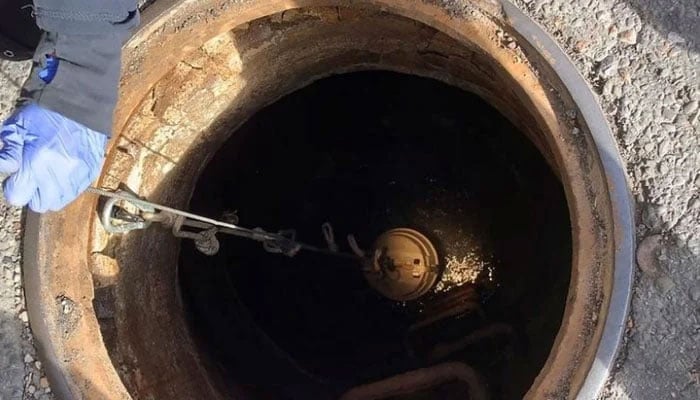
On a late night this past Sunday near Nipa flyover in the Gulshan-e-Iqbal area of Karachi, three-year-old Ibrahim did what children all over the world often do. He slipped from his father’s hand as he was exiting a department store and started running ahead. In any functional society, no parent should have to fear that this could lead to their child’s death. But, this was nighttime in Karachi and, most tragically, Ibrahim joined the long list of children who fall into open manholes and lose their lives. Solving this problem is as easy as putting a lid on a hole, but this appears to be beyond those who run Karachi and many of the other major cities of Pakistan. The fact that incompetent governance has left who-knows-how-many open death traps all across the city is bad enough, but the tragedy of Ibrahim revealed even more familiar but no less damning shortcomings. After Ibrahim fell, residents immediately called local authorities but official help would only arrive the next morning, nearly 12 hours later. In the meantime, local residents arranged a crane on their own, paying for the vehicle and its diesel, and began digging, while volunteers from Edhi and Chhipa also assisted.
Sadly, these souls who embodied everything that those in charge lack did not have the technical expertise needed to locate the child. When those who did have the expertise finally decided to do their jobs the next morning, Ibrahim’s body was found 1.5 kms downstream in a drainage channel. While cases like this are not uncommon in Karachi or even other cities in Pakistan, what happened to Ibrahim has struck a nerve. While many people have taken to social media to lament the state of the city, opposition members have led protests and called for the mayor’s resignation. Legal action is also being taken, with cases being sought against city officials. Meanwhile, a Karachi Metropolitan Corporation (KMC) report has pinned the blame on the Red Line Bus Rapid Transit (BRT) project and the department store administration, while the BRT has said the incident took place at a considerable distance from the BRT construction area.
Many different individuals and parties have had a crack at running Karachi over the past three decades and they have all failed in the same way. Wiser minds would realise that Sindh’s highly fractious politics, often pitting rural against urban, are actually a big part of the problem and systemic change would actually require the PPP, MQM-P, Jamaat-e-Islami and all other parties in Sindh to get on the same page for once. That being said, it is the PPP that is in charge and its best defence for Karachi’s abysmal governance is that others have done no better. While the mayor has ordered an enquiry and the provincial government has formed a committee to investigate the incident, it all seems too little too late. While steps like the Rs25 billion package to rehabilitate the city’s roads are encouraging, Karachi’s residents have become used to seeing roads repaired and manholes covered, only to revert to their original state a few months later. Periodic packages are not what is needed; that would be consistent maintenance. And that requires consistent revenue, which, in turn, would likely require a functional local government. The party that, rightly, spearheaded the devolution of powers to the provinces should be able to see that a city as large as Karachi requires the same.