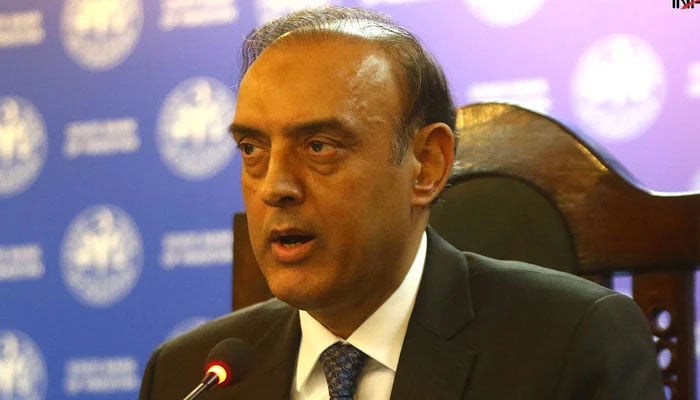
KARACHI: Governor of State Bank of Pakistan Jameel Ahmad has said that co-badged cards are gaining traction in Pakistan’s digital payments sector, enabling users to make international and e-commerce payments seamlessly, enhancing efficiency and reducing reliance on external networks.
Ahmad made these remarks at the launch ceremony of the new co-badge debit card introduced by Faysal Bank Limited in collaboration with Mastercard and Pakistan’s national payment scheme, PayPak, according to a statement released on Tuesday.
He said the co-badging initiative would further strengthen Pakistan’s digital payments landscape. The event marked a key milestone in the country’s journey towards a secure, efficient and self-reliant digital payments landscape.
The SBP’s governor noted that, through this initiative, consumers will be able to make international and e-commerce payments seamlessly, while domestic transactions will be settled within Pakistan, thus enhancing efficiency and reducing reliance on external networks. He described the newly launched co-branded card as a ‘win-win’ financial product that offers convenience to customers and strengthens the national payments infrastructure.
Today’s launch follows the introduction of the PayPak-UnionPay co-badged card last month, reflecting a growing trend where Pakistan’s domestic payment scheme is forming strategic alliances with global payment giants, Ahmad said.
He expressed confidence that more banks would adopt similar models due to the strong value proposition these collaborations offer.Highlighting the evolution of PayPak since its inception in 2016, he recalled that it was designed to provide an affordable, secure, and localised payment solution for a growing digital economy. While PayPak currently commands over 25 per cent of the 53 million debit cards in circulation, its usage share remains at 6.0 per cent. He attributed this gap to challenges such as limited acceptance on e-commerce and international platforms, modest marketing efforts, and the perception of PayPak as a low-value card.
The central bank governor stressed the importance of addressing these constraints to establish PayPak as a sustainable and competitive scheme. He appreciated recent efforts, including marketing campaigns, co-badging arrangements, and integration with e-commerce gateways -- steps that he believes will significantly strengthen PayPak’s value proposition. He also urged 1Link to adopt a long-term strategy focused on investments in technology, fraud detection, cybersecurity, dispute resolution, and incentives for merchants and consumers. Such measures, he said, are essential to build trust and accelerate the adoption of the national payment scheme.
Reaffirming the SBP’s commitment to developing a robust and inclusive digital payments ecosystem, the governor underscored the importance of a regulatory framework that promotes innovation, competition, and consumer protection. He reiterated the SBP’s resolve to ensure a level playing field for all stakeholders, including international payment schemes, as Pakistan advances toward a secure, interoperable and self-sustaining payments infrastructure.
Speaking at the occasion, Yousaf Hussain, president and CEO of Faysal Bank, said that the co-badge debit card is another industry-first product, similar to the bank’s flagship Noor card, the only Sharia-compliant credit card available in the market.
“This milestone reflects the growing strength of our domestic payments ecosystem, the value of collaboration between local institutions and global partners, and our commitment as a bank and as a wider industry to provide customers with secure, modern, internationally accessible digital payment solutions as envisioned by the State Bank of Pakistan,” Hussain said.