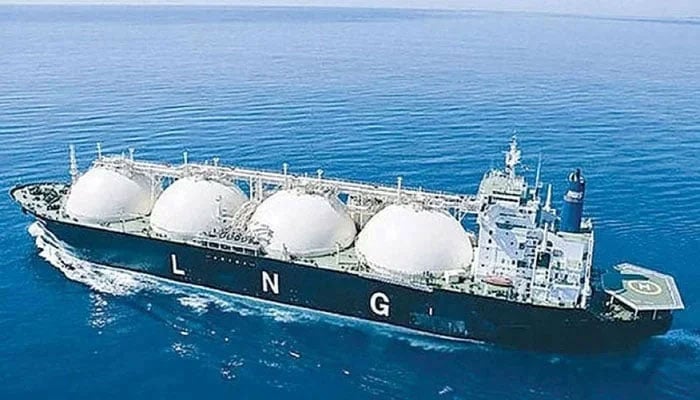
ISLAMABAD: After months of uncertainty, Pakistan has finally approved the much-awaited Annual Delivery Plan (ADP) for 2026 with Qatar and the Italian trading firm ENI — clearing the way for diversion of 35 LNG cargoes to international market. The move marks a significant step toward easing Pakistan’s growing gas surplus and stabilising a transmission system strained by falling demand.
A senior Petroleum Division official told this correspondent that Qatar will divert 24 of 29 cargoes requested by Pakistan under the non-performance delivery (NPD) clause in its long-term agreements with Pakistan.
Under the NPD clause, if a diverted cargo fetches a higher price in the international market than Pakistan’s term contract rate, all profits go to Qatar. However, if the cargo sells below the term price, the loss must be absorbed by Pakistan State Oil (PSO). ENI, meanwhile, will divert 11 cargoes under a negotiated settlement with Pakistan LNG Limited (PLL). Under the settlement with ENI, if a cargo is sold out higher than term price, profit will be shared and if sold at lower price than term rate, the loss will also be shared. The government has also decided that it will not absorb any losses arising from the diversion of cargoes under the NPD mechanism. Any loss from low-priced international sales will be passed directly on to RLNG consumers. This includes RLNG-based power plants, export-oriented industries, the CNG sector and domestic consumers who are supplied RLNG-based connections. Authorities have made clear that neither the state nor Pakistan State Oil (PSO) will shoulder the burden of reduced sale proceeds.
“This is how the total of 35 LNG cargoes will be diverted,” the official said, adding that even after these adjustments, Pakistan will still be left with 13 surplus cargoes in 2026 due to a dramatic decline of over 400 mmcfd in national gas consumption. The government had initially been bracing for 48 extra cargoes in 2026, but the successful diversion of 35 cargoes is expected to provide a major financial cushion. Based on average cargo term price of $30 million, Pakistan stands to save nearly $1.050 billion in foreign exchange. More importantly, the reduced LNG inflow will allow the authorities to re-inject locally produced gas—long curtailed because of high line pack pressure in national gas transmission and distribution network. This will enable consumers to receive system gas at around Rs1,000 per MMBTU, instead of relying on expensive RLNG priced close to Rs3,500 per mmbtu. Although, the restoration of local gas will not eliminate curtailment entirely, it will substantially reduce it—from the current 310 mmcfd to nearly 100 mmcfd next year. The underlying problem persists: Pakistan’s binding commitments require it to import 120 LNG cargoes annually—108 from Qatar and 12 from ENI—even as the country’s demand for imported gas has plunged sharply due to lower GDP growth and high input costs for the export sector. Pakistan imports 10 LNG cargoes per month (5 cargoes at 13.37 per cent of Brent, 4 at 10.2 per cent of Brent and 1 cargo from ENI at 12.14 per cent of Brent). According to the Petroleum Division, the ENI-PLL agreement is becoming a major source of relief for the gas network as well as the national exchequer. Between 2025 and 2027, the arrangement is expected to generate $880-900 million in combined savings and profit. So far in 2025, 11 ENI cargoes have already been diverted, saving Pakistan $300 million in import costs and yielding $45 million in shared profits. For 2026, ENI is expected to divert another 11 cargoes, saving around $230 million and generating $45-50 million in additional profit. A further 10 diversions planned for 2027 are projected to earn another $290-300 million, completing the three-year financial windfall.