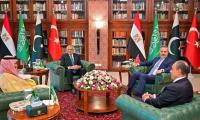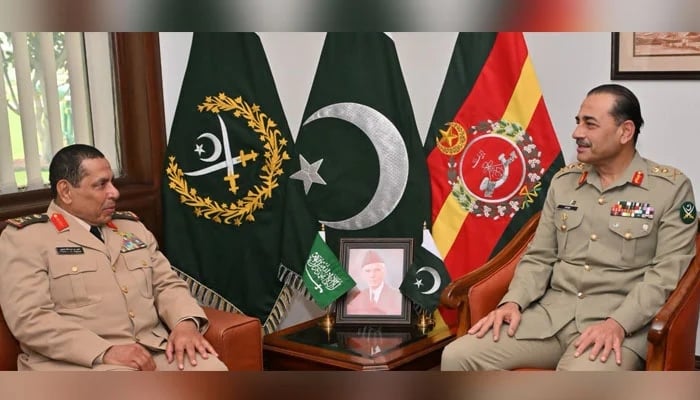
Pakistan’s diplomatic and security landscape entered a new phase this past week as Islamabad hosted two significant high-level delegations: the Saudi chief of general staff and the secretary of Iran’s Supreme National Security Council.
Their simultaneous presence in Pakistan was not coincidental. It reflected a moment in which Pakistan’s regional relevance has become pronounced. The engagements took place against a backdrop of shifting regional dynamics, unresolved conflict theatres and newly emerging alignments that are drawing Pakistan back into the centre of political and security consultations.
On its eastern and South Asian front, Pakistan has remained active as well. Engagement with Bangladesh has begun to show early signs of thaw and future cooperation, with discussions under way regarding direct flights, easier visas, joint military exercises and new avenues for trade and cultural interaction.
With India, Pakistan has publicly reiterated its willingness to re-engage on the basis of principles and outstanding issues, including Kashmir, Siachen and terrorism. Yet India appears consumed by its own internal political considerations and continues to invest heavily in propaganda against Pakistan. New Delhi has opted for a narrative-centric approach that undermines its own standing. A stark example was India’s earlier claim that it had shot down a Pakistani fighter jet months after its failed military attack – an assertion that only highlighted inconsistencies in its strategic communication.
The visits of the Saudi and Iranian delegations are particularly significant when viewed against three critical developments shaping the region.
The first concerns the future of Gaza and, increasingly, the West Bank. The Muslim world has been engulfed by the anguish of watching the systematic genocide of Palestinians by the Israeli state. Pakistan, Saudi Arabia and Iran have each, in their own ways, been heavily engaged with the question of Gaza’s future: governance arrangements, Israeli withdrawal, accountability for violations and the proposed International Stabilisation Force (ISF) envisioned under post-Gaza recovery plans.
During the Saudi and Iranian visits, the ISF question surfaced prominently. Pakistani and Saudi officials exchanged concerns and assessments, particularly as debates intensify around who will contribute, what mandate the force would hold and how Israeli withdrawal would be enforced.
Contrary to repeated predictions that Saudi Arabia is on the verge of formalising ties with Israel under the framework of the Abraham Accords, reports in the Saudi press clarified that Crown Prince Mohammed bin Salman, in his meeting with US President Donald Trump, took a firm position: recognition of Israel cannot take place without a credible and just settlement of the Palestinian issue. This aligns closely with Pakistan’s publicly stated position.
The second important backdrop to these visits is the continuing threat Israel poses to regional states. Even as discussions on the 'Trump plan' continue, Israel’s actions across multiple fronts have intensified. Illegal settlements in the West Bank continue to expand. Meanwhile, Israel has repeatedly and publicly threatened strikes against Iran’s nuclear programme and has already demonstrated its willingness to hit targets in Iran and Qatar, while maintaining military presence in Syria. Its actions in Yemen and its threats towards Lebanon reflect a wider 'Greater Israel' doctrine that continues to destabilise the region.
In this environment, several Middle Eastern states increasingly view Pakistan as a critical security actor. Pakistan’s credentials are clear: the world’s second-largest Muslim military, a nuclear deterrent, cutting-edge air force capabilities and decades of counterterrorism experience. Pakistan has also recently fought a multi-domain war following India’s earlier attack.
Iran’s concerns also fit into this emerging security matrix. With Pakistan maintaining working relationships with both Washington and Tehran, and with Pakistan’s military leadership commanding a degree of trust in both capitals, Iran sees Pakistan as a stabilising neighbour. The arrival of Iran’s top security official at a time of heightened regional insecurity therefore holds particular weight. His delegation also met Pakistan’s top military leadership, including COAS Field Marshal Asim Munir.
The third major backdrop relates to Afghanistan, whose internal turmoil and regional behaviour have created deep challenges for Pakistan. Afghanistan has once again become a staging ground for TTP attacks inside Pakistan, which have forced Pakistan to undertake targeted aerial strikes against TTP training camps and the individuals directing operations against Pakistan.
In the last week alone, militants based in Tirah, only 70 km from a provincial capital, have launched multiple attacks. With nearly three million Afghan refugees in Pakistan and deep cultural, ethnic and economic linkages across the 1500 km border, the security relationship between the two states remains complex. Pakistan’s business community has been severely affected by repeated border closures. Meanwhile, Kabul’s public rhetoric has been dismissed by Afghan traders themselves as economically unrealistic.
In this environment, countries like Qatar and Turkiye have stepped in to mediate between Islamabad and Kabul. Pakistan is also looking to states such as Saudi Arabia to encourage the Afghan leadership towards a more rational, stabilising regional posture. These issues featured prominently in Islamabad’s discussions with the Saudi and Iranian delegations.
Beyond diplomacy, the week also saw concrete military cooperation between Pakistan and Saudi Arabia. The exchanges began with COAS Field Marshal Asim Munir’s visit to Saudi Arabia, followed by former CJCSC General Shamshad Sahir’s engagements in Riyadh. Soon after, the Saudi Chief of General Staff, General Fayyadh bin Hameed Al-Rowaili, arrived in Pakistan. This momentum culminated in the successful conclusion of Al-Battar II, a major joint counterterrorism exercise between the Pakistan Army and the Royal Saudi Land Forces.
Taken together, the engagements of the week illustrate that Pakistan is once again being viewed as a central state in the political and security architecture of the broader region. Whether in the context of Gaza’s future, the threat posed by Israel’s expanding military footprint or the growing instability in Afghanistan, Pakistan’s role is being revisited, reassessed and increasingly relied upon.
Yet Pakistan’s growing external relevance also coincides with internal challenge – economic vulnerabilities, political uncertainty – and governance strains. Translating Pakistan’s rising regional significance into tangible national advantage will require stabilising the economy, strengthening institutions and building political consensus at home.
For now, however, the message from the region is clear: Pakistan has re-emerged as a pivotal actor, and the world – especially the Muslim world – is once again looking towards Islamabad for leadership, partnership and political steadiness at a moment of historic regional upheaval.
The writer is a foreign policy & international security expert.
X/Twitter: @nasimzehra
Email: [email protected]