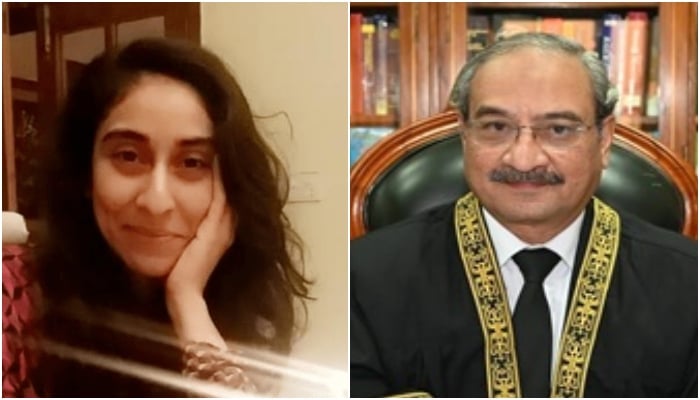
ISLAMABAD: Justice Ali Baqar Najafi has stressed that Pakistan’s youth must understand the “horrible consequences” laid bare by the Noor Muqaddam murder case, a tragedy he says should galvanise social reformers to reflect on rising social vices.
He linked the case to what he described as the growing trend of unmarried cohabitation, calling it a vice that has taken root in upper-class circles.
Justice Najafi — who sat on the three-member Supreme Court bench that heard the case in May — issued his additional note alongside the apex court’s judgment dismissing accused Zahir Jaffer’s appeal.
Jaffer had been convicted by an Islamabad trial court in 2022 and handed the death sentence, which the Supreme Court upheld. On May 20 this year, the bench headed by Justice Muhammad Hashim Khan Kakar had rejected Jaffer’s appeal. The court upheld his death sentence for murder but converted the death penalty awarded under rape charges into life imprisonment.
In his note, Justice Najafi wrote that the state must play a more active role in educating young people about cohabitation, drug abuse and related social risks.
Noor Muqaddam, 27, daughter of former diplomat Shaukat Muqaddam, was murdered in Islamabad’s F-7 area in July 2021, a killing that sparked national outrage. Jaffer, a US national, was arrested and later convicted of the crime.
“I had the privilege of going through the majority view, to which I agree in toto; however, the following is the additional note of the judgement signed by me on May 20, 2025”, Justice Najafi wrote in his seven-page note.
The judge observed that the case was, in his view, “a direct result of a vice spreading in upper society” -- what he termed a ‘living relationship’ (unmarried cohabitation) -- which he said defied both state law and Islamic injunctions, amounting to “a direct revolt against Almighty Allah”.
“The young generation must note its horrible consequences such as in the present case”, he added, calling the issue one for social reformers to confront. He urged that such matters be openly discussed rather than ignored within privileged social circles.
Justice Najafi further noted that there were no mitigating circumstances and that minor discrepancies — including the timing of the incident, delays in the postmortem or the absence of fingerprints on the knife despite a DNA match — did not shake the prosecution’s case, which had proved Jaffer’s guilt beyond a reasonable doubt.
He emphasised that the brief delays in the FIR and autopsy and the small gaps in the CCTV timeline could not override the “consistent chain” of circumstantial evidence.
The judge also rejected the defence theory that Noor had consumed drugs or that Jaffer was mentally unsound, noting that no medical or factual evidence supported such claims.
In examining the circumstantial evidence, the judge wrote that “one end of the rope is found tied with the dead body of Noor Muqaddam and the other end tied with the neck of the petitioner”.