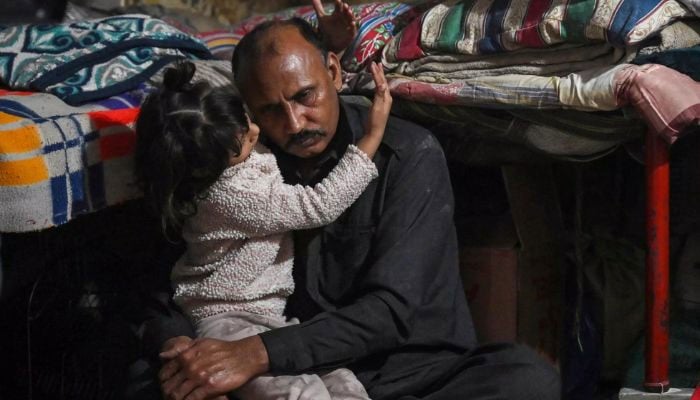
For almost two decades, from 2001 to 2018, the poverty rate in Pakistan consistently fell – from a high of over 50 per cent to less than 20 per cent.
Since 2018, the percentage of Pakistan’s population that lives in poverty has actually been rising. And as of today, by the government of Pakistan’s own estimation, over a quarter of Pakistan’s population lives in poverty.
How did this happen? It may actually have a lot to do with natural causes, in particular the floods that have hit Pakistan severely at least twice in the past five years alone. Another major reason for the reversal of declining poverty in Pakistan is inflation, which till recently was well over 30 per cent. And, of course, the ever-present corruption found at all levels of the economy.
As stated earlier, the government of Pakistan’s figures for poverty hover around 25 per cent and estimates by the World Bank present an even more alarming picture: that up to 40 per cent of Pakistan’s population lives in poverty. Regardless of who you believe more, the fact remains that poverty levels have in fact increased in Pakistan in the last five to seven years, contrary to global trends where poverty has been falling in most countries.
In Pakistan’s case, the GDP growth rate in recent years has been relatively low. In the last decade, it peaked at 6.5 per cent in 2016 and 2021; in 2020, the economy actually contracted – GDP growth was negative 1.27 per cent (due to Covid-19, which affected the global economy). The floods of 2022 and this year both hit GDP growth hard, and when this happens on such a large scale, the adverse effects last beyond a single fiscal year.
So, what needs to be done by the government to stop and reverse the increasing poverty levels in Pakistan?
For starters, there should be an emphasis on protecting the poorest of the poor in the near term. This means expanding cash transfers to this segment through the Benazir Income Support programme, and in particular focusing on households affected by the floods of 2022 and 2025. As much as possible, these payments should be fully digitised – this will increase transparency and minimise any chance of funds being diverted through corruption.
Food security should be strengthened and it should be ensured – not just by the federal government but also by the provincial governments – that everyone’s basic minimum calorie intake and nutritional requirements are met. This will ideally come through a targeted subsidy, prioritising the poorest of the poor and perhaps providing direct food aid via vouchers or food stamps.
Side-by-side with this, the infrastructure of the areas poorly affected by the floods should be rebuilt, and ideally the local population should be used for this, since this will help build income streams for them and facilitate the removal of poverty. For example, daily wage work could be given to able-bodied members of the local population for infrastructure rebuilding and payment for such work should be quick and efficient.
For the medium and longer term, the country’s social protection net should be significantly expanded and strengthened. The social protection net should be in place whenever natural disasters such as floods strike. Economic policies related to digitalisation and extending this to include banking should be sped up. Much of the country’s population already uses mobile phones and coverage of mobile wallets and mobile-linked bank accounts is on the rise – and this should be encouraged further since these are held disproportionately by those with relatively low incomes.
Opening regular bank accounts is not easy for those from such income segments and having a mobile wallet is of great help in facilitating economic sustainability for individuals as well as families. In other financial measures, policies should aim to make the tax system more progressive and reduce reliance on regressive indirect taxes, which place a heavier burden on low-income households.
Since the rural poverty rate is much higher than that for urban areas, the former group should be specifically targeted for assistance. In addition to financial support, policies should provide them with more information and know-how about practices that can help them avoid falling into poverty, such as climate-resilient cropping or rainwater harvesting techniques and crop insurance to protect against unforeseen natural disasters. Microcredit and microfinance should be expanded, especially for women, to enable them to take small loans and earn a livelihood from within the home. This can be an important measure in preventing a rural household from falling into poverty.
Policies that aim to increase GDP growth tend to reduce poverty in any given country. However, they need to be accompanied by policies that specifically target the poorest of the poor, since this segment often needs immediate assistance and food aid.
Perhaps the most critical macroeconomic policy for fighting poverty effectively is one that keeps a check on inflation, since rising prices are probably the one metric that hurts those on the threshold of povertythe most.
The writer is a journalist based in Karachi. He tweets/posts @omar_quraishi and can be reached at: [email protected]