KARACHI: Pakistan on Tuesday condemned India’s latest ceremony at the disputed ‘Ram Mandir’ site in Ayodhya, calling the flag hoisting there a continuation of “majoritarian Hindutva ideology” and a threat to the region’s Islamic heritage.
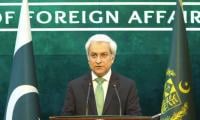
In a clearly-worded statement, the Ministry of Foreign Affairs said Pakistan had “noted with deep concern the flag hoisting at the so-called ‘Ram Temple’ constructed on the site of the historic Babri Mosque in Ayodhya”.
Recalling the demolition of the mosque, the statement noted: “The Babri Mosque, a centuries-old place of worship, was demolished on 6 December 1992 by the extremist mobs inspired by fascist ideologies”. It added that subsequent judicial processes in India -- which acquitted those accused of the demolition and permitted construction of this temple on the same site — “speak volumes about the Indian state’s discriminatory approach towards minorities”.
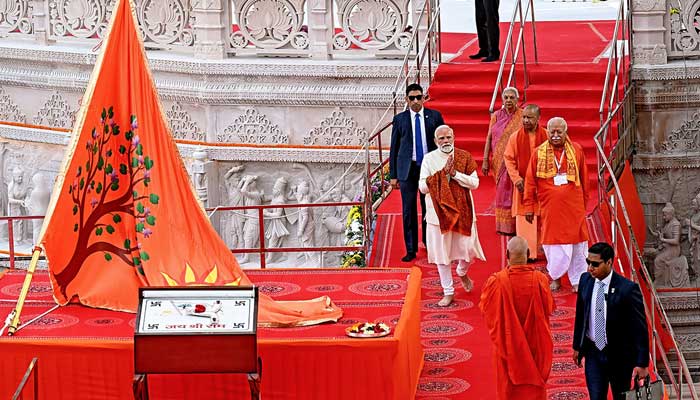
The FO said the episode reflected a broader pattern targeting Muslims in India, warning that “numerous other historic mosques now face similar threats of desecration or demolition, while Indian Muslims continue to experience growing social, economic and political marginalisation”. Calling for international scrutiny, the statement said: “Pakistan calls on the international community to take cognisance of the rising Islamophobia, hate speech and hate-motivated attacks in India”. It urged the UN and other relevant bodies to safeguard Islamic heritage and press India to protect the religious rights of all minorities, adding that New Delhi must “uphold its responsibilities by ensuring the security of all religious communities, including Muslims, and by protecting their places of worship in accordance with international human rights obligations”. The statement came as Indian Prime Minister Narendra Modi oversaw a high-profile Dhwajarohan ceremony in Ayodhya on Tuesday, hoisting a sacred saffron flag atop the newly built Ram Mandir — constructed on the site of the demolished Babri Masjid.
Modi led the ritual during the ‘Abhijeet Muhurat’, described by Hindu priests as an auspicious hour for sacred work. The 22-by-11-foot saffron flag, embroidered with depictions of the Sun, the ‘Om’ symbol and the Kovidar tree, was raised on a 42-foot pole rising from the temple’s spire. All 44 doors of the complex were opened for the ceremony, attended by RSS chief Mohan Bhagwat, priests, dignitaries and over 8,000 invitees.
Addressing the audience after hoisting the Dharma Dhwaj, Modi declared: “Today, the city of Ayodhya is witnessing another turning point in India’s cultural consciousness”, adding that a “500-year-long yajna” had reached completion. He further framed the temple’s construction as part of India’s effort to shed a supposed “mindset of slavery”, asserting that democracy was “ingrained in our very DNA”.
Uttar Pradesh Chief Minister Yogi Adityanath, also present, said the ceremony marked “the beginning of a new era”, describing the temple as a symbol of national pride and proclaiming a “New India” where “there is a perfect synergy of development and heritage”.
The events in Ayodhya remain deeply contentious because the Ram Mandir stands on the site of Babri Masjid — a structure dating back centuries — which was demolished in 1992 by extremist groups.
The demolition sparked nationwide riots in India and drew international criticism. In the decades that followed, court cases, political mobilisations and communal tensions kept the dispute alive. Ultimately, India’s Supreme Court in 2019 granted the site for temple construction, a decision widely criticised in Pakistan and by many international observers who viewed it as reflective of rising majoritarianism in India.