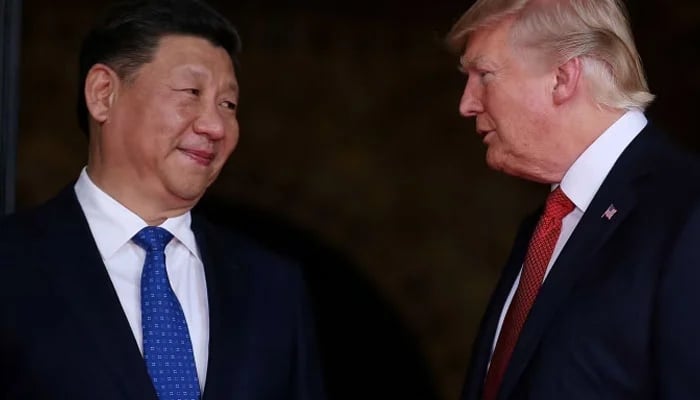
On October 30, 2025, US President Donald Trump and Chinese President Xi Jinping met for the first time in six years at the Gimhae Air Base in Busan, South Korea. The meeting lasted approximately 1 hour and 40 minutes, during which the two leaders secured what could be termed a truce in the ongoing US-China trade war.
As key takeaways from the summit, the US agreed to waive 10 per cent fentanyl tariffs, which previously stood at 20 per cent on Chinese goods, including 24 per cent equitable tariffs from Hong Kong and Macao. Secondly, in return for the Chinese suspension of export control measures on five rare earth minerals crucial to the US defence sector, the US will append the implementation of the export-control (50 per cent) rule for a year.
The US also suspended investigations into China’s maritime, logistics, and shipbuilding sectors under Section 301. Beijing will import soybeans and other farm products from the US. China showed willingness to help mediate the Ukraine war, hinting at a plausible geopolitical concession on China’s part.
Ahead of the meeting, President Trump posted on X, ‘THE G2 WILL BE CONVENING SHORTLY!’, framing the summit as a meeting between the two dominant powers of the world, which caught the attention of many in the geopolitical sphere.
Historically, economist C Fred Bergsten came up with the concept of ‘G-2’ publicised widely in his work (‘A Partnership of Equals’, July/August 2008). Under the G-2 framework, he advocated that the US should establish a genuine partnership with Beijing to lead the global economic order jointly. In 2007, Zbigniew Brzezinski and, later, Niall Ferguson also expanded on the G-2 framework for joint stewardship of the US and China in global financial stability and climate governance.
The concept emerged in the backdrop of the global financial crisis of 2008-2009, when, compared to the rest of the world, China’s economy was relatively stable, and the Obama administration sought to engage with China by striking a balance between confrontation and coexistence.
However, G-2 has faced outright opposition from both sides since its emergence. For China, G2 meant an unwanted bipolar entrapment; for the US, it meant a managed hierarchy. China viewed it as a ‘flattering’ tool to push the country into prematurely assuming the burden of providing public goods to the world. As China was rising at the time, there was scepticism that this could risk China’s domestic development.
Since then, the world has evolved into a complex constellation of power clusters – G7, G20, BRICS+, SCO, QUAD, AUKUS, and RCEP – each reflecting differentiated forms of regional or thematic multipolarity. China has always vouched for such a multipolar configuration of the world as in the China–EU Summit in 2009, when Premier Wen Jiabao rejected the term, and more recently in the 2025 SCO meeting, President Xi also professed to multipolarity, asserting that “world affairs should not be decided by just two countries”.
Whereas, in the US, G-2 was an effort to curb China from ‘US Rebalance to Asia’ strategy to trade wars under President Trump. The ‘China threat’ was further consolidated under President Xi, where China’s magnanimous rise, with a distinct system of governance, marked by its $18 trillion GDP, technological dominance in 5G and AI, patents and institutional influence via the BRI and AIIB, confirmed that it functions as a central pole in global affairs. China’s military expansion in Asia-Pacific and beyond, disputes in the East and South China Sea and a clear stance over Taiwan, intensify US efforts.
The Busan summit, which is a recent case in point for G-2, reveals that the US and China might converge on selective areas but the confrontational nature of their relations would not change. For instance, just 45 minutes prior to the meeting, President Trump stated that the US would carry out nuclear testing.
Also, the location of the meeting (a former US base during the Korean War) was another statement of power, showcasing that President Trump is on home turf. There were no joint statements after the meeting. Core issues, such as Taiwan, were not discussed at all. Interestingly, Trump sought concessions at a time when the US is facing myriad challenges at home and abroad, as compared to China.
President Xi, on the other hand, has a history of taking stringent measures against US actions (such as the trade war). When President Trump imposed tariffs during his second term, President Xi ceased the purchase of soya beans, directly targeting farmers (Trump’s largest Republican voter base).
China also imposed export controls on rare-earth minerals, which are critical to the US defence infrastructure. It was a critical move by China and quite strategic in nature. Rare earths are called as such not because they are scarce but because their refining and processing is extremely difficult, an area where China holds the largest leverage. It subjugated President Trump to lower the sharpest weapon in his economic arsenal.
Therefore, G-2 can be understood as an informal functional reality born of interdependence across key sectors such as trade, technology and critical minerals, rather than a normative partnership that coexists with persistent confrontation in defence, digital governance, and alliance politics.
Despite the concessions, both nations continue to militarise their peripheries, particularly in the Indo-Pacific, and weaponise technology through export controls, highlighting that while bipolarity might define strategic structure, pluralism defines political reality. Therefore, G-2 can be considered a tactical truce and not a strategic shift. However, it retains the plausibility of issue-based engagements in future, given each other’s relative strength and influence.
The writer is a research assistant at the Centre for Aerospace & Security Studies (CASS), Islamabad. She can be reached at: [email protected]