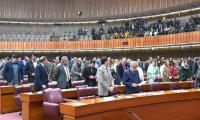
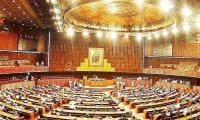
MUZAFFARABAD: The Azad Jammu and Kashmir (AJK) Assembly is once again on the brink of political turmoil, driven by internal discord and public discontent. The unrest, sparked by the Awami Action Committee’s movement, has raised unresolved questions about governance.
Growing distrust in the ruling elite’s ability to address these issues has triggered a fresh crisis, fuelling agitation within the government’s ranks.
With only eight to nine months remaining before the current assembly’s term ends, neither the ruling party nor the political elite seem to have a clear plan for what a change in leadership would achieve at this late stage. Ironically, the same individuals who served in the previous three cabinets under this system are poised to join yet another government, still unable to address the pressing concerns raised by the public.
Abdul Qayyum Niazi, who entered the AJK Assembly aspiring for a ministerial role, leveraged the favour of the PTI founder—partly due to his shared surname—and was appointed Prime Minister on August 4, 2021. However, within months, the PTI itself initiated a no-confidence motion against him, leading to Niazi’s resignation on April 14, 2022. Subsequently, the PTI government appointed Sardar Tanveer Ilyas, a prominent business figure, as Prime Minister. Within a year, Ilyas was disqualified and removed from office for contempt of court. Following this, Chaudhry Anwarul Haq resigned as Speaker and became the third Prime Minister of the current Assembly and the 15th in AJK’s history. According to his own admission, he initially lacked support within the assembly, yet he secured 48 votes in the 53-member House almost overnight to assume the premiership.
Throughout these political manoeuvres, the people of AJK were sidelined. Voters who supported the PPP, PMLN, or other parties saw their elected representatives allegedly vote against party ideology to join Anwarul Haq’s cabinet, reportedly under external influence.
This government is perhaps unprecedented in the assembly’s history, with nearly every member on the treasury benches—except the three former prime ministers—holding a cabinet position. Despite this extensive inclusion, governance remains paralysed. Legislative activity has stalled, and critical constitutional appointments are still pending. A stark example is the absence of a Chief Election Commissioner, who has not been appointed more than a year into the government’s tenure.
With less than 10 months until the next general elections, serious doubts linger about whether the groundwork for elections can be completed in time. The PPP, currently the largest party in the assembly with 15 members and the declared support of 23 lawmakers, may still require additional time to secure a simple majority of 27. The PML-N, despite its alliance with the PPP at the federal level, has chosen to sit in opposition in AJK. Amid this political chaos, the people of AJK continue to grapple with deep uncertainty and a growing sense of political alienation.
Members of the Jammu and Kashmir Joint Awami Action Committee have repeatedly expressed frustration, alleging that the suppression of regional political entities has subordinated AJK’s public mandate to the whims of power centres in Bani Gala, Raiwind and Larkana.
Adding to the political intrigue, rumours suggest that a no-confidence motion against Prime Minister Anwarul Haq is already lodged with the Assembly Secretariat. Should the PPP or another party submit a new motion, the existing one—reportedly sponsored by individuals close to the prime minister—could be activated. In such a scenario, the assembly would be constitutionally required to vote on the pending motion. If it fails, no new motion could be introduced for six months, effectively protecting the prime minister until the next elections.
Observers question how this persistent instability will address the demands of the Joint Awami Action Committee. Many fear it will delay commitments made by the Federal Ministerial Committee. Any move to postpone elections in AJK would reinforce perceptions of eroding political control and autonomy in the region.