ISLAMABAD: The Supreme Court was Thursday told that the decision taken by the Practice and Procedure Committee on October 31, 2024 to constitute a full court for hearing the petitions filed against the 26th Amendment was binding on all and must be implemented to the letter.
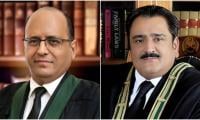
An eight-member constitutional bench, headed by Justice Aminuddin Khan, heard the petitions. Justice Jamal Khan Mandokhail, Justice Muhammad Ali Mazhar, Justice Ayesha A Malik, Justice Syed Hassan Azhar Rizvi, Justice Mussarat Hilali, Justice Naeem Akhtar Afghan and Justice Shahid Bilal Hassan were the other bench members.
Shahid Jameel, the counsel for petitioner Mustafa Nawaz Khokhar, pleaded that his plea concerning the decision taken up by the committee be heard first. However, the court told him that he would be heard later on and invited the SIC counsel Uzair Karamat Bhandari to start his arguments. Bhandari submitted that the petitions challenging the validity of the 26th Amendment could only be heard by a full court.
To substantiate his arguments, he raised three questions: 1) whether a full court could be constituted notwithstanding Article 191-A; 2, by whom; and 3, as to how many judges could sit on the full court.
Regarding question 1, he submitted that a full court could be constituted because it already existed adding that Article 176 of the Constitution was very much clear on this, mentioning the chief justice and judges of the Supreme Court.
Turning to the second question, he contended that the decision taken by the Practice and Procedure Committee on October 31, 2024 regarding the full court was binding on all and must be implemented. “If it is done, it would mean a full court existed on October 31, 2024,” Bhandari said, adding that if the present bench felt that the order passed by the Practice and Procedure Committee could not be enforced, then this constitutional bench should pass a judicial order for constitution of a full court.
Explaining the third question, he submitted that if the constitutional bench was inclined to enforce the decision of Practice and Procedure Committee, then the judges who were there on October 31, 2024 should be a part of the full court.
Justice Aminuddin asked whether this bench will enforce the October 31 decision. Bhandari replied in the affirmative, saying the decision was passed by a valid constitutional body. “If your lordship pass any order, nobody can defy it,” Bhandari submitted.
He added that the judges presently available should sit as well but the judges, who were appointed after the 26th Amendment and by following the procedure laid down in the 26th Amendment, it would be extremely awkward for them to sit in judgment on their own appointments. “You have challenged the 26th Amendment,” Justice Aminuddin told the counsel.
“The moment you say you are bound to that provision of Article 191-A, where does my challenge go?” Bhandari questioned. He said even deciding that question, the court will not take into account those very provisions.
Justice Mazhar, however, observed that they were here under the constitutional amendment of Article 191-A, and if they ignored it, then there was no issue of constituting a constitutional bench and they should be treated as a regular bench. “How can we ignore Article 191-A of the Constitution while sitting within its jurisdiction?” Justice Muhammad Ali Mazhar questioned.
Turning to the status of Article 191-A, Bhandari submitted that certainly it was on the statute book but the question whether it was valid or not was before the court.
Justice Mazhar observed that the bench had been constituted under Article 191-A of the Constitution and he (Bhandari) was asking the bench to ignore it and move forward and constitute a full court. “This is a difficulty we are facing and have been asking for the solution for many days,” Justice Mazhar told the counsel. That’s exactly what I want to address,” Bhandari replied.
Justice Naeem Akhtar observed that the question was which relevant forum will decide that Article 191-A of the Constitution was right or wrong. Bhandari replied that it was the jurisdiction of the Supreme Court to hear this matter. On the question of jurisdiction, Bhandari said, “If Article 191-A is unconstitutional, then your lordship has no jurisdiction to hear it, but if it is valid, then your lordship has jurisdiction to hear the petitions.”
Justice Ayesha A Malik observed that Article 191 could not ouster jurisdiction but it was an exercise of jurisdiction. She remarked that Article 191 simply said that a constitutional bench will exercise the jurisdiction of the Supreme Court. Hence, the jurisdiction rested with the Supreme Court and not with any particular bench.
Later, the court adjourned the hearing until November 10.
Justice Aminuddin said if the bench were available, the case would be heard the same day; otherwise, a new date would be set.