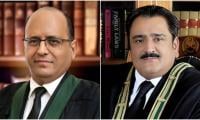
ISLAMABAD: Senior Pusine Judge of the Supreme Court Syed Mansoor Ali Shah and Justice Munib Akhtar – both also members of the Supreme Judicial Council (SJC) -- have raised objections over the recent amendments to the judges code of conduct approved by the council with majority.
The SJC on October 18 had proposed some amendments to the Code of Conduct for Judges of the Supreme Court and High Courts. The approval was made during a meeting held in the apex court chaired by Chief Justice of Pakistan Yahya Afridi.
The meeting was virtually attended by Justice Mansoor and Justice Munib through videolink, while Lahore High Court Chief Justice Aalia Neelum and Islamabad High Court Chief Justice Sardar Muhammad Sarfraz Dogar attended in-person.
Following the SJC decision taken on July 12, 2025, the chair proposed some amendments to the code of conduct. The proposals were deliberated upon and with some amendments approved by majority decision of the council and were directed to be notified in the official gazette.
Justice Mansoor and Justice Munib, however, in a letter addressed to SJC chairman/CJP as well as its members raised objection over the amendments. “We are passing through testing times, when democracy itself faces strain and constitutional institutions are being tested,” the two judges wrote, adding that in such moments, a strong, fearless and independent judiciary is the last and only refuge of the people. Any measure that curtails that independence or can be weaponised to discipline, silence or control judges must be viewed with the utmost caution and resisted firmly.
The two judges further stated that the proposed amendments, particularly the amendment of Article V, the insertion of Article XIX, and the incorporation of the 2003 SJC Resolutions/Guidelines, raise grave concerns about the independence, autonomy and transparency of the judiciary.
“These proposals, if adopted, will restrict judicial freedom, transform an open and collegial institution into a closed and hierarchical one, and create avenues for control both -- internal and external,” the two judges said.
Furthermore, they stated that the 26th Constitutional Amendment, which has also sought to substitute Article 209, remains under challenge before the Supreme Court.
“Until that matter is decided, the status of the chairperson and one of the members is sub judice,” they stated, adding that constitutional propriety, therefore, requires that no amendments to the code be undertaken until that issue is settled. The two judges also referred to the proposed amendment in Article V wherein it was stated that judges shall not have any interaction with the media, especially in relation to issues which may give rise to public debate or adversely affect institutional collegiality and discipline.
They stated that the phrases “public controversy” and “political questions” are undefined and could encompass nearly every matter of constitutional or legal significance.
In Pakistan’s context where most constitutional questions intersect with politics, this provision could prevent judges from contributing to legitimate public or academic debate, they said, adding that even a neutral discussion on climate change or gender sensitivity can lead to public controversy or border on political question. The two judges said that the code of conduct is not a transient rule but a long-term institutional document, administered by changing leadership over time. They maintained that it must be framed with care and restraint, ensuring that its language cannot be abused in different hands.
The two judges said that judges retain limited but legitimate freedom of speech to engage in academic, civic and intellectual dialogue that promotes the rule of law.
“The total ban on ‘speech, writing, debate or comment at any forum’ suppresses this freedom and isolates the judiciary from society, contrary to modern judicial ethics that encourage outreach to build public trust,” said the letter.
They said fear of being accused of “public controversy” will compel judges to remain silent on matters of constitutional importance, even outside the courtroom. This self-censorship undermines intellectual growth within the judiciary, a development of constitutional jurisprudence.
The two judges said that in modern democracies, judges frequently participate in educational conferences about institutional reforms or judgements without impartiality.
“Such contact strengthens public understanding and confidence; an outright ban conceals the judiciary from scrutiny rather than enhancing dignity,” the letter stated, adding that by contrast, an outright prohibition amounts to a gag order, imposing total silence and insulating the institution from public scrutiny. Such enforced silence can be easily abused and risks turning judiciary into an insular and closed body -- an outcome that does not augur well for public trust or democratic accountability.
The two judges stated that they had submitted their comments at the start of the meeting, a day before the SJC session, adding that they participated in the meeting via videolink and tried to present their viewpoint despite poor internet connectivity.
“We had ensured that the signed copy would be submitted on October 20 after the session,” they wrote, adding that after the unconstitutional developments that took place during the National Judicial Policy Making Committee meeting, they are writing the signed letter.
The two judges further wrote that a day before the SJC session, the matter of the judges’ code of conduct was unconstitutionally brought up during the National Judicial Policy Making Committee meeting.
“In the council meeting, we stated that the matter of our letter dated October 13 should be addressed first,” they said, adding that in that letter, it was proposed either to postpone the SJC meeting or to reconstitute it.
The two judges further wrote that the case against IHC Chief Justice Sarfraz Dogar is pending before the Supreme Court, adding that the outcome of the case against Justice Dogar could impact his inclusion in the SJC.