ISLAMABAD: Petitioners again requested Supreme Court on Tuesday to constitute of a full court comprising only those judges who were part of the court before the 26th Constitutional Amendment.
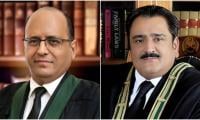
An eight-member Constitutional Bench headed by Justice Aminuddin Khan heard 36 identical petitions challenging the validity of 26th Constitutional Amendment. Other members of the bench were Justice Jamal Khan Mandokhail, Justice Muhammad Ali Mazhar, Justice Ayesha A Malik, Justice Syed Hassan Azhar Rizvi, Justice Musarrat Hilali, Justice Naeem Akhtar Afghan and Justice Shahid Bilal Hassan.
Around three dozen petitioners, including Pakistan Tehreek-e-Insaaf (PTI), Jamaat-e-Islami (JI), Sunni Ittehad Council (SIC), Lahore High Court Bar Association, Lahore Bar Association, Karachi Bar Association, as well as seven former presidents of the Supreme Court Bar Association (SCBA) and various individuals in their personal capacity, had challenged the validity of the 26th Constitutional Amendment.
Abid S Zuberi, counsel for six former SCBA presidents, continuing his arguments, repeated his request for constituting a full court comprising only those judges who were part of the Supreme Court before the enactment of the 26th Amendment.
During the hearing, Justice Mandokhail remarked that some lawyers had even suggested setting aside Article 191-A while hearing the case. “How [can] any article of the Constitution be set aside?” he questioned.
Justice Ayesha added that there are judicial precedents on this issue, stating that if a constitutional provision is challenged before the Supreme Court, it cannot simply be ignored.
She further noted that the Supreme Court (Practice and Procedure) Committee has the authority to constitute benches but not to form a full court, and that the committee’s powers cannot be considered the same as those of the chief justice. Justice Ayesha questioned whether any party has the right to appeal or not, saying that the matter is now in the hands of the Judicial Commission.
At the outset of the hearing, Justice Aminuddin noted technical difficulties, saying that due to internet issues, the hearing could not be live-streamed but efforts were being made to restore the connection.
Zuberi, while advancing his arguments regarding the formation of a full court for the case, cited various court judgements. He argued that while any party may raise an objection against a judge, the authority to decide whether to hear a case lies with the same judge. He reiterated that a full court be constituted comprising only the judges who were part of the Supreme Court before the 26th Amendment.
Justice Mandokhail, however, observed that on the one hand, the counsel was asking for a full court, but on the other hand, he wanted only the 16 judges who were part of the court before the amendment to hear the case.
He asked the counsel to clarify his request. The judge further remarked that instead of saying “full court,” the counsel should explicitly state that only those judges serving before the amendment should hear the matter.
Zuberi, while referring to the Supreme Court (Practice and Procedure) case, contended that the current eight-member bench would not allow his clients a right to appeal. He added that while 15 judges have been nominated for the Constitutional Bench, at least nine additional judges would be required for hearing appeals.
Justice Ayesha noted that the question of whether any party has the right to appeal now lies with the Judicial Commission, which may, if it wishes, nominate additional judges to grant the right of appeal. “If the commission does not agree, that right could be denied,” she said, adding that this directly concerns the independence of the judiciary.
Justice Mandokhail observed that even in a 16-member bench, there would be no right of appeal.
Zuberi argued that in one case, the Supreme Court had held that when a decision is made based on collective wisdom, the right to appeal is not mandatory. The counsel mentioned that the Supreme Court Rules 2025 have been notified, and under Order 11, a three-member committee will constitute benches.
Justice Mandokhail remarked that nowhere in these rules it is written that the chief justice will form benches. The counsel responded that this is not a full court; all full courts in the past have been constituted under specific rulings.
Justice Mandokhail said that the rules should have specified the procedure for forming a full court in 2025. He added that the rules were framed before a full bench of 24 judges.
Justice Ayesha disagreed, saying that not all judges were present, and she had recorded her note of dissent. She was among the four judges who expressed reservations about the procedure adopted for approving the rules and had not attended the full court’s administrative meeting in September.
Justice Mandokhail then said that the meeting minutes should be called for, noting that all judges had been asked to provide input on the matter. He remarked that until this issue is clarified, the case would not proceed further. The attorney general then came to the rostrum, saying that this was an internal matter of the judges and should not be discussed in open court.
Justice Mandokhail responded that he was being portrayed as untruthful, reiterating that a meeting of 24 judges was indeed held, some clauses were referred to the committee, and some judges provided input while others did not. Justice Ayesha repeated that the Supreme Court (Practice and Procedure) Committee has the authority to constitute benches but not to form a full court, and that its powers cannot be considered the same as those of the chief justice. The counsel responded that the two are different and that they were referring to the formation of a full court, not ordinary benches. Justice Aminuddin asked whether the chief justice can form a full court that includes all judges of the Constitutional Bench. The counsel replied that the chief justice still retains the authority to constitute a full court and cited various judicial precedents to support his argument.
Justice Aminuddin observed that the counsel was effectively asking the bench to direct the chief justice to form a full court, noting that in the past, full courts were indeed formed by the chief justice. Later, the court adjourned the hearing until Wednesday (today).