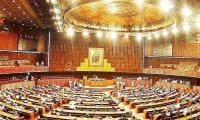
PESHAWAR/ ISLAMABAD: Maintaining unity in its ranks, the ruling PTI in the Khyber Pakhtunkhwa Assembly Monday elected Sohail Afridi as the new Leader of the House amid a boycott by the opposition, which termed the election “unconstitutional.”
Elected as an independent candidate in the February 2024 general elections from Bara, Khyber district, Afridi became the youngest and the first-ever chief executive of the province from the former tribal areas.
Sohail Afridi is the 23rd chief minister of Khyber Pakhtunkhwa. He secured 90 votes, well above the 73 required for his election as CM in the 145-member House. The opposition has 52 members in the assembly. However, the election triggered controversy as the opposition threatened to move the court, arguing that Ali Amin Gandapur was still the chief minister since the governor had not approved his resignation.
The session, chaired by Khyber Pakhtunkhwa Assembly Speaker Babar Saleem Swati, witnessed heated exchanges when Swati announced the election for the new Leader of the House, as the opposition members insisted that Gandapur’s resignation had not yet been approved by the governor.
However, Gandapur, speaking on the assembly floor, said he had twice sent his resignation to the Governor’s House and reaffirmed that he had already stepped down as chief executive of the province. He then proposed Sohail Afridi’s name for the position.
Parliamentary leaders of Jamiat Ulema-e-Islam-Fazl Maulana Lutfur Rehman, Pakistan Muslim League-Nawaz Sardar Shahjehan Yousaf, and Pakistan People’s Party’s Arbab Zarak Khan had also submitted nomination papers for the slot but boycotted the process and did not participate in the voting.
Clad in traditional shalwar qamees with a waistcoat and a turban, the newly elected chief minister entered the assembly hall to take his seat. In his maiden speech, the 36-year-old Afridi said the events of May 9 were a conspiracy against the PTI leadership and workers and vowed to continue the mission of his party chief and to work for the release of Imran Khan, his spouse, and other PTI leaders and workers detained in what he termed “false and fabricated cases.”
“I order an independent inquiry into the attack on the Radio Pakistan building in Peshawar,” he announced, adding that an inquiry into the alleged rigging in the February 8 general elections would also be conducted.
Sohail Afridi said he would personally visit the families of PTI workers killed or injured during the protests. Calling himself a “common worker” of PTI elevated to the province’s top position by his party chief and colleagues, Afridi said he would not betray their trust and would focus on public welfare and provincial development.
“I am a true Pakistani, a Pakhtun, and a traditional tribesman from the erstwhile Khyber Agency,” he said, pledging to bring the merged tribal districts on a par with the rest of the province.
Afridi vowed to continue the development policies of his predecessor, Ali Amin Gandapur. He is the fourth PTI chief minister of Khyber Pakhtunkhwa, as the party has formed the provincial government for the third consecutive term since the 2013 general elections.
Meanwhile, Opposition Leader Dr Ibadullah told reporters after the session that the opposition would challenge Sohail Afridi’s election in court, calling it unconstitutional, as, according to them, Gandapur was still the province’s chief executive.
Amjad Safi adds: The Peshawar High Court (PHC) Monday directed the additional attorney general to confirm whether the Governor’s House had received the summary for administering the oath to the newly elected Khyber Pakhtunkhwa Chief Minister Sohail Afridi.
Chief Justice Attique Shah had heard the Pakistan Tehreek-e-Insaf (PTI)’s application, seeking directions for Governor Faisal Karim Kundi to administer the oath to the new chief minister. PTI’s Secretary General Salman Akram Raja told the court that former chief minister Ali Amin Gandapur had resigned on October 11.
The chief justice inquired whether the governor had accepted the resignation, to which Raja responded that although the resignation had not been formally accepted, the Constitution does not require such approval. He said the provincial assembly had already elected a new chief minister.
The chief justice observed that the court was examining the matter on the administrative side, not the judicial side. Raja argued that the Constitution empowered the chief justice to nominate a person for oath administration if the governor refuses.
The court was informed that the resignation, handwritten by Ali Amin Gandapur, was sent to the Governor‘s House on October 11. However, the governor raised objections on October 12, stating that he was out of the province and would return on October 15.
He had asked the chief minister to appear at the Governor’s House at 3pm. for verification of the resignation. Raja said the governor was aware that the assembly would elect a new chief minister on October 13 but intentionally tried to delay the process.
The chief justice asked whether the summary for the oath had been received by the governor. The court was told that Assembly Speaker Babar Saleem Swati had sent the summary and was present in court.
It was emphasized that the province could not be left without a chief minister, especially if the governor remained absent for 48 hours. Additional Attorney General Sanaullah informed the court that the Constitution was clear — if the governor refuses to administer the oath, Article 255 comes into effect. However, it was still unclear whether the summary had reached the governor.
The PHC chief justice reiterated that the governor’s opinion was essential before the court could proceed. He recalled that a similar case had earlier been filed against him concerning the oath of MPAs on reserved seats.
Raja argued that the oaths of the chief minister and of assembly members were constitutionally different, but the chief justice remarked, “An oath is an oath, whether of a chief minister or a member of assembly.”
The PTI leader maintained that the office of the chief minister was a constitutional post and if the governor refused to act, the chief justice was empowered to nominate a person to administer the oath. He added that since the governor was not in the province, the province could not remain without a chief minister for 48 hours.
The additional attorney general stated that the outgoing chief minister could continue performing duties until the new chief minister takes oath, to which the PTI leader responded that such a provision applied only in cases of no-confidence.
The bench adjourned the hearing till today (Tuesday), instructing that the governor’s opinion be sought and conveyed to the court.
Meanwhile, PTI Secretary General Salman Akram Raja Monday warned that the oath-taking of chief minister-elect Sohail Afridi should not be delayed beyond October 14 (today).
He said this on arrival at the Peshawar High Court to submit a petition seeking the oath-taking of the newly elected KP CM. The election of the new KP CM remains shrouded in controversy after Governor Faisal Karim Kundi rejected outgoing CM Gandapur’s resignation, citing objections to the signature’s authenticity.
Talking to journalists outside the Peshawar High Court, Raja said, “It is necessary to administer the oath to the KP CM-elect. Taking the oath cannot be delayed.”
He said Governor Kundi should have been in the province to administer the oath to the new chief executive. “Under the Constitution, the chief justice can nominate anyone to administer the oath,” he added.
Muhammad Anis adds: In a related development, a delegation of the federal government Monday met the JUIF chief Fazlur Rehman and discussed the strategy to prevent Sohail Afridi from taking oath as chief minister.
“We expect the chief justice and the Peshawar High Court not to become part of this controversial and unconstitutional parliamentary process in the Khyber Pakhtunkhwa Assembly,” said a statement issued after the meeting.
The government delegation comprsied Federal Ministers Ahsan Iqbal, Azam Nazir Tarar, and Engineer Amir Muqam. JUIF leaders Maulana Lutfur Rehman, Allama Rashid Soomro, Sajjad Khan MPA, and others were also present.
The two sides discussed the prevailing political situation and unanimously declared that the election of the leader of the house in the KP Assembly was totally unconstitutional and could not be accepted.
“All opposition parties in the Khyber Pakhtunkhwa Assembly reject this process of electing the chief minister,” the participants maintained. It was also decided that, keeping in view the past practices of the courts, the opposition parties would explore all constitutional options and submit an application to the Peshawar High Court through a panel of lawyers.
The opposition in the provincial assembly is of the view that a new chief minister cannot be elected until the resignation of his predecessor is formally accepted. Meanwhile, KP Governor Faisal Karim Kundi has returned the written resignation of Ali Amin Gandapur, asking him to verify his signatures.