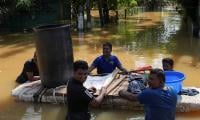
KARACHI: The Asian Development Bank (ADB) has committed an additional $80.75 m(Rs 22.47bn) loan to the Sindh Emergency Flood Assistance Project (EFAP), to enhance flood recovery and infrastructure resilience in Sindh.
This additional funding brings the ADB’s total commitment to $220 m(Rs 61.28bn), to reconstruct areas devastated by the 2022 deluge. Launched following one of Pakistan’s most severe floods, the EFAP aims to restore essential infrastructure—including irrigation, drainage, and flood protection systems—while fostering climate resilience and disaster preparedness.
The revised allocation directs $54.42 m(Rs 15.15bn) towards civil works and construction, a core component of the recovery effort. To date, expenditure on civil works totals $56.83 m(Rs 15.81bn).
The ADB’s overall funding for the EFAP now totals $280.47 m(Rs 78.04bn), with $ 135.33 m(Rs 37.64bn) disbursed, achieving a 48.24pc disbursement rate. Of the ADB’s share, $ 109.99 m(Rs 30.60bn) has been released, though only 5.5pc of the newly approved tranche has been utilised so far.
As of September 4, 2025, the project’s progress stands at 43.9pc, with several obstacles hindering timely implementation. Despite early achievements, the EFAP faces challenges, including contractual disputes, material shortages, delays in land acquisition, and occasional social unrest. They have led ADB officials to stress for improved coordination with local authorities, swift resolution of legal and bureaucratic obstacles, and proactive measures to ensure timely progress.
The additional funds are expected to expedite the completion of vital infrastructure in flood-prone districts, with a particular emphasis on enhancing irrigation and drainage networks to support agricultural recovery and mitigate future flooding. ADB officials reaffirmed their commitment to disaster resilience, climate adaptation, and sustainable development in Pakistan. Stakeholders are encouraged to monitor progress through the ADB’s official portal, which provides regular financial and operational updates.
As the EFAP enters a more intensive implementation phase, officials remain cautiously optimistic that these infrastructure improvements will not only address past damage but also protect Sindh from future disasters.