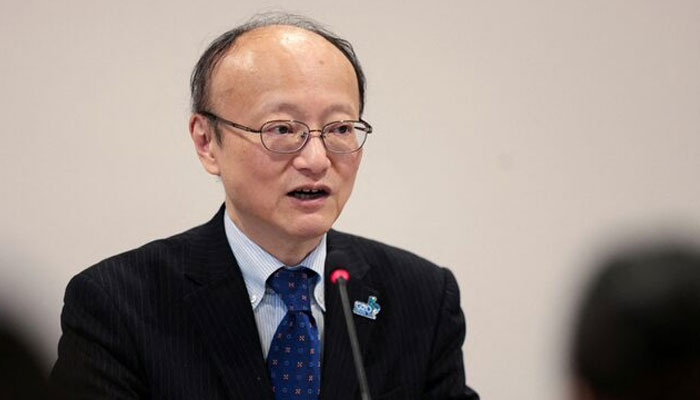
MILAN (Italy): President of the Asian Development Bank (ADB), Masato Kanda has hoped that India and Pakistan would find peaceful solutions to their outstanding issues including the current nuclear faceoff following the Pehalgam terror attack in the Indian-occupied Kashmir in which 26 people were killed on April 22.
India blames Pakistan-backed “outfits” for the attack. Islamabad outright denies the charge and suggests that New Delhi should look inwards to find the real culprits.
Asked by The News during the ADB’s 58th annual meeting that opened in Milan on Sunday, as to how concerned he was being the head of a multilateral financial institution with long-standing lending partnerships with both the South Asian nuclear-armed neighbours, Kanda avoided direct comment on the India-Pakistan tension but added that he hoped that peace and regional stability returned to region as soon as possible.
“As an international development organisation, we do not engage in political matters. However, we believe that peace and political stability are the foundations of sustainable development. We hope for peaceful resolution in all regions, as conflict ultimately harms the most vulnerable populations.” Kanda said the Bank continued to support peace and stability through economic cooperation and inclusive development.
The News also asked if the current leadership was addressing major global challenges like regional connectivity, trade interdependence and globalisation in the face of rising nationalism and fragmentation.
The bank president said, “I share your concern about the global leadership environment. In times of fragmentation, institutions like ADB play a crucial role in fostering collaboration, promoting multilateralism and ensuring that development remains inclusive, sustainable and people centred.”
Kanda delved into history a little to further elaborate his answer. “This may be the first time we’ve seen such conditions since 1944 or 1945. The Asia-Pacific region has benefitted greatly from an open trade system and a relatively stable international order. Our hope is to preserve and improve the international financial architecture for the benefit of all, especially the poor and vulnerable countries.”
Kanda, 59, who has held senior advisory positions with the Japanese prime minister and finance minister before assuming ADB’s presidency on February 23, said the Bank supported peace and economic stability throughout the Asia-Pacific region to ensure sustained development in areas like climate change, food systems progression, regional connectivity and community development.
Listing the Bank’s priorities during the next five years, the president promised substantial funding injection to food system components like agricultural development, value chains and building infrastructure for food systems. He said the ADB planned to add another $26 billion to Bank’s support its agriculture programme by 2030 to the current $14 billion pot in order to take it to $40 billion. “This expanded support will help countries reduce hunger, improve nutrition, protect the environment and create opportunities for farmers and businessmen.”
He hoped the increased investment would drive change across the food value chain from production and processing to distribution and consumption. “Of the additional $26 billion, $18.5 billion will support government efforts, and £7.5 billion will go to private sector. By 2030, we aim for private sector investments to account for over 27 percent of the total programme, underscoring their essential role in food system transformation.” He said the financing injection into agricultural field would not impact Bank’s other core commitments and priorities.
To a question on the volatility of global trade and the impact on small and medium-sized economies of the Asia-Pacific region by President Trump’s tariffs imposition and President Xi’s tit-for-tat response, the ADB president recommended caution due to the uncertainty attached to the action by the leaders of the largest economies of the world.
He also suggested diversification in finding new trading partners rather than banking of regional neighbours for bilateral trade.