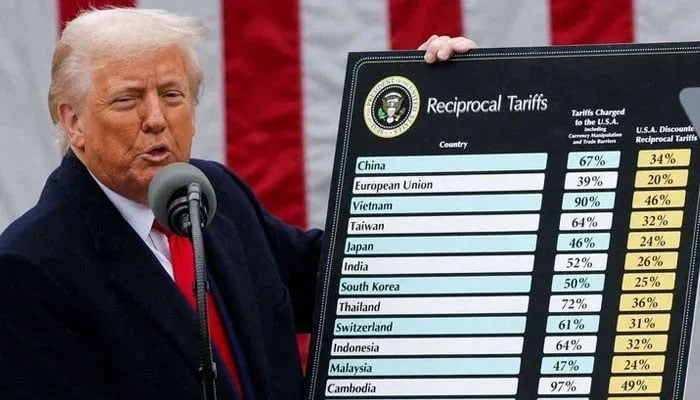
The recently imposed trade tariffs by US President Donald Trump have created panic in world stock markets and forced the leadership of world countries to sit at the dialogue table to sign a deal on a give-and-take basis.
Although the US is famous for exporting weapons, warplanes and defence production to the world, its economy is mainly based on IT services. However, in recent years, other players have also come forward to compete in the US. China in particular is giving the US a tough time on every front. Trump is well aware that the US market consists of over 300 million people, and Americans prefer products from other countries for their daily use. Many cheap Chinese products are helping Americans improve their standard of living but have resulted in a trade deficit.
The promise of ‘America First’ and 'Make America Great Again' Trump made during the election campaign has been fulfilled in the form of the recently implemented tariffs to get his country out of the trade deficit. Undoubtedly, imposing new tariffs on foreign products will increase inflation, but ending foreign monopolies will ultimately benefit America's local industry to flourish. According to Trump, the US is earning $2 billion per day in newly-introduced trade tariffs, while approximately $2.9 trillion is expected to be collected in the national treasury by the decade.
Interestingly, many other countries, including Pakistan, Canada, India, Australia, and the European Union, have also been affected by this action.
India had also faced a similar situation some time ago when PM Manmohan Singh made tough decisions in the national interest to get out of the grip of the IMF and international aid agencies. India, despite tensions on the diplomatic and border fronts, established bilateral trade relations with China. Today, in collaboration with Chinese company BYD, the production of electric vehicles that rival the world-famous American Tesla is being carried out in the Indian city of Hyderabad.
Although we are custodians of Pak-China friendship, our exports to China are very few, and even our national flag is imported from China. Unfortunately, we have not yet been able to convince China to set up any notable major industry in our country whose production would lead to the stability of our national economy.
Trump's tough decision is certainly being criticised at a larger scale, but in my opinion, it will prove to be a key factor in maintaining America's global economic supremacy. China is currently imposing retaliatory tariffs on the US, but very soon China will also have to sit at the negotiating table. If this happens, it will prove to be the starting point of a new world order under Trump's leadership, regarding which astrologers have already predicted that he will reach the peak of his political achievements this month.
Today, every country in the world, including Pakistan, has a golden opportunity to strengthen bilateral ties with the US by signing a deal on the tariff issue. I have expressed on various occasions that Pakistan is also a key exporter country but we have not taken sufficient advantage of our geostrategic position in various matters including the Afghanistan issue in the past. The current situation demands that we should learn from the past and not take any hasty action out of worry. Pakistan must offer a hand of cooperation to Trump.
We need a committee consisting of foreign, finance and defence experts as well as intellectuals and businessmen to start negotiations with the US. We have to first complete our homework and then present a proposal to convince the other side at the negotiating table. We should understand that the more our international trade increases, the more our diplomatic relations will improve.
The challenge we are facing at the moment in the form of the Trump tariffs can only be tackled through bilateral negotiations with the US and maintaining a balance in import and export.
The writer is a member of the National Assembly and patron-in-chief of the Pakistan Hindu Council. He tweets/posts @RVankwani