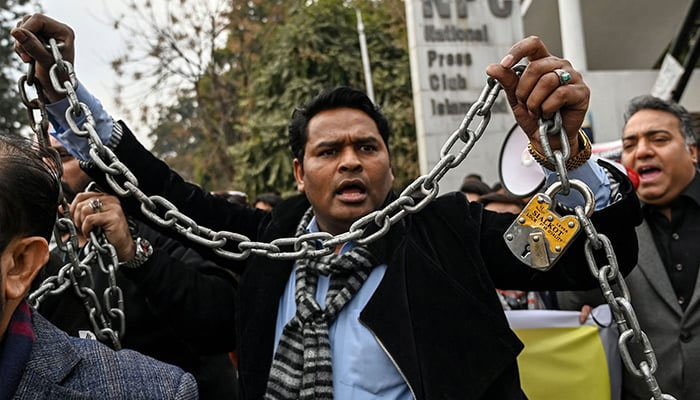
The journalist community, civil society and opposition parties are protesting against the recently introduced amendments in the Prevention of Electronic Crimes Act (Peca). Critics say the legislation aims to suppress the voices of active political opponents on social media, while government circles are calling the Peca amendments a vital effort to prevent the spread of hateful propaganda and fake news on social media.
The recent controversy over the Peca amendments reminded me of my past legal struggle when I had appeared before the Supreme Court of Pakistan for the protection of minorities. The then-CJ, Justice Tassaduq Hussain Jilani, in his historic judgment pronounced on June 19, 2014, ordered strict action against those spreading hateful content against minorities on social media.
In several newspaper columns published in The News too I had emphasised how to regulate social media in Pakistan. Referring to the internet laws implemented in different countries of the world over the past decade, I took the stance that Pakistan can restore its lost prestige in the eyes of the international community only if rule of law were ensured in the country.
According to the bill, the purpose of the authority is to ensure the positive use of social media and the prevention of cybercrime, but critics are claiming that the hidden motive behind the amendments is to impose strict censorship against political opponents and eliminate freedom of expression digitally.
Based on such narratives, I tried to examine other countries of the world to analyse what steps they are taking to regulate social media in their countries. Canada is a significant country in the Western world where there is no restriction on freedom of expression, but to prevent the negative use of the internet, the Online Harm Bill has been introduced in the Canadian parliament. Under the proposed legislation, the Digital Safety Commission of Canada will be established, which will also punish those who use social media negatively.
Twenty-five years ago, India had included the prevention of anti-social activities on the internet among its national priorities under the Information Technology Act 2000. Similarly, government agencies such as the Federal Communications Commission in the US, the Office of Communications in the UK, the Infocomm Media Development Authority in Singapore, the Telecom Regulatory Authority in the UAE, and the Cyberspace Administration of China monitor the activities of negative elements on social media and take necessary action accordingly.
In today’s digital era, every country is trying to continuously update regulatory frameworks to prevent the dissemination of toxic content and misinformation in the form of fake news. No one denies the importance of social media, but unfortunately, the government of Pakistan has been confused for a long time about preventing the dissemination of hateful content under the guise of freedom of expression. My position has always been that we should make some developed country our role model in this regard.
Today, everyone is on the same page on preventing the negative use of social media. All professional journalists consider fake news to be a deadly poison for the sacred profession of journalism. Every sensible person wants to keep their children away from the reach of anti-social elements active on the internet. But then why is there so much fuss over the Peca law and resistance against regulating social media?
In my view, the proposed social media regulatory authority in Pakistan is part of a wider global trend of regulating social media and curbing cybercrimes. However, the vast powers given to the proposed authority are raising concerns about internet censorship and violation of freedom of expression. The government should move forward and convene a roundtable conference, taking the journalist community and other stakeholders into confidence.
A comprehensive regulatory framework can only be developed by adopting a balanced and cooperative approach with a guarantee that the protection of the fundamental rights of citizens should not be violated under the Peca law.
The writer is a member of the National Assembly and patron-in-chief of the
Pakistan Hindu Council. He tweets/posts @RVankwani