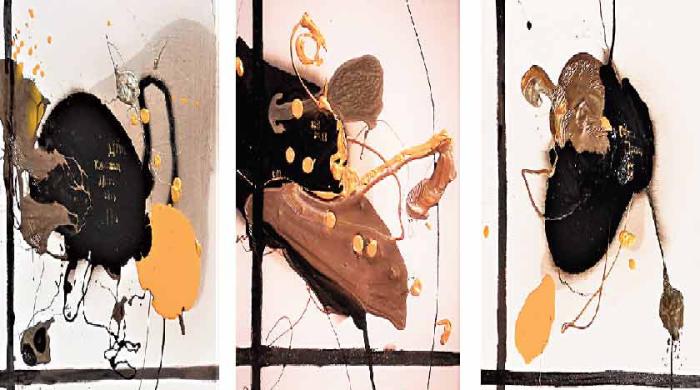
This week, You! reviewed recent works by artist Ayesha Siddiqui, exploring the ideas and messages embedded within her art…
art review
Art seldom comes with a clear message. Some pieces feel in progress, shaped by both intention and chance, where the meaning isn’t fully defined. In these works, the surface shows the artist’s process, including choices that may not feel fully resolved. Rather than offering a finished statement, the work remains open, making it subjective to the viewer, with meaning shaped by individual interpretation.
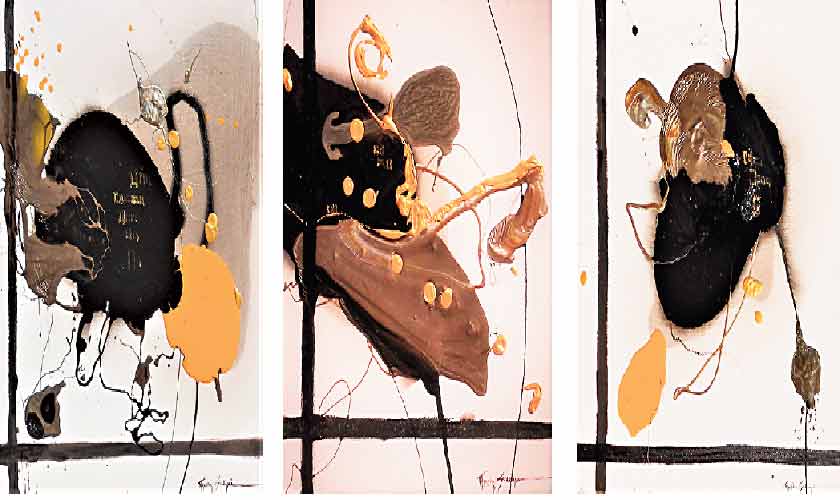
However, there is a visible tension in Ayesha Siddiqui’s ‘Labyrinth-2026’ series, which the viewer can grasp upon first look, one that sits between control and collapse. The works do not present themselves as resolved compositions. Instead, they appear caught mid-process, as if the act of making has been deliberately left exposed.
Siddiqui, a trained painter with a strong academic grounding in geometric form, steps away from rigid structure here. What remains, however, is the memory of geometry, faint grids, vertical and horizontal axes and a sense of spatial division that holds each canvas in place. Across the series, this grid acts less like a framework and more like a boundary, something the paint resists, spills over or disrupts.
A recurring visual presence takes shape through dense accumulations of black, spreading unevenly across the surface. These forms absorb light and attention, creating void-like centres that anchor the compositions while simultaneously destabilising them. Against this weight, bursts and fields of orange emerge, at times controlled and restrained, at others expansive and insistent. The contrast is not merely chromatic; it establishes a dynamic opposition between density and release, heaviness and interruption.
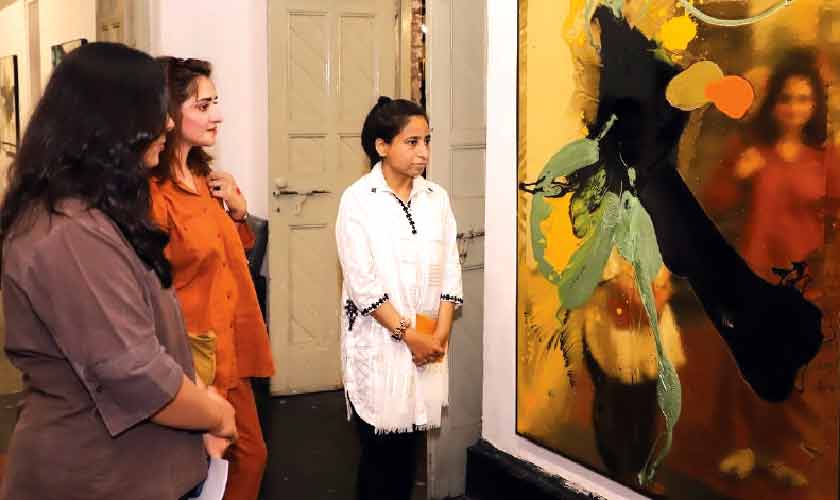
Alongside these elements, ambiguous forms begin to surface, translucent, stretched and difficult to define. They appear suspended, neither fully solid nor entirely dissolved, occupying a space that resists clear categorisation. Their presence introduces a sense of unease, as if the work itself is in a state of transition, caught between formation and erosion. Lines remain intact in places, yet they seem increasingly irrelevant to the movements unfolding across the surface. This disconnect creates a tension between what attempts to contain and what refuses containment.
At moments, the compositions edge toward fragmentation. Drips, splatters and thread-like extensions of paint stretch across the canvas, forming unstable networks that resist cohesion. The visual field becomes dense, almost crowded, asking the viewer to navigate layers that do not easily resolve into a single focal point.
In contrast, there are passages where the work seems to gather itself, where movement becomes more directed and spatial divisions more pronounced. Here, forms appear slightly more grounded and the interplay between elements feels measured rather than reactive. Even so, this sense of order never fully resolves the underlying tension. Instead, it coexists with it, creating a sustained push and pull between structure and disruption.
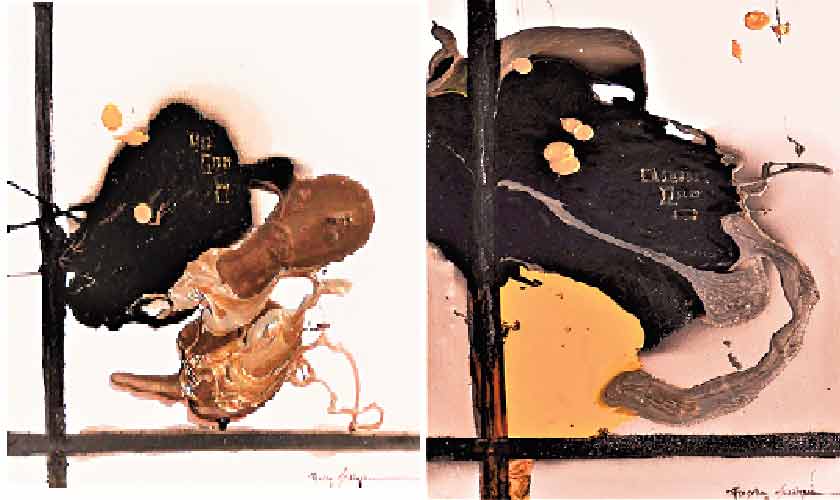
Siddiqui’s use of mixed media reinforces this dynamic. Glossy black surfaces sit against matte greys, while thick, almost industrial applications of orange introduce a physical weight that extends beyond the visual. The textures create a tactile presence, making the surface feel worked, layered and lived through. The paintings do not conceal their making; they foreground it.
At the same time, the series occupies a precarious position. In Labyrinth-2026, the notion of the labyrinth does not manifest as a literal structure. It exists within the act of making itself, in the layering of surfaces, in the movement of paint and in the viewer’s effort to go through forms that refuse to settle. The labyrinth becomes a metaphor for process, for the way meaning is constructed, disrupted and reconfigured over time.
In this way, Siddiqui’s work aligns with a broader understanding of contemporary painting, one that values openness over completion, tension over harmony and process over finality. It suggests that meaning does not always lie in what is resolved, but in what remains unsettled, continuing to shift long after the act of viewing has ended.