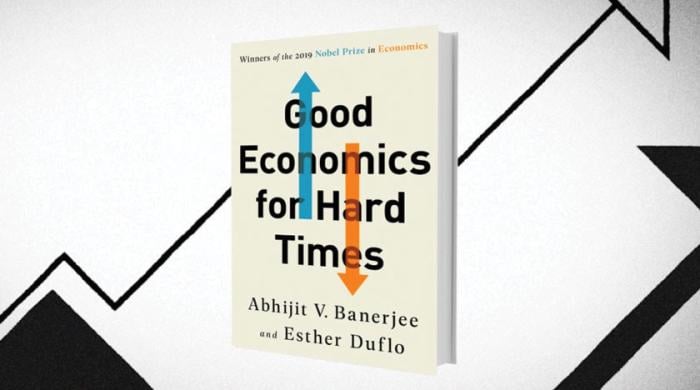
Good Economics for Hard Times is not just a book for economists or economics students....
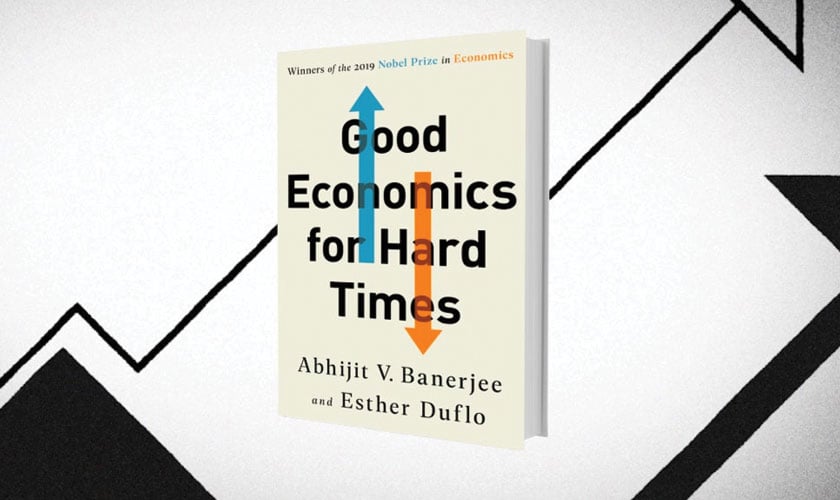
BOOK REVIEW
Book: Good Economics for Hard Times: Better Answers to Our Biggest Problems
Authors: Abhijit V. Banerjee and Esther Duflo
Reviewed by: Rumaissa Chouhan
Good Economics for Hard Times is not just a book for economists or economics students. It is written for policymakers and even young readers who feel lost or alienated in the difficult times we live in. The youth of today is heavily influenced by “bad economics” and has become increasingly doubtful about economics and politics. Banerjee and Duflo’s book is an exceptional work that aims to debunk these doubts and offer a roadmap towards a better future.
The Nobel Prize-winning authors open their book by noting that people do not trust economists. In the UK and the USA, for example, only about 25 percent of people trust economists on matters related to their own field, placing them only slightly above politicians. This distrust stems from the dominance of bad economics on our screens, which presents money as a shortcut to dignity. This idea has, over time, created a divide between the West, the ‘haves’, and the East, the ‘have-nots’, making the former deeply suspicious of the latter and fearful of losing their privileged position. The book attempts to restore human dignity by rethinking economic priorities and promoting good economics in these challenging times.
Banerjee and Duflo point out that facts and fact-checking often fail to change people’s views on subjects such as immigration, trade, preferences, economic growth, climate change, inequality, the role of government, and poverty. Strongly held beliefs lead to polarisation, which is then fuelled by politics. For example, although India claims that the caste system is in the past, and the USA claims discrimination against Black people has ended, research still shows persistent statistical discrimination in both countries. By questioning traditional assumptions, the authors show that many core beliefs simply do not hold up to scrutiny.
The authors present numerous arguments that challenge mainstream economic thinking. For instance, while international trade is commonly believed to reduce poverty and increase competition, research has shown that this is not always the case. They partly blame economists for reinforcing such beliefs and call for good economics to take centre stage. Good economics begins with troubling facts, forms hypotheses based on what is known about human behaviour and tested theories, uses data to examine those hypotheses, refines its approach when new facts emerge, and, with some luck, arrives at a workable solution.
The authors position themselves as advocates of reality-based research, relying on methods such as randomised controlled trials and surveys. Throughout the book, they demonstrate how good economics operates in practice. They argue that a country can progress only when quality education is accessible to all, people are healthy, cities are liveable, and policies are progressive. This not only drives economic growth but also restores human dignity.
The book aims to offer clues rather than ready-made solutions. Economists, the authors insist, must do what they do best: be rigorous with facts, sceptical of easy answers, modest about what they know and willing to test ideas, even if they fail, as long as it moves us closer to building a more humane world.