Pakistan has significant potential to achieve sustainable social and economic development in the 21st century. However, the challenges ahead for Pakistan are complex. Climate change, rapid population growth, resource shortages, inadequate job creation and rising poverty are among the interrelated challenges that hinder Pakistan’s economic development.
SUSTAINABILITY
Pakistan has significant potential to achieve sustainable social and economic development in the 21st century. However, the challenges ahead for Pakistan are complex. Climate change, rapid population growth, resource shortages, inadequate job creation and rising poverty are among the interrelated challenges that hinder Pakistan’s economic development.
According to the United Nations Population Fund (UNFPA), Pakistan’s cumulative population was over 255 million in 2025. The Ministry of Planning, Development and Special Initiatives reports that Pakistan’s population is increasing by 2.55 per cent per year and is expected to exceed 386 million by 2050.
On the one side, our population is increasing exponentially, which means the same natural resources need to be distributed on an ever-increasing population. Consequently, per capita resource availability is sharply reducing in Pakistan. On the other side, the UNDP points out that altogether 45 per cent of the people (over two-thirds of whom are women and girls) in Pakistan live below the poverty line. Poverty acts as a plague that hinders economic development, prevents the population from achieving its full physical potential, hampers professional growth and forces us to make poor choices.
To mitigate resource shortages in Pakistan, we must learn to do more with limited natural resources. Our ecological footprint matters, and we must do all that is necessary to reduce our negative impact on the environment. An excellent method of doing this is to recycle, reuse, and repair products, which would increase the lifespan of products we buy and allow us to do more with fewer natural resources. Doing so would be good for our pockets and protect our environment too.
We can apply the principles of recycling, reuse and repair across almost every sector of the economy, and the textile sector is no exception. We have the capacity to recycle, reuse and repair textile waste in Pakistan. As discussed, we are experiencing an exponential increase in our population, which will be followed by a surge in demand for clothing, shelter, employment and adequate food availability.
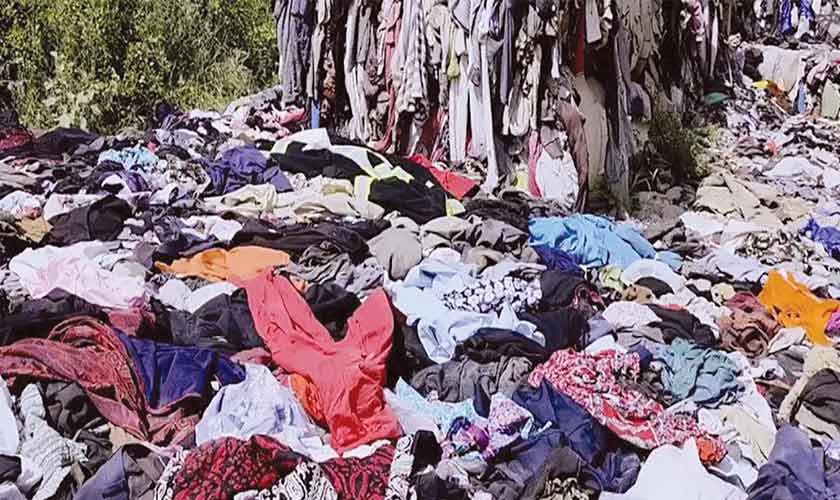
A policy brief from the Pakistan Institute of Development Economics (PIDE) reports that the European Union (EU) exported used clothing worth $46 million to Pakistan in 2021, which ended up in secondhand markets and dumping sites. As per the United Nations Environment Programme (UNEP), we need 3,000 to 4,000 litres of water to produce a pair of jeans. Similarly, WWF notes that producing one t-shirt requires 20,000 litres of water.
The already given facts highlight the dire need for us to recycle, reuse and repair textile waste in Pakistan and we simply cannot take this for granted. Circular and sustainable textiles produced from textile waste can help us mitigate the needs of a growing population, boost economic growth over the coming decade and increase business and development cooperation between Pakistan and the EU.
In the world of fast fashion,we need to slow down and consider our environmental impact. The European Parliament points out that we need land to grow cotton and fibres and a massive amount of water to produce textiles
We desperately need to shift our perspective on textile waste in Pakistan. Let’s look at it from the viewpoint of total resource utilisation. As noted, the EU exported used clothing valued at $46 million to Pakistan in 2021. Imagine: the shipment of clothes from the EU contained 100,000 pairs of jeans. The country that produces these 100,000 pairs of jeans might have used 300-400 million litres of water across the entire production process. Similarly, in case the exported garments had 100,000 t-shirts in it, the country of origin for t-shirts might have used a whopping two billion litres of water during the whole production process. Beyond water, we need fossil fuels to power tractors and harvesters that produce cotton.
In most cases, we rely on fossil fuels to generate electricity, which we then use to produce garments. We need fossil fuels to transport garments from the factory to boutiques, and we again rely on fossil fuels to export textiles from the EU to Pakistan. Thus, we must do all it takes to turn waste textiles into something meaningful, repair them or donate them to charities that will distribute them to people who cannot otherwise afford multiple clothing items.
There are many textile recycling and repurposing solutions that we can rely on to solve textile waste in Pakistan. Sana Khan is the founder of Earthy Murkey, a brand based in Pakistan that makes handbags from waste fabrics and leather. It is an excellent example of women’s empowerment, entrepreneurship, and the transformation of textile waste into practical, meaningful products in Pakistan.
Similarly, RESPUN is another start-up that transforms textile waste into circular textiles. It sorts textiles by colour, fabric, and quality, then removes buttons and zips, and finally converts waste textiles into recycled fibre that can be used in home furnishings and locomotive insulation. Here are two more examples of women’s empowerment: addressing the textile waste curve and entrepreneurship.
Sandra Junele is a Scotland-based artist who turns textile waste into meaningful art pieces, helping reduce the local textile waste stream. Finally, Clarisse Merlet is the CEO and founder of a French start-up, FabBRICK, that turns textile waste into bricks that could then be deployed to construct walls and furniture.
In short, in the world of fast fashion, we need to slow down and consider our environmental impact. The European Parliament points out that we need land to grow cotton and fibres and a massive amount of water to produce textiles. Thus, textile production is both land and water-intensive. Do you know that we need 2,700 litres of fresh water to produce a cotton t-shirt? It is enough water to satisfy a person’s drinking needs for roughly 2.5 years. Thus, recycling, reusing and repurposing textile waste would help us save water, land and electricity, and prevent the use of fossil fuels in textile production. By upcycling textile waste, we can reduce our greenhouse gas emissions and minimise the consequences of climate change.
Research published in the Pakistan Journal of Scientific and Industrial Research indicates that Pakistan generates approximately 270,125.34 metric tons of textile waste annually. There is a dire need for the National Assembly of Pakistan to impose a strict ban on textile dumping in the country. Simultaneously, it is crucial for the government of Pakistan to mature the textile recycling industry and employ women and girls in this sector to transform waste textiles into meaningful and creative products.
Imagine Pakistan, in a decade, among the top five countries exporting circular, sustainable textiles made from recycled waste textiles. That would be a much-needed step to combat poverty, reduce textile waste, and preserve the country’s land, water and electricity resources. We have the capacity to eliminate textile waste in Pakistan and transform it into creative products. We need to act now. Choice is ours and will always be.
The writer is a Stockholm-based policy analyst and the founder /operations manager of Project Green Earth (www.projectge.org). He can be reached at: [email protected]