Pakistan’s energy sector is once again at a crossroads. The issue surrounding the proposed 18 per cent sales tax on imported solar panels, later rejected by the National Assembly and Senate standing committees, triggered a fierce public debate, after which it was reduced to 10 per cent.
ENERGY SECTOR
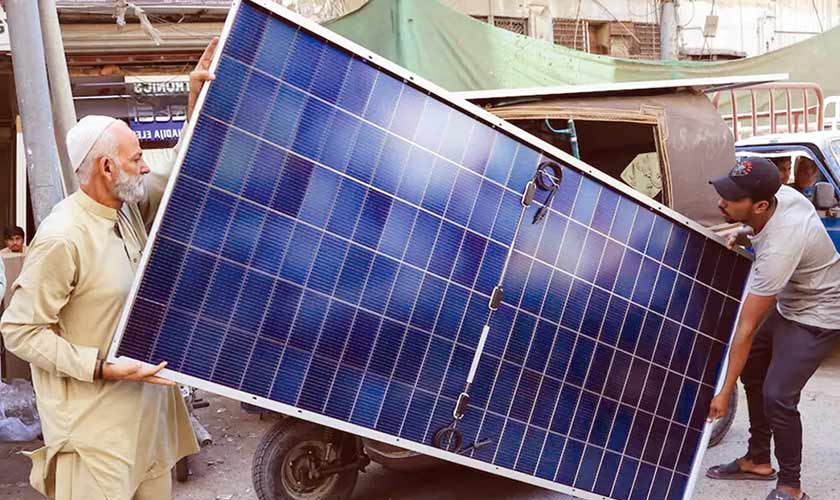
Pakistan’s energy sector is once again at a crossroads. The issue surrounding the proposed 18 per cent sales tax on imported solar panels, later rejected by the National Assembly and Senate standing committees, triggered a fierce public debate, after which it was reduced to 10 per cent.
While the rejection at that time may appear to signal a victory for clean energy advocacy, it has left a critical conversation unaddressed about who truly bears the cost of Pakistan’s rooftop solar boom, and what are the unintended consequences for the nation’s power grid and fiscal stability?
The allure of solar panels is undeniable. They offer households and businesses greater energy independence and promise lower monthly electricity bills. But in this growing enthusiasm lies a structural imbalance that Pakistan can no longer afford to overlook. Behind every rooftop solar success story is a silent transfer of financial responsibility from solar adopters to millions of ordinary electricity consumers who remain connected to the grid and from whom distribution companies must recover costs to keep the power system afloat.
The country’s power infrastructure was never built to accommodate a surge of micro-generators feeding electricity into the grid on an ad hoc basis. Pakistan's net metering policy, generous in its original intent, allowed solar customers to export excess electricity to the grid and receive credits often well above the actual avoided cost of generation.
The result? A financial model in which high-income solar adopters effectively reduce their contribution to shared infrastructure while relying on it for backup and stability, shifting the burden of fixed-grid maintenance costs to non-solar users, many of whom are from vulnerable segments.
According to government data, cost transfers to non-solar consumers reached an estimated Rs159 billion, and without reform, projected losses could exceed Rs500 billion over the next decade. These are not minor discrepancies and represent the crumbling foundation of Pakistan’s centralised energy architecture.
Opponents of the newly structured solar panel tax have argued that taxing solar panels will slow solar adoption and threaten Pakistan’s climate goals. However, this is well-intentioned but incomplete. Promoting clean energy does not require blind subsidies. It requires intelligent reform.
Solar energy, like any industry, must evolve beyond artificial price support structures and operate within a framework that is equitable, transparent and aligned with national priorities
Solar energy, like any industry, must evolve beyond artificial price support structures and operate within a framework that is equitable, transparent and aligned with national priorities. Tax on imported panels, especially as global prices have declined sharply in recent years, can be seen as a strategic tool to slow unregulated expansion, recalibrate policy, and redirect focus to grid upgrades and utility-scale renewable projects.
This is not a novel approach. In California, where rooftop solar adoption surged in the past decade, regulators introduced Net Energy Metering 3.0 to reduce export rates and promote battery storage. Germany introduced technical limits to prevent grid overload from decentralised solar, while Australia allowed utilities to charge fees during peak solar export hours to manage supply volatility. These policy pivots were not designed to stifle solar, rather they were aimed at making it sustainable and fair. Pakistan needs to borrow a page from these playbooks and craft a policy that supports renewable growth without collapsing the financial ecosystem on which power reliability depends.
It is worth noting that utility-scale solar projects remain the most efficient and grid-compatible path toward renewable energy. A single 100MW solar farm, connected via a purpose-built transmission line, is far easier to integrate than thousands of scattered rooftop systems that inject unpredictable power into urban networks.
K-Electric’s upcoming 220MW Dhabeji Hybrid project, featuring a record-low tariff of 3.09 cents/kWh, exemplifies how renewables can be scaled without destabilising the grid or burdening consumers. Similar initiatives are underway in Balochistan, with the utility pursuing 150MW in clean energy capacity. These efforts reflect a more systemic approach to decarbonisation.
Pakistan’s power sector is already under strain from circular debt, tariff subsidies, and fluctuating fuel costs. Every policy decision, especially one as critical as solar import taxation, must be evaluated not only through environmental and public sentiment lenses but also through fiscal and infrastructure realities. The solar tax debate presents an opportunity to pursue broader reforms, including recalibrating net metering, mandating battery storage for new rooftop systems, implementing time-of-use tariffs and implementing equitable cost-sharing mechanisms. Instead, the conversation had reduced to simplistic binaries of pro- and anti-solar.
Policymakers must recalibrate net metering policies to reflect true grid costs, introduce equitable grid maintenance fees for solar users, and incentivise battery storage to mitigate erratic power injections. These measures, modelled on successful international frameworks, would preserve momentum for renewables while safeguarding the system’s financial viability.
For utilities and distribution companies, collaboration with regulators is key, as only through balanced, data-driven dialogue can Pakistan harmonise solar expansion with the imperatives of grid stability and energy equity, ensuring progress that benefits all consumers, not just a privileged few
The writer has served at the Energy Conservation Fund, NEECA. He can be reached at: [email protected]