Print Story
X




A dominant ITF season highlights his potential but sustained support will define his future
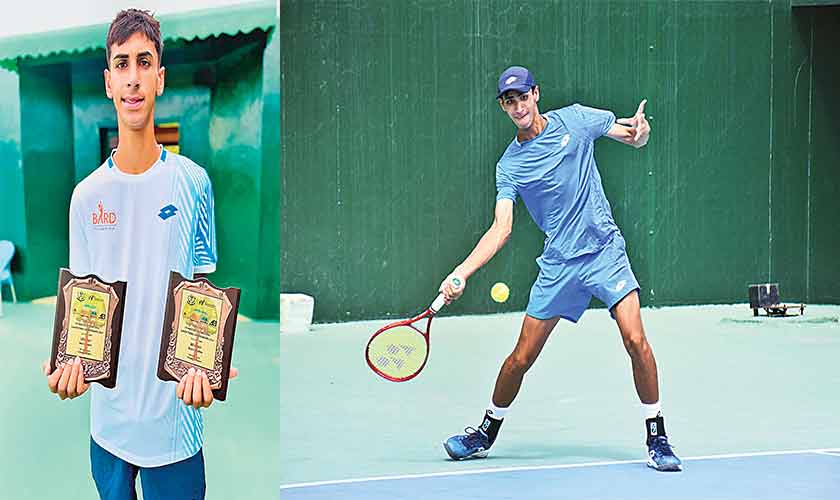
Pakistan sport has never suffered from a lack of talent, it has suffered from a lack of continuity, planning, and support. Every few years, a promising athlete emerges, raises hopes, and reminds us of what could be. In tennis, that promise currently carries the name Mikaeel Ali Baig.
Over the past few months, Mikaeel has quietly but emphatically begun to announce himself on the international junior circuit. His latest achievement at the ITF J30 tournament in Islamabad, where he swept both the singles and doubles titles, was not just another victory. It was a statement. A statement of consistency, of temperament, and of a player who is beginning to understand how to win.
What makes this achievement even more significant is its timing and context. Just a week earlier, Mikaeel had already claimed the doubles title at another ITF event at the same venue. To return under similar conditions and produce another title-winning performance speaks volumes about his adaptability and mental strength, qualities that separate good players from future professionals.
But beyond the trophies and statistics lies a deeper narrative, one that Pakistan must pay close attention to. Mikaeel now has 14 ITF titles to his name, a milestone that reflects not just talent, but sustained performance. Earlier this year, he achieved a remarkable singles and doubles sweep at an ITF event in Jamaica, proving that his game travels well across surfaces and continents. That victory was not an isolated success; it was the beginning of a pattern.
In 2026, Mikaeel has shown consistency, arguably the most important currency in modern tennis. He is no longer just participating in tournaments; he is competing to win them. His game has evolved noticeably. There is greater composure in his shot selection, improved physical conditioning, and a more aggressive approach that allows him to dictate points rather than react.
From a cricketing perspective, one might compare this transition to a player moving from domestic promise to international readiness. The technique may already be there, but what truly matters is the ability to deliver under pressure, and Mikaeel is beginning to demonstrate exactly that. However, this is where the real challenge begins.
Junior success, while encouraging, is only the first step in what is an extremely demanding journey. The transition from ITF juniors to the ATP circuit is perhaps one of the toughest in global sport.
It requires not only skill and mental toughness but also something Pakistan has historically struggled to provide: structured and sustained support.
To compete at the highest level, a player must participate regularly in international tournaments. Rankings are not built on isolated performances; they are built on consistency, exposure, and the ability to compete week in and week out against top-tier opposition. Travel, coaching, fitness training, and tournament participation all come at a cost, one that cannot be borne by talent alone. This is where institutions must step in.
The Pakistan Tennis Federation has certainly made efforts to revive the sport, and hosting ITF events in Islamabad is a positive sign. Mikaeel himself acknowledged the professionalism, security, and international participation at the event, an encouraging reflection of improving standards. But organizing tournaments at home is only one part of the equation.
The bigger question is: what happens next? If Mikaeel is to fulfill his potential and represent Pakistan at the ATP level, and perhaps even at Grand Slams, he will need a clear pathway. This includes financial backing, access to high-performance coaching, international exposure, and a calendar that allows him to compete consistently across different regions.
Equally important is the role of the corporate sector. In countries with successful sporting ecosystems, private sponsorship often bridges the gap between talent and opportunity. Pakistan must recognise that investing in athletes like Mikaeel is not just about individual success, it is about national representation, global visibility, and long-term sporting culture.
There is also a broader lesson here. Pakistan tennis has, in the past, produced players who showed promise but were unable to sustain their progress due to systemic limitations. The risk is not a lack of talent; the risk is losing that talent before it fully matures.
Mikaeel Ali Baig stands at a crucial juncture. He has the ability, the discipline, and the results to suggest that he can go much further. But potential, no matter how bright, requires nurturing. Without consistent support, even the most promising careers can stall.
What makes Mikaeel’s journey particularly compelling is his attitude. His recent performances reflect not just technical growth, but mental resilience. He is learning to handle pressure, adapt to different match situations, and maintain focus across tournaments. These are not small achievements, they are the building blocks of a professional career.
The road ahead, however, will be far more demanding. The level of competition will rise, expectations will grow, and the margin for error will shrink. This is precisely why the support system around him must evolve now, not later.
Pakistan has an opportunity here. An opportunity to do things differently. To identify a rising talent early, to invest in him, and to provide the resources needed to compete at the highest level. It is an opportunity not just to support a player, but to set a precedent.
Because if Mikaeel succeeds, it will not only be his victory, it will be a statement that Pakistan can still produce and sustain world-class athletes beyond its traditional strongholds. For now, the signs are promising. The titles are coming, the confidence is growing, and the trajectory is upward.
The question is no longer whether Mikaeel Ali Baig has the potential. The real question is whether Pakistan will give him the platform to realize it.