Print Story
X




House Specialty Coffee offers — other than coffee — the right to sit close enough to four centuries of history where it begins to feel like your own
| A |
s people step into the café on the ground floor, the sheer density of the décor gives them a pause. Everywhere you look, there is staged opulence: oversized crystal chandeliers heavy with light; gilded velvet settees that seem designed for a period drama set rather than for rest; and walls crowded with ornate, gold-framed mirrors that catch and splinter the light into a dozen directions.
Bunches of people drift towards the elevator — a sleek, brushed-metal capsule that feels jarringly out of place among the vintage brass and velvet. As the doors hiss shut, the heavy, staged opulence of the ground floor is replaced by a clinical silence. The ascent is brief but functions as a necessary cleanse. It strips away the clutter of the shop’s manufactured past and prepares the patron for the main attraction: the unobstructed horizon. Here, the artifice of the interior gives way to a different kind of staging, one where the city itself is transformed into a luxury backdrop.
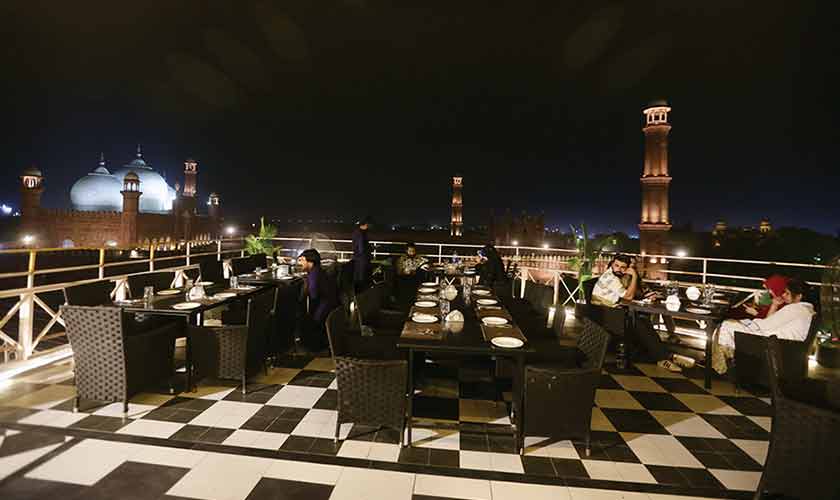
There is a specific kind of silence that falls when a camera shutter clicks. A moment where the messy, unscripted reality of Lahore is suddenly flattened into a two-dimensional frame. In the background of the rooftop of House Specialty Coffee, the Badshahi Masjid rises like the enormous red sandstone structure it’s always been, its three marble-clad domes held aloft by centuries of history, seemingly indifferent to the city unfolding around its perimeter.
A few feet away, the scene is governed by a different set of laws: the precise angle of a porcelain cup, the froth of a foam latte and the frantic need to capture a version of the city that looks more like a movie set than living, breathing history.
The rooftop operates on an unspoken agreement: you are here for the view and the feeling it gives you. The ambience is secondary. The conversation is secondary. Even the coffee — technically the whole point of the café — is secondary. What you are really purchasing is proximity. The right to sit close enough to four centuries of history that it begins to feel, briefly, like your own.
Most of the people here do not live anywhere near androon Lahore. They drove in from Gulberg, from DHA, from the wide, tree-lined streets where the city’s past exists mostly as a talking point. They navigated the wide-lane expanse of the new CBD grid where the asphalt still gleams like fresh oil, the contrasting stop-and-start crawl of Canal Road then the sudden press of bodies that androon Lahore generates at any hour of the day. They arrived here faintly disoriented, slightly sweaty, ready to be rewarded.
The café is the reward. It is a decompression chamber: air-conditioned, curated, and most importantly, facing the right direction.
On the terrace, the air is thick with the roasted-nut scent of high-end espresso and the faint, chemically sweet undertone of the shop’s air-fresheners; a scent profile that acts as a sensory buffer against the raw, unscripted breath of the city rising from the bazaar below.
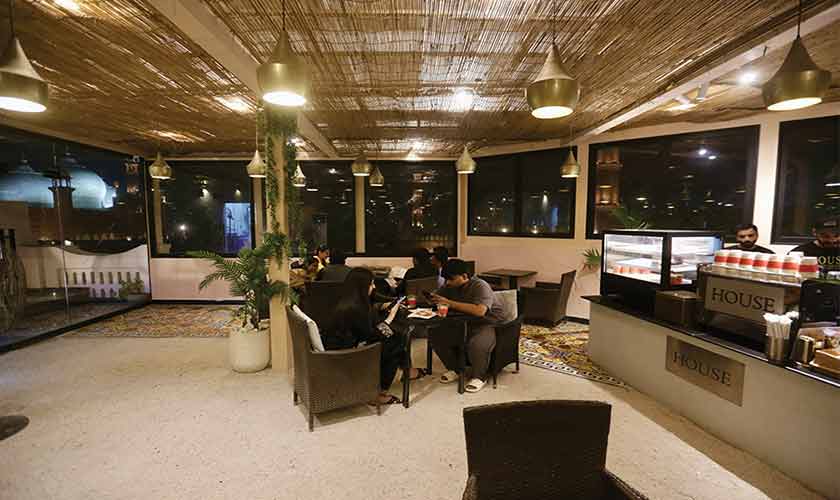
The rooftop operates on an unspoken agreement: you are here for the view and the feeling it gives you. The ambience is secondary. The conversation is secondary. Even the coffee — technically the whole point of the café — is secondary. What you are really purchasing is proximity.
Standing on that rooftop, with the call to prayer still dissolving in the air and the mosque’s sandstone walls catching the last of the afternoon light, you feel something genuine. The smell of something frying in the street below — tallow and cumin and something older that has no name — drifts up uninvited. For a moment, the distance between the porcelain cup in your hand and the city spreading out beneath you collapses entirely. You are simply there, in Lahore, a city that is perpetually being rediscovered, yet forever slipping through our fingers.
The moment passes. The shutter clicks. The caption is typed. The city, unedited and unfiltered, contracts back to the size of a screen.
This is the question that House Specialty Coffee perhaps tries to answer: is it a door, or is it a painting of one? In theory, a café like this could be a genuine point of entry, a reason for a generation raised on MM Alam Road and in Packages Mall to find their way into a part of the city they have been taught to find inconvenient. The food street in Gowalmandi was the last attempt at this. Before that it was the Haveli. Every time, the argument is the same. Dress it up, make it comfortable, make it photographable; and they will come. They do come. The tables are full. The elevator runs constantly.
The harder to answer question is what do they find when they get here and whether the finding changes anything. The neighbourhood outside the café doors is not a set. The henna-stained hands of the woman negotiating at a stall below belong to a Lahore that does not need reclaiming because it never stopped being claimed. It simply continued, slower because it was indifferent to being discovered.
The girl who grew up in a Defence bungalow, who took the elevator up and now stands at the railing with her iced latte in her hand, is looking at the mosque with something that is not entirely aesthetic. Something in the call to prayer, bouncing off the sandstone and arriving at her chest before her ears, is doing work that no Instagram caption can neutralise. The city is getting through. Imperfectly and commercially, through the distorting lens of a curated experience, here it gets through.
Whether that counts as access or consumption is a question Lahore has never had the patience to answer plainly. The city has always been re-made by whoever arrives next: the Mughals, the Sikhs, the British and now the brunch crowd, each group convinced that it was the one finally doing the place justice.
The mosque has seen them all. It will see the next ones too as it continues to rise from its sandstone foundations, its domes neither approving nor condemning, waiting with the patience of something that knows it will outlast the argument.
The elevator doors open. A new group steps out, phones already raised. Below, the city carries on.
Nadia Ahmed Uqaili is a content strategist with over five years of global agency experience. She also writes short fiction on Substack. She can be reached at [email protected]