Print Story
X




Karachi Literature Festival, held at the turn of the season this year, featured thoughtful conversations, exchanges on fiction and riveting performances
| T |
he sky over Rawalpindi is clear and full of stars. There are no omens written in the clouds; no storms gathering; no blood about to rain down. Nothing in the heavens signals what is about to happen on the ground.
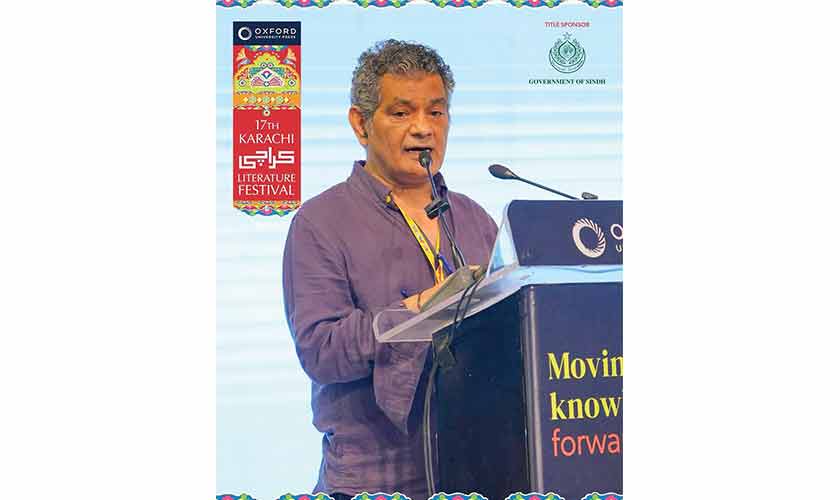
That is how Hanif begins reading from his new novel, Rebel English Academy. For a moment the Karachi Literature Festival fades away. The crowd, the lights, the banners, the polite clinking of tea cups disappear. Instead there is a prison cell; in it a man waiting to die.
The man asks for a safety razor. In death, he says, he does not want to look like a cleric. Permission is sought. A barber is called. His face is shaved gently, even the soft fuzz around his ears carefully removed. He asks for a cigar. This time no permission is needed. No one scheduled to be hanged in a few hours has ever tried to kill himself with a Monte Cristo. He takes two puffs, regrets it, and thinks he should have quit earlier.
He sprays on some perfume. He listens to a mosquito buzz near his ear. On any other night, he might have complained about the prison conditions. Tonight, he waves it away lazily. He is grateful for the company.
Everyone agrees on these details, Hanif reads. Those who want him dead. Those who want him saved. Those who want a martyr by morning. Those who do not care. All agree that the man lies down, pulls a sheet over himself, and stays very still, rehearsing being dead.
When Hanif stops reading, the silence in the hall is heavy. This is not history, exactly. But it is not fiction either. It sits in that uncomfortable space Pakistan knows too well, where rumours live longer than facts and stories never quite end.
Hanif smiles, slightly awkwardly, as applause follows. He says it took him seven years to write the book. Once a book is published, he says, writers are expected to say intelligent things about it — a task he does not always enjoy.
His most honest literary critic, he explains, is his eleven-year-old son. In a message sent that morning, the boy wrote: “This book is the culmination of all the work you have ever done.” Then he added a warning: “Please do not read out the dirty bits.”
Hanif promises he is following that advice. Mostly.
It is a small, almost throwaway moment, but it grounds the evening. This is not a writer speaking from a distant tower. This is a father, a citizen, someone who jokes because the alternative is silence.
Hanif tells the audience he did not grow up in a city. He grew up in a village where the city existed as fantasy. When he first went to a city school in Okara, he was astonished by doorbells, drawing rooms, dining tables and people who spoke Urdu and called their parents “Mummy” and “Papa.”
Back home, he remembers, tea was only for sick or dying people.
That culture shock stayed with him. Like many of his generation, he moved from village to city, from city to megacity — ending up eventually on stages, talking about books and life. It is a familiar Pakistani journey: migration not just across geography, but also across class, language and imagination.
Rebel English Academy grows directly out of this experience. It is about ambition, about learning English, about wanting to move just a little forward in life. It is not about becoming powerful — just less invisible.
Hanif writes fiction in English. He does journalism in Urdu. Sometimes he writes in Punjabi. People, he says, accuse him of running a long con, lying to three different audiences at once. But for people like him, there was never a choice.
He was educated first in Punjabi, then in Urdu, and then suddenly, at college, in English. Someone once described Pakistani life perfectly, Hanif says: at home, mothers speak Punjabi; at school, teachers speak Urdu; at college, professors speak English; and when we die, our accounts will be taken in Arabic.
This confusion is not accidental. It is structural. And it shapes who gets ahead.
The book, he says, is about people learning just enough English to survive — to sit on a stage, to get a job, to be taken seriously. It is about how language becomes power without ever announcing itself as such.
Hanif speaks carefully when he talks about institutions. He says he comes from inside the institution that everyone talks about. It exists everywhere, he adds, and he hopes it is in the room, listening carefully.
When his first novel came out, some journalists warned him: “Have you gone mad? How can you write this?” His response was always the same: it is a novel. It says so on the cover.
Stories, he reminds the audience, are an old trade. Heer Ranjha. Sassi Punnu. Some people believe they happened exactly as they are told. Those who read a lot understand that writers shape their reality.
Hanif insists that he writes from a place of love. Someone once described his first novel as a love letter to the institution. He liked that description. “I write those love letters voluntarily,” he says.
Yes, there is a young captain in the book. Who does not love a young captain? That is innocence, he says. Once they become generals, nothing can be done. He wanted to return to the moment before power hardens.
The joke lands. It also cuts close to the bone.
The Karachi Literature Festival takes place once a year. Hanif reminds the audience of Sabeen Mahmud, who held a festival every day. She used to say, “Fear is a line in your head.” Fear, he says, is not a line in your head. It is a bullet in your head. Often several. He is not sure whether we are scared enough yet.
It is one of the quietest moments of the evening. No slogans. No dramatic pauses. Just an observation delivered calmly, like a fact everyone already knows but rarely says out loud.
Later, Hanif speaks about Junaid Hafeez. Hafeez was a gifted student from Rajanpur. He topped his board exams. He won a gold medal. He made it to King Edward Medical College — the ultimate dream for many Pakistani families.
Then he made what Hanif calls a “silly” but deeply human choice. He left medicine for literature. A doctor, Hanif says, lives one linear life. A reader and writer live many lives in one lifetime.
Hafeez studied literature abroad, returned to Pakistan, did an MPhil, and began teaching. Then, in a classroom meant for adab, he allegedly committed be-adabi. No one dares repeat what he is accused of saying.
He was arrested. His lawyer was murdered. He was sentenced to death.
For thirteen years, Hafeez has lived in solitary confinement. Appeals unheard. Time frozen. Journalists, Hanif says, are warned that even writing about him might “get them into trouble.”
“What trouble,” Hanif asks, “can come to a man already condemned to die?”
He reminds the audience that danger is not the same for everyone. Some people enjoy applause and free coffee. One man sits alone in a cell.
Even if one believes Hafeez guilty, Hanif says, prayer, remembrance and speech remain acts of humanity. Silence, he suggests, helps no one except power.
| T |
his year’s Karachi Literature Festival brought together more than 200 participants from eight countries. There were over 90 sessions, 28 book launches in English, Urdu and Sindhi, films, theatre, qawwali, rap and classical music.
A Youth Pavilion buzzed with workshops and storytelling. New additions like debates, mushairas and school competitions tried to draw in younger audiences.
Fragility hung in the air. Some sessions were thinly attended. Critics pointed to empty seats, especially at the mushaira. But numbers tell only part of the story.
The theme this year was Literature in a Fragile World. Few themes have felt so literal.
In one panel, senior journalists spoke bluntly about shrinking freedoms. Veteran columnist Ghazi Salahuddin said the post-World War II global order was breaking down, creating chaos in which journalism struggled to breathe.
Sometimes, he said, fiction spoke the truth more effectively than journalism because the space for reporting has narrowed so much.
Geo News managing director Azhar Abbas described how censorship rarely arrived as a ban. Instead, advertising was blocked. Money dried up. Self-censorship followed. Red lines, he said, shifted overnight. A reporter went to bed unsure of what will be unacceptable by morning.
Digital media, journalist Nadia Naqvi noted, had increased awareness but also confusion. Truth and falsehood travelled at the same speed. Still, she argued, people turned to responsible journalism when it mattered most.
Dr Miftah Ismail offered a different diagnosis of fragility. Pakistan, he said, was stuck in a low-growth equilibrium: low growth, high unemployment and high poverty.
This was not because individuals were bad or incompetent, he said, but because the system pushed the country into stagnation. Terrorism, uncontrolled population growth, failing education, wasteful spending and broken incentives had locked Pakistan into “bust-to-bust” cycles.
Asad Umar echoed the frustration. Pakistan’s industrial structure, he said was outdated; its economy choked by uncertainty. Without clear governance, competition and rule of law, no economy could grow.
Historian Sam Dalrymple widened the lens further. South Asia’s problems, he stated, could not be understood through 1947 alone. Partition, he said, happened not once, but multiple times — beginning with Burma’s separation in 1937.
Borders were rushed, arbitrary and often accidental. Libraries were split. Artefacts cut in half. Paperwork lost. Deadlines missed.
We are still living, Dalrymple warned, in the aftershocks of an empire that shattered badly.
Discussions around censorship, creative freedom and the declining focus on social issues in television drama took centre stage. Actors and directors argued that audience preferences play a decisive role in determining what succeeds on screen.
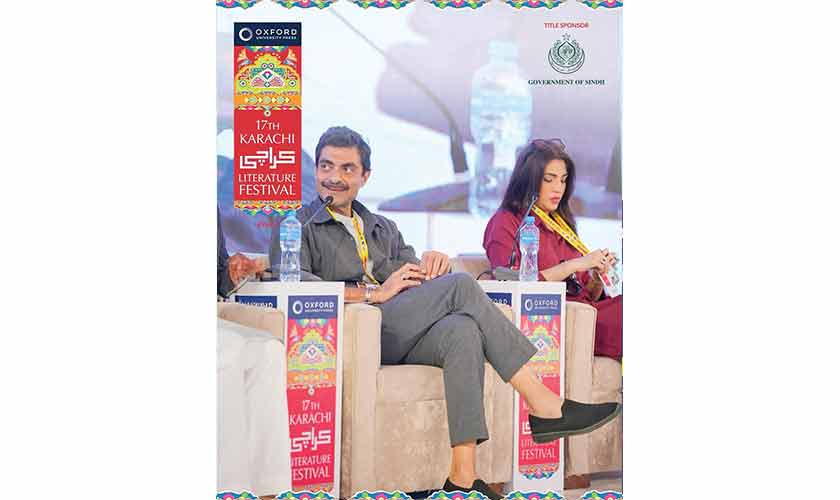
Actor Ahmed Ali Akbar said that while direct threats were rare today, artists still faced strong social resistance. “I was never threatened, but I was discouraged a lot,” he said. “When Parizaad started, even my family asked why I was doing it. There was a point when I seriously thought about what my alternative career could be.”
Panellists stressed that commercial success reflects viewer choices as much as producer decisions. “We only place content on the table,” one speaker said. “What becomes a hit or a flop reflects what the audience chooses to consume. What goes viral is actually a reflection of the audience’s own psychology.”
Director Saif Hassan rejected constant comparisons with the state broadcaster’s past, saying the industry had changed dramatically. “In the PTV era, no more than 20 dramas were produced in an entire year. Today, over 100 are made annually,” he said. “Private production has transformed artists’ survival and visibility, even if it comes with commercial pressures.”
Actor and writer Zhalay Sarhadi emphasised the importance of realism over linguistic or stylistic perfection. “When we portray characters from real life, they will not speak textbook Urdu,” she said. “Our job is to reflect people as they are. Urdu is a living language. Living languages are flexible—they absorb, they evolve.”
Audience members called for a stronger engagement with issues such as education, healthcare and the justice system. A lawyer in the audience noted that legal cases can take decades to conclude. “A case can follow a person from lower courts to the Supreme Court and consume their entire life,” he said, urging writers to address institutional failure more directly.
Sarhadi agreed that social responsibility and authenticity must go hand in hand. “There are places where correct pronunciation matters, and there are places where it doesn’t,” she said. “What matters most is honesty in storytelling. If we lose that, no amount of technical correctness can save a drama.”
The session concluded with panellists agreeing that meaningful storytelling required shared responsibility—between institutions, creators and audiences alike.
The writer is a freelance journalist and a researcher. Her X handle: @FehmidaRiaz