Print Story
X




A blockbuster need not persuade to exercise power. It only needs to arrive first. The reception of Dhurandhar exposes how contemporary cinema structures belief, polices criticism and turns plausibility into a form of control
| C |
inema rarely announces itself as propaganda. When it does, the declaration is usually clumsy enough to be resisted. The more effective form of propaganda arrives under the cover of genre, plausibility and technical confidence. It asks first to be consumed and only later to be examined. By the time interrogation begins, the emotional work has already been done.
Dhurandhar did not need to declare an agenda to provoke one. Whatever politics it carries did not surface most forcefully on screen, but in the turbulence that followed its release. Indian film critics faced organised backlash. Television studios closed ranks. Pakistani newsrooms parsed familiar misrecognitions. Baloch commentators found themselves pressed into a choice they had been asked to make too many times before: decide whether they had been seen or merely used.
The film’s significance lies less in what it depicts than in what it activates. It is not a work that demands agreement. It demands orientation. It invites viewers to recognise certain things instantly, to accept certain connections as self-evident and to treat others as implausible by default. What follows, across borders, is not a debate about cinema but a contest over whose version of reality arrives first and settles hardest.
This piece is not a review of Dhurandhar. It does not weigh performances, pacing or spectacle. It is a meditation on reception. On why the film landed where it did. On why its claims to fiction proved insufficient insulation against demands for accountability. And on what its afterlife reveals about how cinema now shapes plausibility in a world where narratives travel faster than rebuttals and arrive pre-aligned with power.
Dhurandhar insists on narrative licence and on the freedom of genre to bend history into suspense. Yet the intensity of its reception exposes a deeper condition. Some fictions enter public space already charged. In such cases, invention cannot be disentangled from implication. Plausibility itself becomes political.
Discursive gravity and the weight of certain stories
At the centre of this condition is what might be called discursive gravity. Some stories fall heavier than others. They circulate faster, settle deeper and require fewer corrections to be believed. They draw on familiar emotional templates and established hierarchies of credibility. When a film produced within a dominant cinematic economy maps another society through tropes of disorder, intrigue and latent menace, it does more than entertain - it tilts the interpretive field.
This tilt does not require malice. It does not even require intention. It operates through scale, repetition and timing. A large industry with global reach does not merely tell stories; it shapes them. It sets defaults. It decides which images feel intuitive and which require explanation. The labour of rebuttal begins immediately, but it starts unevenly.
In such a media ecology, fiction enjoys an asymmetrical advantage. It arrives whole. It travels intact. It asks little of the viewer except recognition. Correction, by contrast, arrives fragmented. It must annotate, contextualise and argue. It must speak in footnotes to an audience already moved on.
Nowhere is this imbalance more evident than in Dhurandhar’s representation of Karachi.
Karachi, Lyari and the compression of place
The film’s portrayal of Karachi, particularly the Lyari neighbourhood, follows a recognisable cinematic syntax. The city is framed as a volatile frontier where criminal violence bleeds seamlessly into espionage and national security intrigue. It is a dangerous city as a geopolitical threshold, legible primarily through threat.
Karachi-based journalists were quick to object, not because the city has been depicted as violent, but because of how violence is reassigned. The real Lyari gang wars were not extensions of India-Pakistan hostilities. They were not linked to Indian intelligence operations or global terror networks. They were intensely local conflicts, shaped by Karachi’s political economy, party rivalries, patronage systems and criminal infrastructures.
For decades, scholars and reporters had described Karachi as a city of “ordered disorder.” Violence was not an aberration but a form of governance, mediated through brokers, neighbourhood loyalties, political parties and informal sovereignties. Lyari was not a rogue enclave on the edge of the state. It was a dense political ecology shaped by migration histories, sporting cultures, municipal neglect and the slow erosion of civic responsibility.
It is this texture that Dhurandhar compresses. By folding Lyari into a spy narrative, the film does more than fictionalise events. It reassigns causality. Neighbourhood history becomes geopolitical backdrop. Local dynamics are rendered intelligible only once absorbed into a national security script.
What disappears is not simply accuracy. It is proportion. The understanding that violence in Karachi was produced internally, through overlapping regimes of control, rather than being imported wholesale from across the border. The compression is not merely spatial. It is moral.
The response from Karachi’s journalists has, therefore, taken the form of a correction rather than a counter-narrative. Geography is annotated. History is clarified. Context is restored. The insistence is less on telling a better story than on resisting a dominant one. This asymmetry matters. A spectacle arrives whole. Rebuttals arrive piecemeal.
Baloch culture and the limits of visibility
The foregrounding of Baloch cultural markers has been among the most discussed and divisive aspects of Dhurandhar’s reception. On the surface, the film appears to depart from Bollywood’s habitual flattening of Pakistani identity. Balochi language cues, music and visual motifs are introduced. Some Baloch viewers acknowledged moments of unexpected care, particularly in pronunciation and costuming.
Others rejected these gestures outright. They argued that cultural markers were deployed ornamentally, stripped of political depth or narrative agency. Culture appears, but nothing shifts. Presence becomes atmosphere rather than recognition.
These objections are not new. Debates over Balochi cinema stretch back decades, when early films became flashpoints precisely because authenticity and authorship mattered deeply in Baloch public life. Representation was never neutral; it was contested terrain.
Seen in this extended media history, the anxieties surrounding Dhurandhar are not reactive but cumulative. They reflect a recurring tension between visibility and power. To be seen is not the same as being allowed to speak. Cultural texture can coexist easily with narrative dispossession.
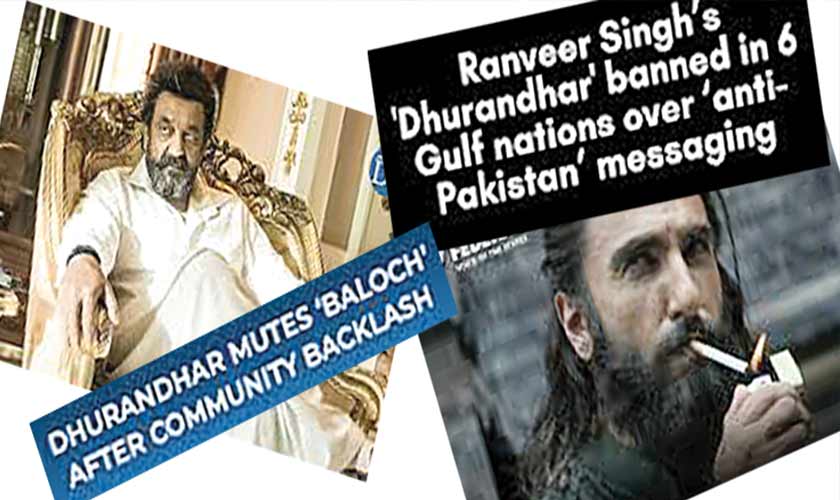
The disagreement, then, is not about whether Baloch identity is visible, but about what that visibility is permitted to do.
Internal debate and narrative fatigue
What complicates any easy reading of Dhurandhar as simple anti-Pakistan propaganda is that much of the most sustained criticism has emerged within Pakistan and not in a single register. Reporting in outlets such as The Express Tribune noted that the film reignited familiar India-Pakistan arguments online, but with a distinct undertone of fatigue.
Commentators oscillated between condemnation and resignation. Some objected sharply to the film’s framing. Others conceded its technical competence while lamenting that Pakistan’s own cultural industries had failed to tell these stories with comparable reach.
This reflexive turn is telling. It confirms that narrative asymmetry does not require hostility to operate. Where local industries lack the resources or political space to narrate their own histories at scale, external narratives acquire disproportionate interpretive weight, even when contested.
The result is a double bind. To object to misrepresentation is to acknowledge its reach. To remain silent is to allow it to settle.
International reporting also makes clear that Dhurandhar did not arrive on time. Its release coincided with renewed India-Pakistan tensions, when public sentiment was already primed to read narrative gestures as geopolitical signals. In such a climate, fiction is not encountered as play but as a position.
The film’s reception has been shaped as much by jurisdictional deflection as by aesthetic debate: a Pakistani court dismissed calls for criminal proceedings against Dhurandhar’s makers, noting the limits of its reach and quietly consigning outrage to the realm of media spectacle rather than law. At the same time, the muting of the word “Baloch” in certain prints—officially framed not as state censorship but as a voluntary adjustment—has only intensified the sense that the film’s afterlife is being negotiated in the shadows between political sensitivity, preemptive compliance and the anxieties of transnational address.
Reception becomes temporally saturated.
Discipline, not debate
Context helps explain why dissent hardened so quickly and why criticism itself became risky. As reported by Al Jazeera, reviewers who questioned the film’s political framing faced organised harassment. At least one critical review was withdrawn under pressure.
What emerges here is not mere controversy but discipline—reception shifts from interpretation to exposure. The afterlife of the film begins to resemble a loyalty test rather than a field of judgment.
In a media ecology where popular cinema functions as moral reassurance, criticism is increasingly perceived not as disagreement but as disturbance. Films like Dhurandhar do not simply seek approval. They stabilise a sense of collective righteousness.
Within such a structure, dissent becomes intolerable not because it is wrong, but because it unsettles consensus.
Indian critics themselves have warned that the problem is not any single narrative choice but the narrowing of cinematic latitude. In an environment of anticipatory alignment, certain stories become easier to tell, while others become riskier by default.
The anxiety is not that propaganda is mandated. It has become the path of least resistance.
As Pooja Pillai has argued in The Indian Express, the grievance animating backlash against criticism collapses under scrutiny. Films like Dhurandhar are not marginal. They are commercially dominant, institutionally supported and publicly endorsed. Box-office success, tax exemptions, awards and state approval function not merely as accompaniments but as moral alibis.
Against this backdrop, the claim that a handful of critical reviews constitute gatekeeping rings hollow. What is being resisted is not exclusion but scrutiny.
Propaganda does not merely seek approval. It demands moral submission. In such a climate, criticism is recast as sabotage. The reviewer becomes the aggressor in a drama in which power insists on being seen as a victim.
Timing, saturation and the fate of criticism
Cinema’s power lies not only in scale but in timing. It arrives early, loud and intact. It shapes affect before reflection can organise itself. Criticism, by contrast, is condemned to being late. It must explain after belief has settled.
This temporal imbalance explains why critics are increasingly framed as obstructive rather than interlocutory. Disagreement is misread as refusal. Judgment becomes betrayal.
When narrative momentum is institutionally protected, criticism ceases to be conversation and becomes risk. In a culture governed by speed and saturation, arriving first matters more than being right.
The censor certificate issued to Dhurandhar, with its list of excisions and softening gestures, completes the logic announced by the disclaimer. Following directions from the Delhi High Court, the Central Board of Film Certification undertook a fresh examination after the family of Ashoka Chakra recipient Late Major Mohit Sharma raised objections. The board concluded that the film bore no resemblance to the officer and no biographical connection and relied crucially on the film’s disclaimer stating that all characters are fictitious.
That this legal insulation applies to a film running over three and a half hours is instructive. Narrative immersion is permitted to organise affect and plausibility, provided accountability is neutralised in advance. The disclaimer performs the conceptual work. The censor board executes the technical one. Together, they produce a cinema that gestures insistently toward reality while ensuring that reality cannot answer back.
To ask whether Dhurandhar is propaganda is, therefore, to ask a question that is too narrow. Propaganda presumes instruction. Dhurandhar structures plausibility. It organises intuition. It allows belief to settle without demanding assent.
The shrinking space for interpretation
The aftermath of Dhurandhar suggests that the real contest is no longer over what cinema shows, but over what criticism is allowed to do. The disclaimer insulates the film. The censor sanitises its surface. The market certifies its virtue. Dissent is left exposed.
What is shrinking is not ideological diversity but the space in which interpretation can occur without penalty. The politics of plausibility does not silence criticism outright. It makes criticism feel increasingly untenable.
Anyone still mistaking narrative certainty for truth might recall Om-Dar-B-Dar, a film made when Indian cinema trusted confusion, risk and the audience’s intelligence enough to proceed without disclaimers, certification rituals or the need to be morally correct.
Kamal Swaroop’s 1988 descent into madness, mythology, physics, tadpoles and terrorists stands as a reminder of a moment when cinema chose uncertainty over reassurance and ambiguity over plausibility.
It risked being misunderstood. Today, the greater risk lies in being understood too easily.
Narendra Pachkhédé is a critic and writer who splits his time between Toronto, London and Geneva.