Print Story
X




What works and what needs to be worked on? Urban planners, environmentalists and experts weigh in
| A |
s Punjab braces for local government elections, expected later this year, Faisalabad has emerged as a focal point of the provincial government’s development drive.
From long-neglected water and sewerage systems to public transport, wastewater treatment and the revival of the Clock Tower precinct, a series of large-scale initiatives were launched or accelerated over the past year.
While these projects signal renewed attention to the city’s chronic civic and environmental challenges, questions remain about their sustainability, long-term urban planning and whether political urgency rather than institutional reform is driving Faisalabad’s development agenda.
Among the most critical issues faced by Faisalabad’s residents are the shortage of drinking water, widespread water contamination and persistent drainage problems during the monsoon season.
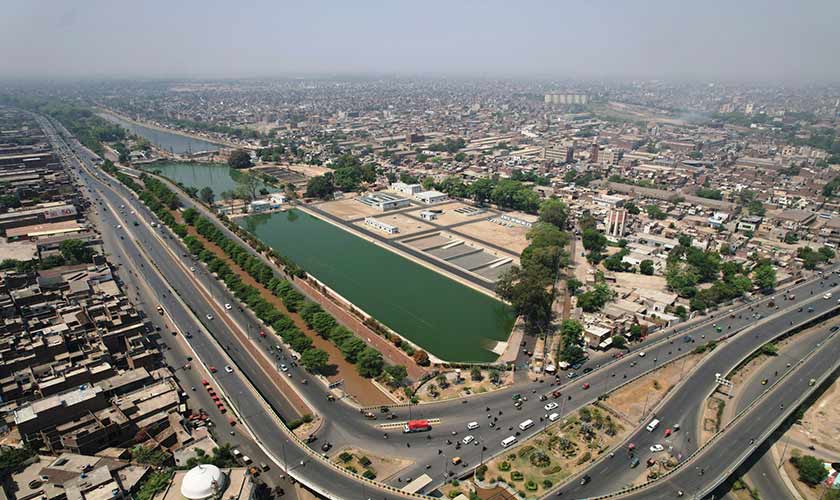
In this regard, significant progress was recorded in 2025. The Water and Sanitation Agency began work on 14 sewerage upgrade schemes, funded through a special grant of Rs 11 billion by the Punjab government.
In addition, the WASA, with financial assistance exceeding 4 billion Japanese Yen from the Japan International Cooperation Agency, rehabilitated the century-old Jhal Khanuana Water Works and upgraded it into a five-million-gallon-per-day surface water treatment plant. The project has enabled the supply of clean water to more than 200,000 people.
The project cost Rs 7,866 million, of which Rs 6,636 million was a Japanese grant and Rs 1,230 million was contributed by the Punjab government.
The WASA and the JICA have also agreed to initiate three new projects worth $250 million during the current year. These include the construction of a 20-million-gallon-per-day surface water treatment plant on the Jhang Branch Canal, a 10-million-gallon-per-day plant on the Gogera Branch Canal and the expansion of the Jhal Khanuana surface water treatment facility.
Another major milestone is the launch of Punjab’s largest wastewater treatment plant on the eastern outskirts of Faisalabad at Makkuana. The project is being implemented by the WASA in collaboration with the Punjab government and Denmark’s Danida Sustainable Infrastructure Finance.
With a treatment capacity of 33 million gallons per day, the project carries an estimated cost of Rs 56 billion. Of this, Rs 53 billion will be provided by Danida - a combination of a tied loan and grant - while Rs 3 billion will be provided by the Punjab government.
The mega-project is being executed under the design, build and operate (DBO) model and is scheduled for completion by September 2028. This unique project aims to treat sewage for use in agriculture and is expected to significantly reduce environmental and air pollution in the city upon completion.
Public transport remains another major challenge for Faisalabad. Progress was made last year with the launch of an eco-friendly electric bus service.
During the current year, the number of electric buses operating under the scheme is set to increase from 30 to 90.
Additionally, a Metro Bus project with an estimated cost of Rs 80 billion is expected to be launched in Faisalabad this year. The project is anticipated to ease the shortage of public transport, reduce traffic congestion and help curb air pollution.
Questions remain about sustainability, long-term urban planning and whether political urgency rather than institutional reform is driving Faisalabad’s development agenda.
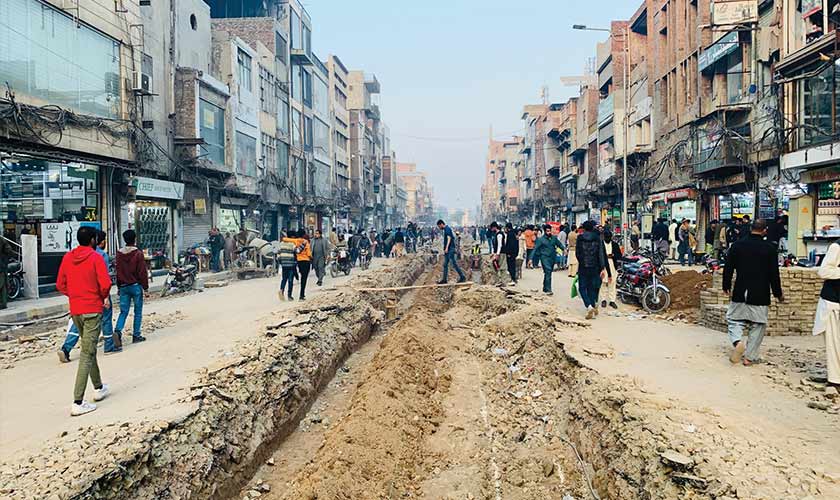
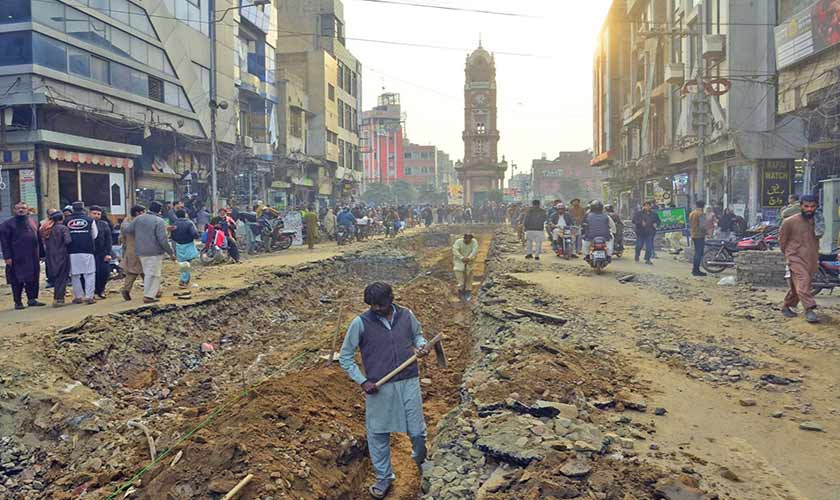
Work is also under way on the restoration and beautification of cultural heritage sites in the eight bazaars surrounding the historic Clock Tower. The project began with Katchery Bazaar, where development work costing approximately Rs 1 billion is in progress.
Under the scheme, electricity poles are being removed and power lines placed underground. The 80-foot-wide road is being excavated to create a central green belt. The plan includes 10-foot-wide footpaths on both sides of the bazaar and a 10-foot-wide landscaped median carrying plants and seating areas.
The project also includes the restoration of the historic Zail Ghar building located in Katchery Bazaar, along with the only remaining old residential building in the area.
Dr Tohid Ahmad Chattha, a faculty member of the History Department, Government College University Faisalabad, says that the eight bazaars around the Clock Tower constitute the city’s historic downtown.
“If you look at old maps and photographs, you will find dense tree cover even around the Clock Tower area,” he says. “Over time, these trees were cut and replaced with concrete. This has not only damaged the city’s beauty but has also significantly worsened environmental pollution.”
He says Chief Minister Maryam Nawaz Sharif’s vision - removing encroachments, restoring the city’s original character and reintroducing greenery is commendable.
Despite being the city’s cultural core, Dr Chattha says, the eight bazaars around the Clock Tower currently offer little attraction for tourists. “There are tangled overhead wires and signboards everywhere. There are no designated parking spaces. Encroachments on the sidewalks and chaotic traffic leave no room for pedestrians,” he says.
“Much damage has been done to Faisalabad’s cultural heritage. Several historic buildings have been lost to commercialisation and erased from the city’s landscape.”
The professor says that the provincial government appears to be completing projects left unfinished by the previous administrations. “Given the pace at which work is being carried out across different sectors, the government is likely to reap political dividends in the upcoming local government elections,” he says.
Arif Ayaz, provincial general secretary of the Awami Workers Party, tells TNS that no meaningful development work was carried out in the city during the previous government’s tenure. As a result, he said, the present government had inherited an overwhelming backlog.
“The work carried out by the Punjab government in Faisalabad over the past year is likely to benefit PML-N in the upcoming local government elections,” he said. “The operations against encroachments have raised hope.”
Ayaz points out that, in the past, anti-encroachment drives were often abandoned midway due to political pressure or protests by traders. “This time, it appears the provincial government is not bowing to any pressure. This is an encouraging development,” he says.
“The problem had become so severe that walking in the city was nearly impossible. People had almost learned to live with it. Someone had to take the unpopular step sooner or later.”
Stressing the need for a green cover, Ayaz says that plantation is essential to counter the rising temperatures. However, he concedes that providing housing is also important.
“More than two decades have passed since the Faisalabad Development Authority launched a housing scheme,” he says. “Many people from the working classes do not own homes. There is an urgent need to launch three- or four-marla housing schemes on the city’s outskirts.”
Ayaz says that Faisalabad is essentially a city of labourers. “If the government wants to do well in the local government elections, it must take concrete steps to protect labour rights,” he says.
“Labour laws are not being enforced anywhere. The minimum wage has been set at Rs 40,000. This is inadequate in view of the living costs. Yet, even this amount is not being paid. Workers are dying in workplace accidents but the government has taken no action to improve safety.”
Dr Fahad Rashid, an associate professor at the Department of Forestry and Range Management, University of Agriculture, Faisalabad, says that the development projects in the city need to integrate environmental protection measures.
“A beautification project is under way in the eight bazaars around the Clock Tower. Its focus should not be limited to ornamental plants and hard infrastructure,” he says. “Instead, priority must be given to planting indigenous tree species that effectively reduce noise, traffic-related pollution and overall environmental degradation in the area.”
He says plantation drives should prioritise native tree species.
“Establishing Miyawaki forests can significantly improve the city’s air quality index.”
Dr Fahad also highlights the need for scientific data to guide such interventions.
“Accurate, area-wise monitoring of air quality, particularly PM10 and PM2.5 levels is essential before planning plantation strategies.”
“Alongside legal reforms, public awareness is important so that citizens understand the role of trees in reducing noise, air pollution and heat and take ownership of these initiatives.”
Calling for capacity-building at the Parks and Horticulture Authority, he says that the plantation of non-native species in the name of beautification should be banned.
“These trees are not only expensive but also largely ineffective in improving environmental conditions. PHA’s role should go beyond watering plants and planting flowers; it must include proper tree management. The biomass generated through effective tree management can also become a significant source of revenue for the authority.”
Dr Fahad also says the waste management system is “inadequate from an environmental perspective.”
“Waste management must prioritise segregation at source. If implemented properly, up to 80 per cent of waste can be recycled.
“At present, segregation at source is virtually non-existent in Faisalabad, resulting in ever-growing landfill sites and increased emissions of methane gas.”
Water resources planner Arfan Chaudhry says that Faisalabad urgently needs a development strategy based on sound urban planning principles.
He says the WASA and most other government departments rely on haphazard approaches rather than long-term planning aligned with population growth and future demand.
“Despite spending billions of rupees on water supply schemes, the water supplied by WASA is not fit for drinking,” he says.
He says that access to safe drinking water is a fundamental human right.
“Water resource development must correspond with the city’s growth rate. This requires integrated urban planning, including rainwater harvesting systems, improved building codes and upgraded sewerage infrastructure so that grey-water and black-water can be separated, treated and recycled at source.”
He warns that Faisalabad’s excessive reliance on groundwater poses serious sustainability risks. “There must be a balance between groundwater extraction and recharge to ensure long-term water security.”
Architect Pervaiz Vandal says that Faisalabad, despite its current challenges, is one of the easiest Pakistani cities to plan because it is only about a century old.
He says the original planners developed wide boulevards, 200-foot-wide bazaars, circular road networks, bungalows and an integrated traffic and infrastructure system. He says traffic congestion and an infrastructure breakdown had emerged as the city’s most serious problems.
Vandal says Pakistan has inherited many colonial by-laws without adapting them to local realities, resulting in a confused planning framework that is neither fully colonial nor contextually indigenous.
“The dominant mindset today is to carve out plots, sell them and move on,” he says.
He says drainage is Faisalabad’s biggest structural failure, pointing out that even light rainfall turns streets into ponds.
“Those who planned these colonies apparently considered proper drainage an unnecessary expense,” he says. With most new housing schemes being developed under private ownership, he adds, by-laws are routinely violated.
Vandal says that only 10 to 15 per cent of the city reflects meaningful improvement, warning that newly created green belts could easily turn into dumping grounds. Referring to the eight bazaars around the Clock Tower, he says the British “gifted Faisalabad an urban model that lasted for over a century,” but one that was designed for horses and horse-drawn carriages, not thousands of cars and motorcycles.
He also criticises the ‘revolving-door’ model of governance, where successive bureaucrats launch new projects without continuity or consultation.
Vandal says that no urban intervention can succeed without meaningful consultation with stakeholders and citizens. “People must be encouraged to take ownership of their city. This is a political issue, not merely an administrative one. No problem can be solved through force alone.”
He says local representatives cannot deliver good results without financial authority. “Where the money is, that is where the power lies,” he says.
Vandal says bureaucracies alone cannot run cities. “Only citizens can run cities. A strong and empowered local government system is essential. Elected local representatives are the only ones who can truly take ownership of the city and make it livable.”
The writer has been associated with journalism for the past decade. He tweets @naeemahmad876