Print Story
X




Residents of Muslim Colony say they will never forget how their homes were demolished within moments
| M |
uslim Colony was established in the 1960s to house Islamabad’s working-class population. Many of its residents were engaged in constructing and servicing the capital. Over decades, it developed into a neighbourhood where residents paid electricity bills, municipal charges and other dues.
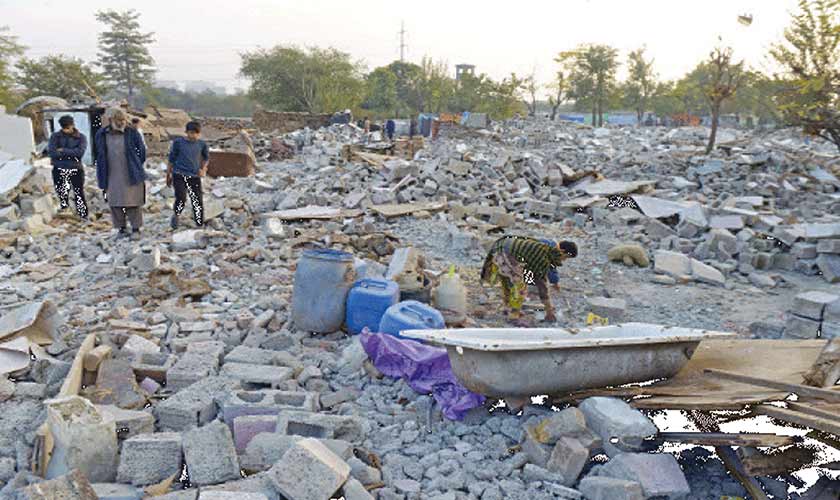
In recent days, however, the settlement was demolished in an anti-encroachment operation, leaving more than 20,000 low-income residents displaced. The residents say they spent decades working for Islamabad. From constructing the offices and roads of the city to the gated sectors that now surround the remains of their demolished neighbourhood, their labour was long accommodated, if rarely acknowledged.
They say it was only when the land they occupied gained commercial value that their presence was deemed unacceptable.
They are now asked to show proof of legal ownership, which they were never provided. The operation represents a broad pattern in which legal frameworks are mobilised to clear land rather than protect lives. They say anti-encroachment disproportionately targets working-class communities.
Among those affected is Muhammad Jan, a daily-wage labourer who moved to Muslim Colony after his home in Mansehra was destroyed in the 2005 earthquake. Like many others displaced by natural disasters, he rebuilt his life without formal state assistance.
Standing beside the rubble of his house, he reflects on the contradiction he now faces: “They say my vote matters. Every election they come and take my vote. But my home doesn’t matter.”
Jan says he had paid electricity bills and complied with civic requirements for years. Jan and others who resisted eviction were arrested and kept behind bars for four days.
The residents describe the demolition as “abrupt” and “destabilising.” Jamila*, a 40-year-old resident of the nieghbourhood says that the operation caught them unawares.
The operation represents a broad pattern in which legal frameworks are mobilised to clear land rather than protect lives. The residents say anti-encroachment disproportionately targets working-class communities.
“They came early, with police. We kept asking for time to take our things out, but the machines didn’t stop. Everything was happening at once.”
Jamshed, a father of three, says the demolition left his family without shelter or clarity about what would come next. “No one told us where to go. They only told us to leave. My children are asking where we will sleep now and I don’t have an answer.”
Other residents say that they had complied with rules for years but their homes were demolished in the blink of an eye.
“We regularly paid electricity bills and other charges,” says a resident who says he has lived in Muslim Colony for over 30 years. “If we were in illegal possession, why were we allowed to live here for so long?”
The residents say the stress of the operation had led to the death of an elderly man, last Sunday. A neighbour says he had survived years of displacement and hardship, but was unable to cope with the shock of losing his home. Many have now moved to suburbs like Chak Shehzad and are forced to pay rents; others have become homeless.
Some lawyers say that the eviction appears to be at odds with the National Housing Policy of 2001 that states. “there shall be no eviction till katchi abadis residents are relocated as per resettlement plans.”
In Muslim Colony’s case, residents say no relocation, compensation or alternative housing was offered.
There has been no political intervention on the affected people’s behalf. The local MNA did not visit the site or issue a public response despite repeated appeals. Urban planners and housing advocates say that such silence is common in cases involving informal settlements, which are often tolerated until land value rises and redevelopment becomes lucrative.
The displacement of Muslim Colony residents has once again highlighted a pattern in Islamabad’s urban development, where low-income communities are removed to make way for commercial or elite projects. While authorities describe such actions as anti-encroachment measures, residents describe them as loss of long-established homes and livelihoods.
The contributor is a writer, organiser and climate activist who leads a research and advocacy institute. She tweets @Sanaaimuhammad3