Print Story
X




Having a large young population, is Pakistan doing enough for their future and its own?
| “T |
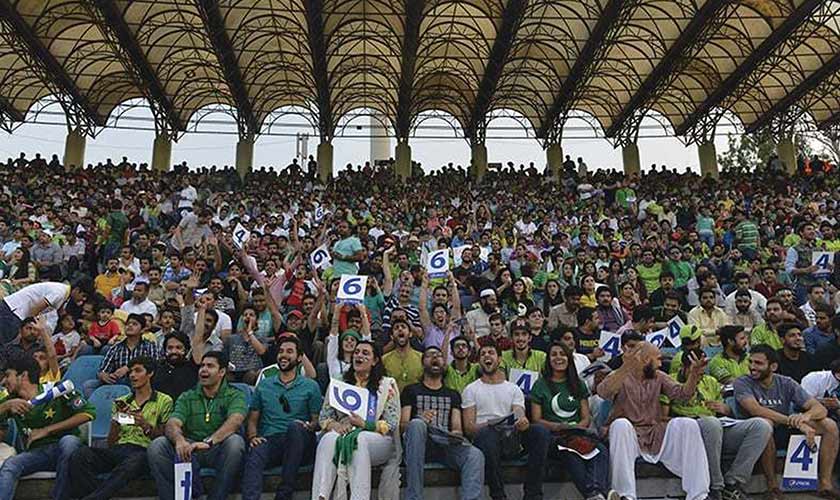
he future of Pakistan—good or bad—will be determined by its young,” exclaimed Prof Adil Najam, dean emeritus at the Pardee School, Boston University, and presently the WWF International president, as he started his keynote on Pakistan’s Moment of Youth at the Afkar-i-Taza ThinkFest on Campus, at the GC Women University, Sialkot, on December 18. To a hall full of nearly five hundred women, studying diverse fields such as computer science, economics, and art, this was not news, of course.
The sheer number of young people in Pakistan—a staggering 65 percent under the age of 35—means that until 2050, at least, Pakistan will be a young country. These people will go on to shape the country.
Despite several conversations about this ‘moment’ and ‘opportunity,’ we seem to be missing the boat.
Why?
The one-word answer to the question above is: education. Education, which includes the school, home and societal norms, shapes a human being. It either makes or breaks a society. Give good education and one can have a happy, content and prosperous society; or bad, lazy, faulty or ideologically motivated education and it will create discord, strife and degeneration. Sadly, since the inception of Pakistan, we have chosen the latter route. The result is in front of us. Despite immense potential, we seem unable or unwilling to understand how we will break with our vicious cycle of poverty and underdevelopment.
In the past twenty or so years, various governments in Pakistan have pumped billions of dollars into elementary, secondary and higher education, with little concrete results. We have over 25 million out of school children—one of the highest ratios in the world. The knowledge and skills of our students are abysmal when segregated by levels. Most of our universities dole out degrees not worth even the paper they are so carefully and securely printed on. Let alone being creators of knowledge, we have not even become good consumers of knowledge. Most of our top scholars are either people from before the creation of the country or from the first few decades after independence or those who live abroad. Since the 1980s, Pakistan—the world’s fifth largest country by population—has hardly produced anyone who has topped their field or even come close to doing so. According to our size and potential, we are nowhere when it comes to innovation either.
Tomes have been written about the solutions, but our crisis is not about a want of solutions—we have all the answers and then some. The rub is that there is no will to implement these. Politics, ideology and, at times, sheer laziness, prevent us from doing the simplest of fixes. Given bad education, throw in the effect of social media, rise of polarisation and persistent economic malaise, and we have the perfect recipe to ensure that not only is our moment of youth lost, but that we are headed towards a very bleak future.
Since history repeats itself, I hope the readers of this newspaper will forgive me in again repeating what I have written on these pages for years. The solutions to our education problems are rooted in a few simple, yet critical, measures. First, primary education needs to be in the mother tongue. Even though there have been hundreds of studies on this, showing that students learn, assess and achieve better when basics are taught in the mother tongue, this is a question asked of me almost every month—and sadly, mostly by someone young, who is unable to not only realise that there is no harm in being multilingual, but that their own handicap of language and hence ability to communicate is due to this problem. Today, we have the youth proficient in no single language. They cannot speak full sentences, express or write in a single language. No wonder their ability to think has become severely limited.
Secondly, we need to stop education being ideological. This has and will continue to destroy our youth. For those who think that ideological education does not matter, look at India: in just over ten years, Hindutuva— notions of Hindu supremacy—have permeated all spheres of life. Today, millions of people in India hate anyone who is not a Hindu, cannot tolerate expressions of any other religion and want everything around them to be Hindu related. The sharp rise in verbal and physical violence against non-Hindus in India is staggering. The recent disruptions and even attacks on Christmas celebrations, showcase that it was never a tale of Hindu-Muslim conflict, but something deeper and darker. This rapid change in India was made possible through the control of the ‘narrative,’ where education is a key element. The changing of textbooks; appointment of likeminded professors and vice chancellors; monitoring, marginalisation and ultimate dismissal of those who do not toe the line; and even changing tourist guides, is how the young generation of India has been sold the Hindutva tonic—now poised to transform the country into something ugly for non-Hindus.
Pakistan went through a similar phase, albeit over a longer period of time. We had also started much earlier. I need not remind readers about sectarianism, attacks on non-Muslims and other issues that have become quite the norm in the country as a result. Is this the legacy we want to bequeath to our budding youth? To have an exclusionary view of their religion, state, society, and even, personal life? It is a no brainer that we should not.
But it also seems that we are digging our heels in keeping out skewed ideological education. Let me illustrate with one example: all our constitutions have mandated that in Pakistan, Muslim students should be taught their religion. Leaving aside the question as to whether the state should do this or not, we have consistently failed to give good religious education to our students. In an effort to do this, we have simply piled on more and more religion in every subject thinking that the strategy will work. The result is that not only do a vast majority of students not know their religion well, they now do not know other subjects well either. Recently, we have thought that maybe the study of religion alone should be increased. Thus, in addition to the already mandatory Islamiyat course at the undergraduate level, we have a Quran course, mandated in the Punjab by the chancellor and now an HEC-mandated course on the Quran. We are hoping that three courses will save us from making one good course or that repetition of the same is a good thing.
I have been teaching for over a decade now, and try to teach first year students whenever I can. Over the years, I have seen a consistent decline in the quality of students, from their ability to read and write, to their comprehension levels, and recently, their interest in getting educated. Unless we implement some of the essential fixes to our education immediately, our youth moment will certainly be lost. We will be staring into a black hole—without most of us knowing what it is.
The writer is a historian based in Lahore. He can be reached at [email protected]. He posts on X @BangashYK.