Print Story
X


| I |
t is a few minutes past 11 in the night when I quite rebelliously decide to leave the house. The errand is banal — I just have to grab a few kitchen essentials and, perhaps, two samosas as a treat from the stall that stays open late in my street. But what if I admit that the decision felt larger than the grocery list?
For a moment I treated it like an experiment: how many small freedoms could the city grant me that night?
My internal checklist is familiar enough to be ritual. If you’re wearing Western clothing, cover up with a shawl; the phone should at least be charged to 50 percent; share my live location with a friend (with their usual “Call when you reach”); choose the route that trades a few minutes for better light and known faces. These might seem like theatrics to our mard hazraat, but for us women are the arithmetic of existing in Lahore after dark.
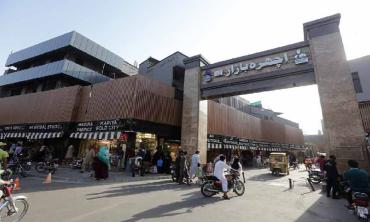
Night turns the signs in Lahore immediately into a gendered space. For the majority middle-class mohalla, the chai dhaba on the corner is full of men in conversation that is loud but not unkind. A group of teenagers in shalwar qamees lean against a wall and smoke. You see alleys predominantly of men, with a usual peep of a woman at most by the door half open, only if needed. You measure safety in gestures: a stray glance that lingers too long, a cluster of men who do not pretend they are not watching, the way shopkeepers’ eyes flick to your face as if assessing whether you belong.
And yet, there are pockets of tenderness. The owner of the samosa stall recognises me from the afternoon market; he wraps the packet with extra care and calls me aapi endearingly, though I am much younger than him. The guard uncle at the apartment block nods and says, without looking up from his thermos, “Khush raho,” (may you be happy) which is a blessing dressed as habitual politeness. These gestures arrive quiet and unspectacular, but they accumulate into a kind of nocturnal civility.
The routes I choose are not the shortest, because I would rather walk where the streetlights are more forgiving and the roar of passing traffic is proof that the city is still awake. Familiarity of lanes and turns and corners in Lahore is a kind of silent companion.
Class works quietly at night in this City of Gardens. In a car, the city rearranges itself with closed windows, locked doors, a familiar driver who knows which U-turns to avoid after 10; you can play Nusrat a little louder and let Gulberg slide past like a film.
On foot, the body learns a different language with eyes trained on the pavement and dupatta adjusted not for modesty but for anonymity. Money opens some roads and seals others, but even then the city asks women to account for themselves: where they’re headed, why they’re out this late in the first place.
There’s a strange pleasure to anonymity at night. When the city thins, so does obligation. I pass a woman by a stall with a slight smile. We do not speak, we do not need to. She is a signal that women still move through the city. There’s not many of us, but enough to remind you that you are not the only one performing courage in small increments.
There is also the surveillance that does not soothe. There is a contradiction in being watched and not feeling safer, because being seen does not always mean being protected. Often, it means being questioned or quietly intimidated. The city may uphold safety in law, but it routinely dismisses verbal catcalls as trivial, leaving women to interpret the slow footsteps behind them as their own problem to manage.
Still, this cultural hub of Pakistan offers pleasures that are not merely the absence of daytime chaos. There is a luxury to driving through a stretch of The Mall; there is a kind of meditation in circling the Liberty Roundabout until a thought resolves.
*******
The year 2025 has been quite kind to Lahore. The nights felt shaped as much by policy as by habit. Public transport, long treated as a daytime utility, quietly began to change the geography of after-dark movement. What followed was not a transformation but a loosening. A bus passing at midnight did not make the street safe, but it made it readable. You could tell who belonged to the night now: hospital staff, delivery riders, women sent out for one last errand rather than escorted home. Shops stayed open because someone was still moving, not because the city promised protection.
You notice it in small, unmistakable ways. A woman on a scooter waits at the signal, helmet over her dupatta, scrolling through her phone with the ease of someone who expects to arrive. Five years ago, she would have drawn a small crowd; now she barely registers beyond a second glance. Ride-hailing bikes zip past, delivery boxes stacked high, the city learning to feed itself at odd hours. These are not signs of safety but of permission. The darkness has not softened, but it has grown busier, more transactional, and less curious about why you are out at all.
In Lahore, that indifference is a kind of progress.
******
I come back with the samosas, fingers oily and warm from the packet, and the house smells ordinary and safe. Small rebellions add up. The city, in its nighttime generosity, lets you be a different kind of person for a few hours: softer yet braver, permitted to take up space without explanation.
Freedom here has no ordinance, it runs on rituals. Every late night is a negotiation, and every successful return is a tiny, stolen victory.
Kiva Malick is an academic and writer who focuses on education, philosophy, music and culture