Print Story
X




Palestine 36 delves into what happens when exposure to violence becomes normalised and long-term

| P |
alestine 36 is not a film that seeks to shock through spectacle or overwhelm through graphic imagery. Instead, it unsettles the viewer through restraint. In its silences, pauses and ordinary moments, the film captures the psychological burden of living under occupation, offering a poignant reflection on collective trauma, identity and survival.
The title itself is suggestive. 36 does not merely denote a year or a statistic; it symbolically gestures toward a historical rupture—an era when displacement, loss and contested identity became embedded into Palestinian collective memory.
The film operates less as a linear narrative and more as an emotional archive, presenting fragments of everyday life that together form a broad portrait of sustained oppression.
At its core, Palestine 36 is about normalisation—how extraordinary violence becomes woven into the fabric of daily existence. The camera lingers on routine acts: walking through streets, waiting, observing, enduring. These scenes are deceptively simple but psychologically loaded. They illustrate how chronic exposure to uncertainty, surveillance and restriction reshapes perception, emotional regulation and one’s sense of agency.
From a psychological perspective, the film can be understood through the lens of chronic stress and collective trauma. Unlike acute trauma, which stems from a single catastrophic event, chronic trauma arises from prolonged exposure to threat without resolution. The characters in Palestine 36 are not shown breaking down dramatically; instead, they carry a quiet exhaustion. This depiction aligns with research on populations living under long-term political violence, where symptoms often manifest as emotional numbing, hypervigilance and subdued affect rather than overt distress.
One of the film’s strengths lies in its refusal to individualise suffering. There is no singular protagonist whose personal arc drives the narrative. This deliberate choice reflects a collectivistic understanding of trauma, where pain is shared, inherited and sustained across generations. The absence of a traditional hero underscores the reality that under systemic oppression, resilience is not heroic—it is necessary.
Visually, Palestine 36 employs a muted colour palette and static framing. The camera often remains still, mirroring the sense of stagnation experienced by those whose lives are circumscribed by external control. Long takes allow discomfort to settle in, compelling the viewer to sit with moments that might otherwise be glossed over. This stylistic choice reinforces the film’s psychological realism; life under occupation is not fast-paced or dramatic, but slow, repetitive and draining.
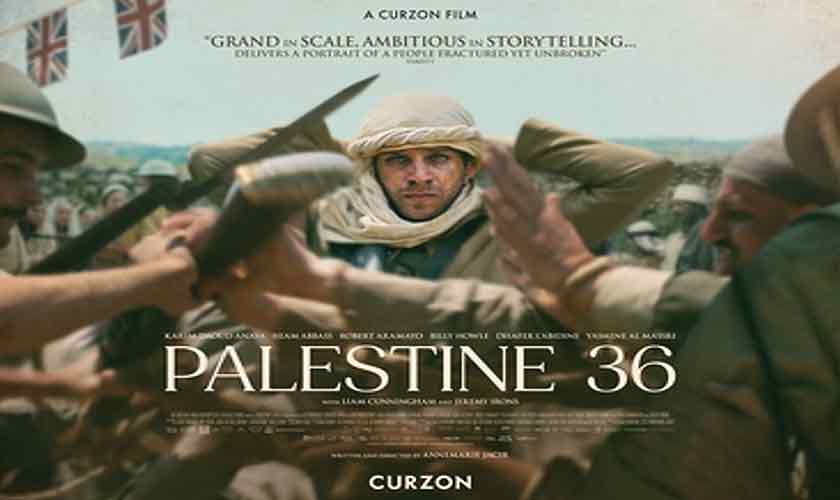
At its core, Palestine 36 is about normalisation—how extraordinary violence becomes woven into the fabric of daily existence. The camera lingers on routine acts: walking through streets, waiting, observing, enduring. These scenes are deceptively simple but psychologically loaded. They illustrate how chronic exposure to uncertainty, surveillance and restriction reshapes perception, emotional regulation and one’s sense of agency.
Sound design is used sparingly. Silence becomes a narrative device, representing both suppression and endurance. When dialogue does appear, it is functional rather than expressive, reflecting how emotional expression is often curtailed in environments where vulnerability can be dangerous. This aligns with trauma literature, which notes that individuals in high-threat settings frequently prioritise survival over emotional articulation.
Importantly, Palestine 36 avoids portraying Palestinians solely as victims. While suffering is central to the film, so too, is resilience. Small acts—continuing routines, maintaining relationships, preserving memory—serve as subtle forms of resistance. The film suggests that survival itself becomes political when existence is constantly threatened. This portrayal resists reductive narratives and affirms the psychological complexity of oppressed communities.
The film also invites reflection on intergenerational trauma. Though not explicitly stated, the weight of history is ever-present. Past losses inform present fears and future uncertainty looms large. The characters appear caught in a temporal loop, where time does not heal but accumulates. This echoes findings in trauma psychology, where unresolved collective trauma is transmitted through stories, behaviours and emotional climates within families and communities.
What makes Palestine 36 particularly compelling is its ethical restraint. It does not instruct the viewer on how to feel, nor does it sensationalise suffering for emotional impact. Instead, it demands attentive witnessing. This approach may frustrate viewers accustomed to conventional storytelling, but it is precisely this discomfort that gives the film its power.
As a piece of cinema, Palestine 36 is austere, deliberate and politically conscious. As a psychological text, it offers insight into the lived realities of chronic oppression—realities often reduced to statistics or headlines. The film reminds us that behind every political conflict are individuals negotiating identity, memory and meaning under conditions not of their choosing.
In an era saturated with images of violence, Palestine 36 stands out for what it withholds. Its quietness is not emptiness; it is accumulation. The film, available on streaming platforms, leaves the viewer not with answers, but with an enduring sense of unease—an emotional residue that mirrors the unresolved nature of the conflict it portrays. In doing so, it succeeds not only as a film, but as an act of remembrance.
The writer has a degree in psychology with a minor in mass communication. She can be reached at [email protected]